Individual Quick Freezing for Fruit and Vegetable Processing: Matching Berries and Cut Produce to Cabinet Freezers and Tunnel Lines
The challenge in fruit and vegetable freezing is not just “freezing fast” — it is that the product stays loose after freezing, the color does not change, and no liquid leaks out on thawing. Berries and cut produce have high moisture content; when they enter the equipment with free water on the surface, they come out as one solid ice lump. If feed temperature, spreading thickness, and mesh belt speed are not matched, the color and texture of the same batch can differ by two grades. Below, the configuration approach is broken down by material, with all parameters taken from the published technical data of Kunning Cryo liquid nitrogen freezing equipment.
TL;DR
- Many varieties, small batches (a few hundred kilograms per batch): use the liquid nitrogen cabinet freezer DKN-LFC; switching products only means changing trays and parameters.
- Single variety with continuous output, daily output in the tons: use the liquid nitrogen tunnel line DKN-LFT, controlling individual-piece condition through mesh belt speed and spreading.
- The root cause of clumping after freezing is mostly surface water before feeding: draining, an air-drying section, and single-layer spreading are more effective than adjusting equipment parameters.
- Workshop length is a hard constraint: tunnel line external dimensions are 12 m (LFT-1212/1612), while the cabinet freezer footprint is 1740×1730 mm (LFC-300).
- Nominal capacity values vary with material and packaging; run a full-load test with your own material before production.
Where fruit and vegetable freezing gets stuck in the workshop
Surface moisture is the first bottleneck
After washing, cutting, and draining, a layer of free water remains on the surface of fruits and vegetables. This water frosts first in the low-temperature zone, sticking particles to the mesh belt and bonding adjacent particles into clumps. Whether individual quick freezing succeeds depends largely on this pre-feed stage: whether draining time is sufficient, whether there is an air knife or air-drying section, and whether gaps are left between particles during spreading.
Individual-piece sticking and freeze cracking
After particles clump together, they must be manually broken apart before packaging, and the broken surfaces are where cells are damaged; on thawing, juice flows out from these breaks. Another issue is freeze cracking: thin-skinned, small items such as strawberries and blueberries can crack if the cooling rate is insufficient and a hard shell forms on the surface while the interior is still contracting. Passing the material quickly through the 0℃ to -5℃ range produces fine ice crystals and less tissue damage — the common criterion for quick freezing is: in equipment at -30℃ to -40℃, pass through the maximum ice crystal formation zone within 30 minutes, with the core temperature dropping from -1℃ to -5℃ and the final temperature reaching below -18℃.
Seasonal peaks
Fruit and vegetable processing is highly seasonal, with harvest periods concentrated in a few weeks. Equipment is either sized for the peak and idle the rest of the time, or sized for normal output with peak volumes outsourced. Cabinet freezers and tunnel lines make completely different trade-offs here: cabinet freezers feed in batches, so peaks can be absorbed through overtime and batch scheduling; a tunnel line, once started, requires continuous feeding, and if the upstream washing and cutting line cannot keep up, the line runs empty.
Workshop space
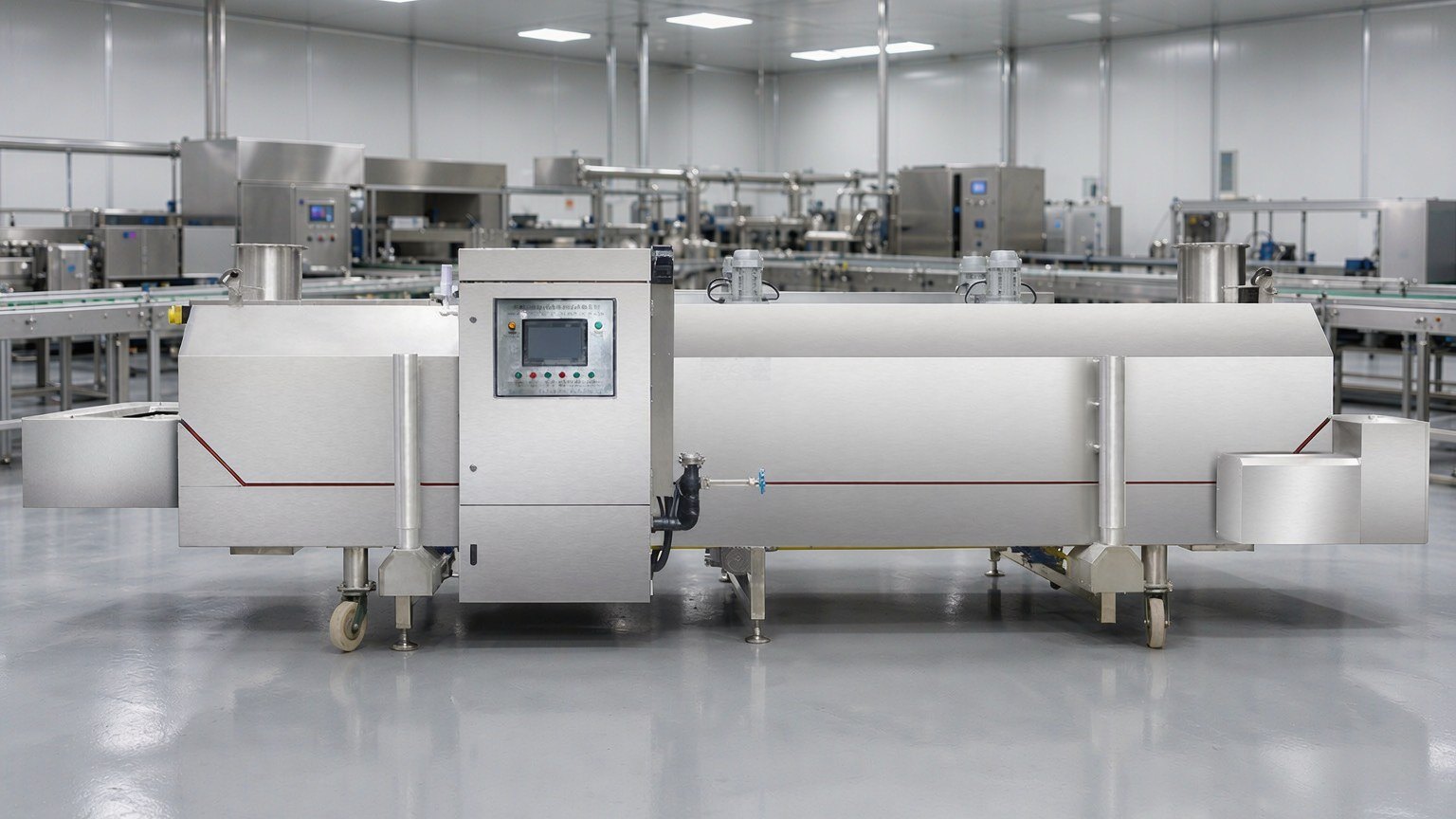
The length of a tunnel line directly consumes workshop length. The DKN-LFT-1212 external dimensions are 12000 × 2250 × 1670 mm, and the DKN-LFT-1612 is 12000 × 2700 × 1950 mm; a line plus buffer tables and transfer passages at both ends typically occupies more than ten meters. Cabinet freezers are vertical in structure, and the DKN-LFC-300 footprint is only 1740 × 1730 mm. For projects in rented buildings with limited modification, lay out the floor plan and measure before deciding on model and orientation.
Cabinet or tunnel line: dividing work by material and output
| Criterion | Liquid nitrogen cabinet freezer (DKN-LFC) | Liquid nitrogen tunnel line (DKN-LFT) |
|---|---|---|
| Production mode | Batch feeding, one tray or one cart per cabinet | Continuous feeding, mesh belt conveying |
| Suitable materials | Multiple varieties, small batches, frequent product changes | Single variety, continuous scheduling |
| Cost of product change | Change trays and process parameters | Adjust spreading, mesh belt speed, and spray groups |
| Capacity basis | LFC-300 300 kg/h, LFC-600 600 kg/h, LFC-1200 0~1200 kg/single zone | LFT-1212 nominal 1 m³/hour, LFT-1612 approx. 1000 kg/h (varies with product and packaging) |
| Workshop footprint | Vertical, small single-unit footprint | Long strip, requires upstream and downstream supporting lines |
| Typical scenarios | Premium fruit, trial batches, order remainders | Large export orders, single item produced year-round |
The recommended decision sequence: first look at the number of varieties — if you process a dozen fruit and vegetable varieties a year at tens of tons each, a cabinet freezer is more flexible; if you have only two or three varieties at over a hundred tons per month per variety, a tunnel line requires lower labor input. Then look at the upstream — whether the washing and cutting line can supply steadily; if not, start with a cabinet freezer.
Equipment parameter comparison
Published parameters for the three cabinet freezer models:
| Item | DKN-LFC-300 | DKN-LFC-600 | DKN-LFC-1200 |
|---|---|---|---|
| Internal cavity dimensions | 900×1320×1800 mm | — | 2000×1500×1750 mm × four zones |
| External dimensions | 1740×1730×2220 mm | 2900×1700×2450 mm | 8730×2350×2170 mm |
| Working temperature | -150℃~ambient | -150℃~ambient | -150℃~ambient |
| Temperature control accuracy | ±1℃ | ±1℃ | ±2℃ |
| Temperature uniformity | ±3℃ | ±3℃ | — |
| Cooling rate (no load) | ≥20℃/min | ≥20℃/min | ≤50℃/min |
| Total power | 2.5 kW | 5 kW | 12 kW |
| Power supply | 380V/50Hz | 380V/50Hz | 380V wide voltage |
| Liquid nitrogen pressure | 5-8 bar | 5-8 bar | 6-8 bar |
| Throughput | 300 kg/h | 600 kg/h | 0~1200 kg/single zone |
| Cart/rack | 40 trays at a time (cart 1050×750×873 mm) | — | 10 racks, four zones loaded independently |
Published parameters for the four tunnel line models:
| Item | DKN-LFT-0908 | DKN-LFT-1206 | DKN-LFT-1212 | DKN-LFT-1612 |
|---|---|---|---|---|
| Tunnel mesh belt dimensions | 8000×900 mm | 6000×1200 mm | 12000×1200 mm | 12000×1600 mm |
| External dimensions | 8000×1750×1670 mm | 6000×2200×1750 mm | 12000×2250×1670 mm | 12000×2700×1950 mm |
| Working temperature | -150℃~ambient | -150℃~ambient | -150℃~ambient | -150℃~ambient |
| Temperature control accuracy | ±2℃ | ±2℃ | ±2℃ | ±2℃ |
| Cooling rate (no load) | approx. 10℃/min, adjustable | approx. 10℃/min, adjustable | approx. 10℃/min, adjustable | approx. 10℃/min, adjustable |
| Total power | approx. 15 kW | 9 kW | 18 kW | 26 kW |
| Inlet/outlet cycle | Not specified in technical data | 6~30 min adjustable | 5~25 min adjustable | 8~40 min adjustable |
| Nominal freezing capacity | Not specified in technical data | Not specified in technical data | 1 m³/hour | approx. 1000 kg/h |
The same equipment set uses a SUS304 stainless steel mesh belt and variable-frequency speed-controlled motor; the cycle from inlet to outlet is adjustable; the spray devices are arranged above and below the mesh belt with adjustable angles and can also be operated in groups independently. Mesh belt width and tunnel length are designed according to material size and capacity; the table above shows standard model dimensions. Nominal capacity values vary with material moisture content, piece weight, and packaging method; only a full-load test with your own material before production counts.
How to handle the pre-feed stage
After washing and cutting, fruits and vegetables go through draining and air drying. Control the layer thickness to single-layer or two-layer spreading, leaving gaps between particles — do not let particles pile up. Piled portions cool slowly, and by the time the core temperature drops, the outer layer is already frozen through, resulting in inconsistent color and texture.
If the upstream section of the workshop has pre-cooling capability, lowering the material temperature before it enters the freezing equipment can shorten the residence time in the low-temperature zone. The food rapid cooling cabinet uses forced cold air circulation, with a minimum cabinet temperature of -45℃ and an evaporation temperature of -40℃; dual cabinets with 30-tray trolley loading at 3~5 kg per tray, 1~2 hours per batch of cooling, suitable for first bringing freshly washed fruits and vegetables close to storage temperature before entering the tunnel, and also suitable for small-batch upstream cooling. It is not vacuum equipment; fans deliver cold air to the material surface, and throughput is counted by trays.
Three key points for on-site operation
Oxygen concentration. Liquid nitrogen vaporizes into nitrogen gas; both tunnel lines and four-zone cabinets are equipped with oxygen concentration detection, with a setpoint of 19.5%~21.5%; when the concentration is too low, the equipment automatically closes the liquid nitrogen solenoid valve and the exhaust fan continues running. Workshop exhaust should be interlocked with the equipment; do not place exhaust vents above operator positions.
Cleaning. The tunnel body is of integral lift type; when raised, the mesh belt and inner cavity can be directly rinsed; the bottom of the body is a shallow V-shape with a drainage outlet, and cleaning residue and standing water flow out through the drain. Fruit and vegetable lines have high sugar content; if residual liquid is not rinsed clean, there will be odors when the equipment is started the next day.
Product changeover. For cabinet freezers, changing products means changing trays and process parameters; for tunnel lines, changing products requires readjusting spreading, mesh belt speed, and spray groups, with changeover time counted in half-days. For fruit and vegetable processing plants with many varieties and small batches, actual scheduling often uses cabinet freezers as the base and tunnel lines for large orders.
The export line for frozen fruits and vegetables has been growing steadily in recent years; customs data show that in January~February 2026, the export growth rates of dried fruit and frozen fruit were 52.3% and 64.5% respectively (International Business Daily, 2026-04-10). Export orders have stricter requirements on individual-piece condition and packaging specifications, so equipment selection should leave margin for changing varieties and specifications. For the mechanism of freezing curves and the ice crystal formation zone, see Freezing Curve and Maximum Ice Crystal Formation Zone; for general guidance on cabinet versus continuous types, see Batch or Continuous; the handling process for similar export orders is documented in Fruit and Vegetable Juice Quick-Freezing Export Case.
Frequently asked questions
What equipment is suitable for freezing berries?
It depends on output and number of varieties. For many varieties at a few hundred kilograms per batch, use a liquid nitrogen cabinet freezer, such as the DKN-LFC-300 (throughput 300 kg/h, 40 trays at a time) or DKN-LFC-600 (600 kg/h); changing products only means changing trays and parameters. For a single variety produced continuously in tens of tons, use a liquid nitrogen tunnel line, controlling individual-piece condition through mesh belt speed and spreading. Both types are supplied with liquid from an external liquid nitrogen storage tank at 5~8 bar.
What mainly causes clumping after freezing?
In most cases, surface water was not adequately removed before feeding, followed by piled spreading. Particles entering the low-temperature zone with surface water frost first, and the frost connects adjacent particles. Solutions include extending draining, adding an air-drying section, and single-layer spreading; for product already frozen into clumps, do not break it while frozen — sort it out by batch and handle separately.
How do cabinet freezer and tunnel line capacities compare?
Cabinet freezer throughput is nominal in kg/h: LFC-300 is 300 kg/h, LFC-600 is 600 kg/h, and LFC-1200 is 0~1200 kg/single zone with four zones loaded independently; tunnel line DKN-LFT-1212 is nominal 1 m³/hour, and DKN-LFT-1612 is approx. 1000 kg/h. These figures are reference values that vary with material; actual capacity requires a full-load test with your own material.
If workshop height and floor area are insufficient, can a tunnel line still be installed?
It depends on clear height and length. The DKN-LFT-1212 external dimensions are 12000×2250×1670 mm, and the DKN-LFT-1612 is 12000×2700×1950 mm; additionally, allowance must be left for lifting maintenance (lift stroke 550 mm, inner cavity 750 mm) and for transfer space at both ends. For workshops with insufficient length, combining cabinet freezers is more practical; the DKN-LFC-300 external dimensions are 1740×1730×2220 mm, and several units side by side can handle medium output.
What additional requirements do export orders place on equipment and power supply?
The power system is determined by the destination country; standard models are 380V/50Hz, and for 60Hz markets the motor and components need separate verification; sea freight also requires consideration of equipment segmentation and packaging dimensions. These two topics are covered in Voltage and Frequency Selection for Export Markets and Sea Freight Packaging and On-Site Installation.
The fruit and vegetable freezing solution must be grounded in three specific conditions: material, output, and workshop. Send us your product form, daily throughput, target core temperature, and on-site power supply, and we will configure the model according to these parameters. Contact us