
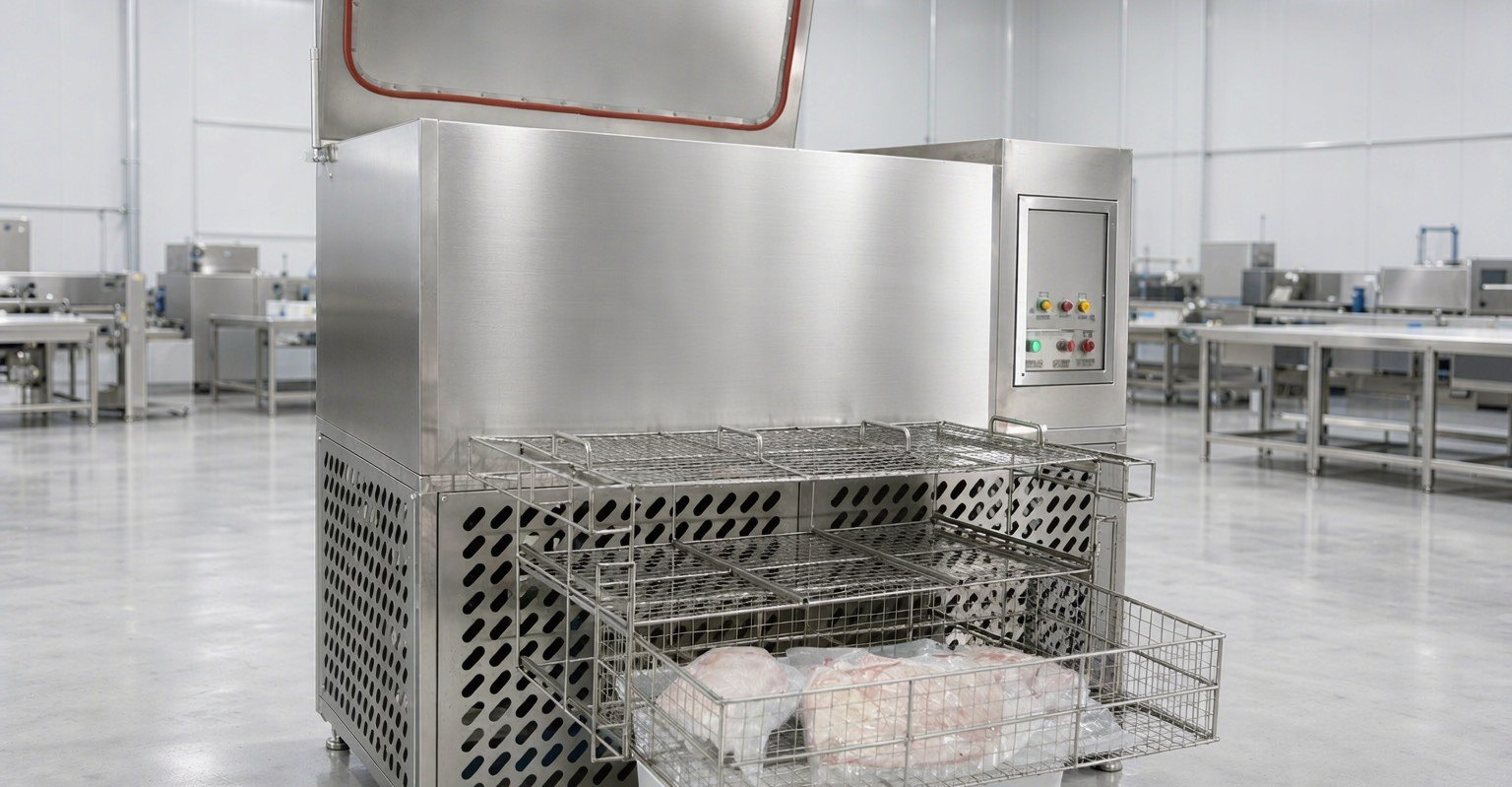
Model selection is not about matching a throughput figure to a model number. For the same 500 kg/h, whether the material is whole crawfish or sliced fish fillets, bare-packed or bagged, at 85℃ inlet or room temperature, the configuration differs considerably. So we complete the engineering review first, then provide a quote: calculate the cooling time or cryogenic time, and determine the model, configuration and lead time accordingly.
Why review first, quote later
| Common situation | What happens with a direct quote | The review-first approach |
|---|---|---|
| Only throughput given, e.g. 500 kg/h | Configuration cannot be fixed; quote can only be a range | Use material, unit specifications and temperature to calculate cooling time first, then work back to configuration |
| Material state unspecified (just out of the cooker at 85℃ / pre-cooled at 0~5℃) | Same throughput requires noticeably different refrigeration capacity | Recalculate cooling load based on actual inlet temperature |
| Site area and ceiling height not verified | Equipment arrives to find tunnel length or cabinet height does not fit | Verify internal and external dimensions, infeed and outfeed direction during review |
| Export project voltage and frequency not confirmed | Configuration quoted at 380V/50Hz cannot be used at destination | Re-select based on destination country voltage and frequency |
| Non-standard parts not confirmed | Items added after quoting change both lead time and price | Confirm tank, conveying, lifting and auxiliary devices in one pass |
Simply put: the configuration on a quotation follows the process. Only when process parameters are calculated first do the model and configuration written in the quote carry meaning.
Information we need from you
You do not need to provide everything at once. Give us the material, throughput and target temperature first, and we can start calculating time; the remaining items are confirmed step by step during the review.
| # | Item | Description and examples |
|---|---|---|
| 1 | Material type and form | Fish, shrimp, shellfish, meat and poultry, prepared dishes, bakery, fruits and vegetables, etc.; whole / sliced / IQF / packaged |
| 2 | Unit specifications | Weight, thickness and dimensions of a single piece or single package |
| 3 | Throughput | kg/batch (batch type) or kg/h (continuous type) |
| 4 | Inlet temperature | e.g. 85℃ (cooked food just out of the cooker), 20℃ (room-temperature material), 0~5℃ (pre-cooled) |
| 5 | Target final temperature | Temperature required at discharge, e.g. -18℃, -35℃, 0~5℃ |
| 6 | Freezing or cooling method | Liquid nitrogen quick freezing, immersion quick cooling, compressor refrigeration; if unsure, just state the target temperature and we will suggest a direction |
| 7 | Packaging and placement | Bare, tray, vacuum bag; whether IQF and tray arrangement are needed |
| 8 | Site conditions | Available area, ceiling height, infeed and outfeed direction, presence of forklift or cart access |
| 9 | Power supply conditions | Domestic 380V/50Hz, or the voltage and frequency at the export destination |
| 10 | Cold source conditions | Whether a liquid nitrogen tank and gas supply already exist; whether a cooling water source is available when using mechanical refrigeration |
| 11 | Target country and standards | Export destination country, and the voltage, frequency, certification or industry standards to be met |
| 12 | Project stage and lead time | New production line, capacity expansion or prototype validation, and expected arrival time |
Review process
- Requirement confirmation — Collect the information in the table above, communicate by phone or video if necessary, and confirm key items one by one.
- Cooling / cryogenic time calculation — Calculate cooling or freezing time and required refrigeration capacity based on material dimensions, packaging method, inlet temperature and target final temperature, then derive batch time or hourly throughput.
- Model and configuration selection — Determine the direction among liquid nitrogen quick freezing, immersion quick cooling and compressor refrigeration, and provide specific models (such as DKN-LFC cabinet type, DKN-LFT tunnel type, DKN-RHV immersion type, DKN-RHC quick cooling cabinet), specifications and configuration list.
- Quote and lead time — Issue a quote based on the confirmed configuration, clearly stating which items are included and which are the buyer’s responsibility, such as the wiring from the main power line to the electrical control cabinet.
- Trial run validation — Where conditions permit, bring materials to the factory for a trial run and verify time and final temperature against the actual cooling curve; for export projects, a full-machine test can be conducted according to the destination voltage and frequency.
- Manufacturing, installation, commissioning and acceptance — Manufacture according to the plan, dispatch personnel for installation and commissioning after arrival at site, and cooperate in completing appearance, configuration and function acceptance.
Engineering capabilities
| Direction | Content |
|---|---|
| Model coverage | Liquid nitrogen quick freezing cabinets, liquid nitrogen quick freezing tunnels, immersion quick coolers, food quick cooling cabinets; box type, cabinet type, tunnel type |
| Non-standard customization | Design tank dimensions, conveying and lifting mechanisms, dewatering and recovery and other auxiliary devices according to material form, packaging method and production line rhythm |
| Cryogenic process | Liquid nitrogen equipment operating temperature can reach -150℃ and lower; immersion quick coolers operating temperature ≤-35℃, food-grade freezing liquid minimum temperature -50℃; food quick cooling cabinet internal minimum -45℃ |
| Cabinet and insulation | SUS304 food-grade stainless steel inner and outer chambers, load-bearing positions reinforced and low-temperature treated, multi-layer insulated foam layer, ultra-low temperature sealing rings to absorb cold shrinkage stress |
| Control and safety | PLC + touch screen, PT100 (Class A) temperature measurement, PID automatic adjustment and stepwise cooling; liquid nitrogen quick freezing tunnels equipped with oxygen concentration detector (setpoint 19.5%~21.5%) and exhaust linkage |
| After-sales support | 1-year warranty for the whole machine, 2-year warranty for the control system, annual on-site follow-up visits; fault reports are first handled by phone or video, and on-site handling is arranged according to the response process |
For equipment structure and on-site photos, see About Us; for more process and performance curve descriptions, see Technical Information.
After the review
Once information is confirmed, proceed in the following order: confirm direction and configuration → issue quote and lead time → arrange trial run as needed → material preparation and production → shipping and on-site installation and commissioning → acceptance. The confirmation results of each step are kept on file, and both parties follow the confirmed plan and contract.
You can start now
Just send us the material, throughput, inlet temperature and target temperature.
Contact Us · Equipment Selection · Product Center
Online Inquiry
Fill in the form and we will reply with configuration advice and a quote within one business day.