
When equipment is exported, power supply conditions must be confirmed before quotation and cannot be defaulted to domestic standards. The same model shipped to Vietnam and to the United States requires two different sets of electrical component selections: different voltage levels and different frequencies mean motors, controllers, and heating elements may all need to be replaced. The cost of discovering such issues after arrival is high, so the five pieces of power information must be provided in full at the inquiry stage.
Five Pieces of Power Information That Must Be Provided at the Inquiry Stage
| Information Item | Description | Common Values |
|---|---|---|
| Voltage | Line voltage, not phase voltage | 380V / 400V / 415V / 440V / 480V |
| Frequency | Determines motors and clock-type components | 50Hz / 60Hz |
| Number of phases | Three-phase or single-phase | Mainly three-phase, control circuits may be single-phase |
| Control circuit voltage | Often different from the main circuit | 220V single-phase is more common, 110V also exists |
| Grounding method and plug standard | Affects on-site wiring | According to local standards |
If any one item is missing, the electrical configuration in the quotation can only be written based on assumptions, and subsequent changes will involve delivery schedules and costs. Writing these into the technical confirmation sheet at the proposal stage is a relatively effortless approach.
Which Components Must Be Selected According to Local Power Supply
| Component | Affected by Frequency | Description |
|---|---|---|
| Motors (fans, pumps) | Yes | At 60Hz, the same model motor speed increases, and air volume and shaft power change accordingly |
| Inverters and controllers | Yes | Input voltage and frequency need to match, and parameter settings also differ |
| Contactors and relays | Mainly voltage | Coil voltage must match local supply |
| Heating elements (if any) | Mainly voltage | Resistance value is converted according to voltage, power must not exceed |
| Temperature control and instruments | Yes | Some instruments keep time according to frequency |
| Transformers | Both | Customized according to local input |
Among these, motors are a key item. When the same motor runs at 60Hz, the speed is about twenty percent higher than at 50Hz. For fan-type loads, shaft power changes with the cube of speed, so power consumption rises noticeably and may exceed the original design. Therefore, when exporting to 60Hz regions, fan and pump motors must either be selected separately or operated through an inverter with the frequency limited to 50Hz and the air volume recalculated.
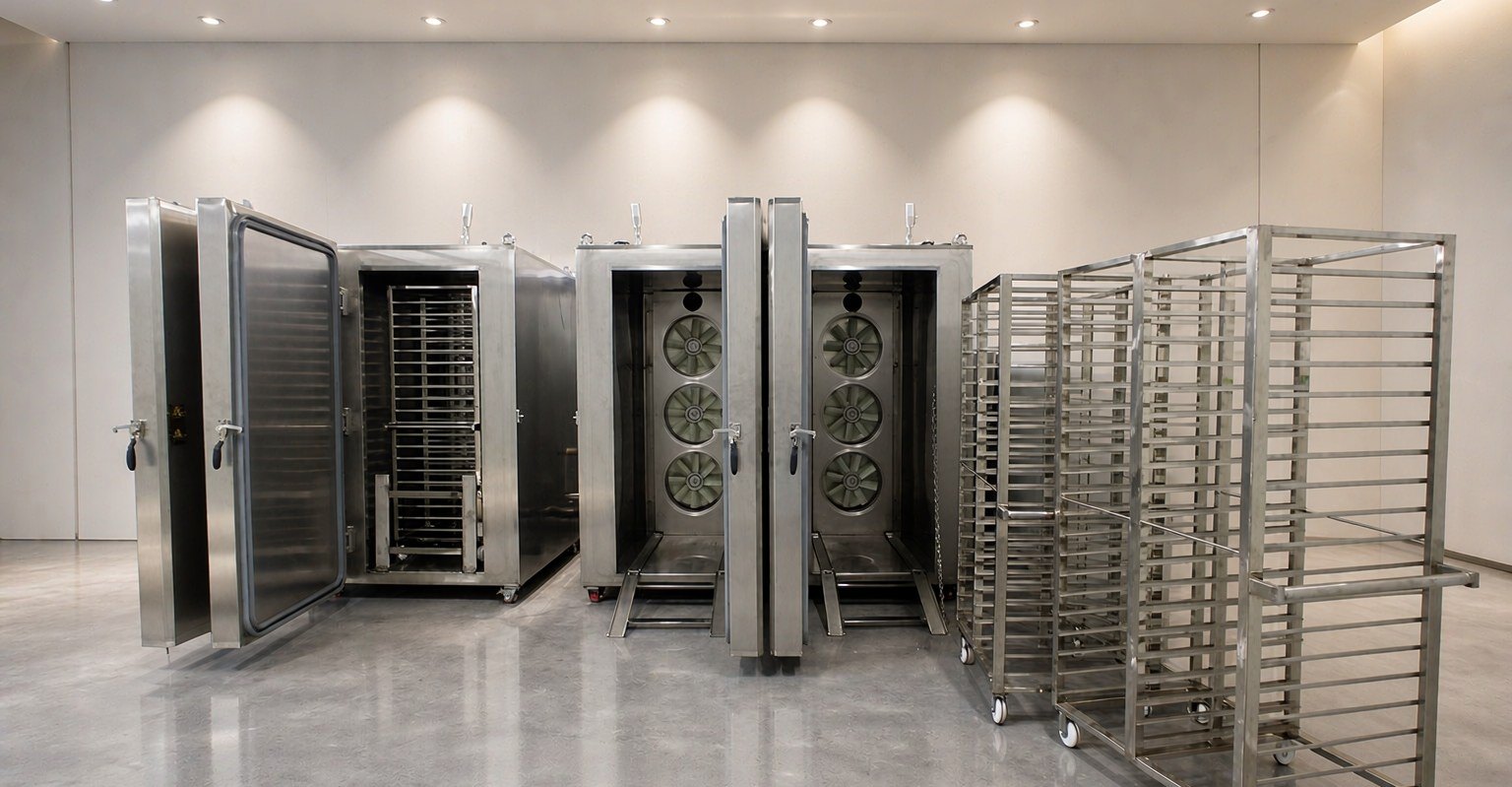
In LN2 freezing equipment, fans are responsible for dispersing liquid nitrogen and forcing it into the gaps between trays. Changes in air volume directly affect heat exchange performance, so this item must be reviewed together with process parameters. For the cabinet’s airflow structure, see the LN2 freezing cabinet series models.
Voltage Deviation and On-Site Low Voltage Conditions
In some regions, the actual voltage is below the nominal value for extended periods, or fluctuates significantly. These situations must be clarified at the proposal stage:
- Whether voltage stabilization equipment is available on site;
- Voltage fluctuation range (the lower limit is more important than the upper limit);
- Whether power outages are frequent and whether auto-restart after power recovery needs to be considered.
When voltage is low for extended periods, motors may have difficulty starting and controllers may restart repeatedly. Solutions include selecting components according to the on-site voltage lower limit, adding voltage stabilization devices, or adjusting protection setpoints.
Interaction with Altitude and Environment
Power supply is not an isolated condition. High-altitude projects usually also involve adjustments to cooling methods (air cooling changed to water cooling), and high-temperature high-humidity projects involve enhanced heat dissipation for electrical control cabinets. These items should be confirmed together to avoid changing only one aspect.
- For the effects of altitude and atmospheric pressure, see Effects of Altitude and Atmospheric Pressure on LN2 Freezing;
- For heat dissipation and condensation treatment in high-temperature high-humidity environments, see LN2 Freezing Equipment in Hot and Humid Climates: Operating Points for Southeast Asia and the Middle East.
On-Site Wiring and Acceptance After Arrival
After the equipment arrives, wiring and first power-on should be checked according to the list:
- Verify that the voltage, frequency, and number of phases on the nameplate of the arrived equipment match the on-site power supply;
- Confirm that the grounding method complies with local regulations;
- Check whether the control circuit voltage and instrument display are normal;
- Run no-load trial operation, observing motor rotation direction, current, and temperature rise;
- Run full-load trial operation, recording the cooling curve and core temperature.
For specific items of trial operation and acceptance, see On-Site Acceptance and Trial Operation of Freezing Equipment.
Frequently Asked Questions
Can wide voltage be used so that one set of equipment works universally?
Some components can (such as wide-range input switching power supplies and inverters), but motors and heating elements that are directly related to voltage cannot be truly universal. Feasible approaches are customizing according to the target market, or selecting according to a stricter set of conditions and adding a transformer, the latter of which increases losses and costs.
Can equipment designed for 50Hz be shipped directly to 60Hz regions?
Not recommended. Fans and pumps at 60Hz will have increased speed and shaft power, possibly leading to overload, increased vibration, and higher noise. If it is determined to ship 50Hz equipment, the inverter frequency upper limit needs to be set properly and the air volume recalculated, and this should be stated in the technical confirmation sheet.
Three-phase 380V and three-phase 400V differ by 20V — does it matter?
Most components can operate within a certain range above and below the nominal value, but motor-type loads and protection setpoints need to be verified according to actual voltage. The larger the difference, the more selection should be based on actual on-site values rather than nominal values.
What if the power supply information is uncertain?
First provide a preliminary plan based on the public grid standard of the target country or region, and at the same time write “subject to on-site measurement” into the technical confirmation sheet, to be locked before equipment production. On-site measurement data can be supplemented during project advancement.
For export projects, send the target country, on-site voltage, frequency, number of phases, control circuit voltage, and control method at the inquiry stage, and we will provide electrical configuration suggestions according to local power supply: Contact Kunning Cryo
The electrical common knowledge in this article (relationship between motor speed and frequency, fan load characteristics) is general engineering knowledge; equipment configuration and selection practices are cited from Kunning Cryo LN2 freezing equipment technical documents, and parameters of each model are subject to the corresponding technical parameters.