
DKN-LFT-1612 is one of the wider mesh-belt models in the Kunning Cryo liquid nitrogen quick-freezing tunnel line: mesh belt 12000 mm (length) × 1600 mm (width), equipment outer dimensions 12000×2700×1950 mm, working temperature -150℃~room temperature, temperature control accuracy ±2℃, total power 26 kW, capacity about 1000 kg/h, mesh belt cycle 8~40 minutes adjustable. Suitable for continuous large-batch quick-freezing production lines of aquatic products, meat and poultry, and prepared dishes.
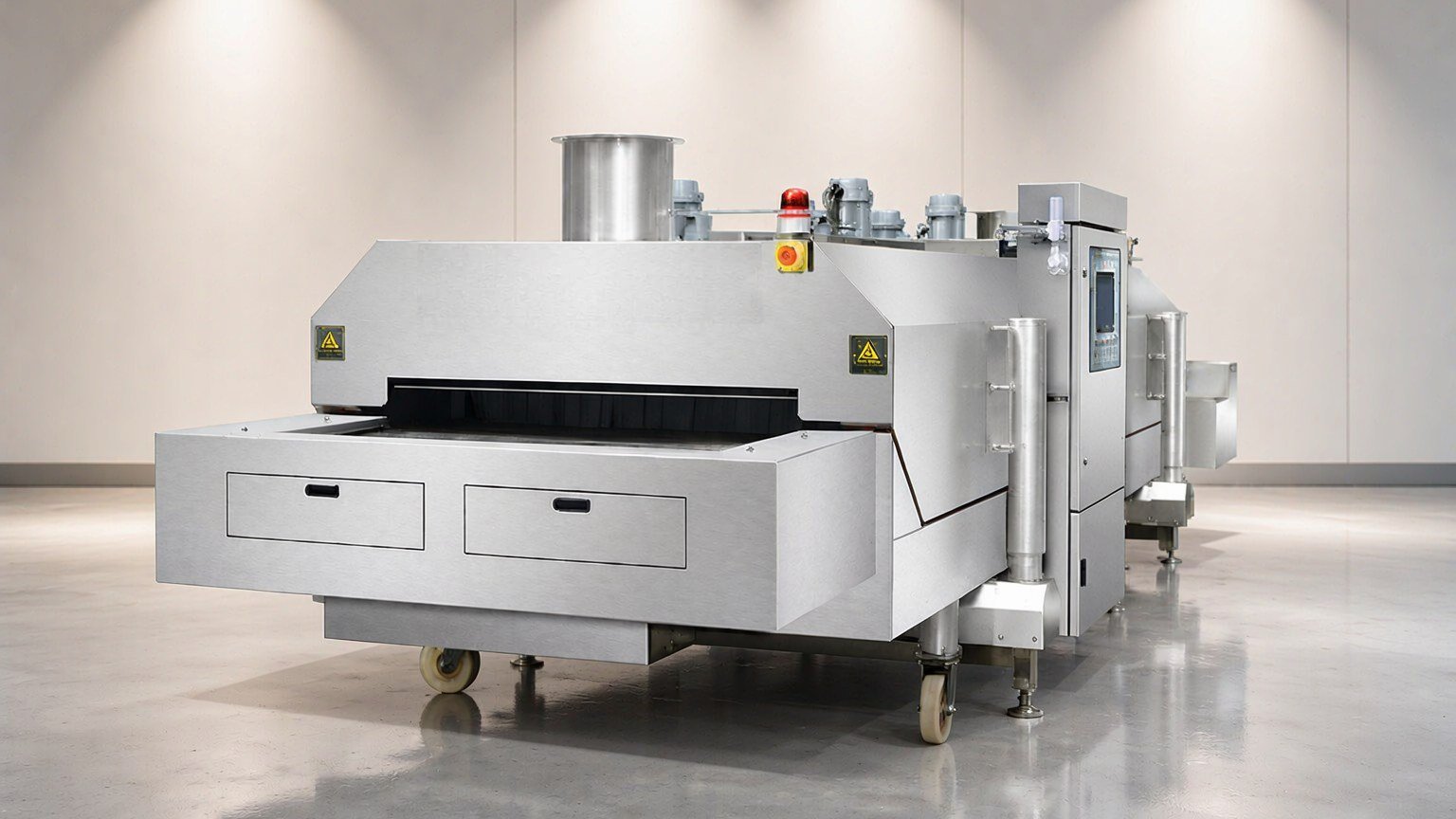
Technical Parameters
| Item | Parameter |
|---|---|
| Structure type | Mesh-belt tunnel continuous production line, integral lifting type |
| Tunnel mesh belt size | 12000 mm (length) × 1600 mm (width), effective width 1600 mm |
| Equipment outer dimensions | 12000 mm (length) × 2700 mm (width) × 1950 mm (height) |
| Working temperature | -150℃ ~ room temperature |
| Temperature control accuracy | ±2℃ |
| Cooling rate | ≤ 10℃/minute (no load, adjustable according to actual process) |
| Mesh belt cycle | 8 ~ 40 minutes adjustable (customizable) |
| Refrigerant | 0.5 ~ 0.8 MPa (5 ~ 8 bar) liquid nitrogen |
| Total power | 26 kW |
| Power supply specification | 380V/50Hz |
| Capacity | About 1000 kg/h |
| Oxygen concentration detection | Set value 19.5% ~ 21.5% |
| Lifting stroke | 550 mm (inner cavity 750 mm) |
Capacity varies with product type, piece weight and packaging method; the specific configuration is determined according to customer materials and capacity requirements.
Body and Insulation
- Integral lifting type body; inner and outer cavities are formed by shearing, bending and double-side welding of food-grade stainless steel plates, with reinforcing ribs at load-bearing positions to avoid deformation under long-term load.
- Reinforcing ribs are simultaneously low-temperature foamed to avoid cold air penetrating along structural parts.
- The insulation layer is a multi-layer adiabatic foamed low-temperature insulation layer; sealing strips are customized for ultra-low temperature working conditions to improve sealing performance.
- The lifting system is a mechanical structure, driven by a motor plus worm gear, with good synchronization on both sides and an automatic locking device; the bottom of the body is a shallow V-shaped design with a drainage outlet, facilitating the discharge of cleaning residue and accumulated water.
Conveying System and Operating Rhythm
- The conveyor belt uses SUS304 stainless steel mesh belt wire, equipped with a variable-frequency speed-regulating motor and a self-adaptive tensioning device to maintain operating tension at low temperatures.
- The tunnel transmission power is a variable-frequency motor with a reducer; the mesh belt speed can be flexibly adjusted according to the product, with stable operation.
- The mesh belt cycle is 8~40 minutes adjustable and can be customized according to actual customer needs.
Freezing System and Cooling
- The cooling system offers two modes: manual and automatic liquid nitrogen.
- The system consists of an external liquid nitrogen storage tank, liquid nitrogen delivery pipe, pneumatic liquid nitrogen low-temperature valve, spray pipes and nozzles, low-temperature motor fans, and exhaust gas extraction fan.
- Liquid nitrogen flow is controlled by the pneumatic liquid nitrogen low-temperature valve, combined with a manual stop valve; multiple groups of stainless steel nozzles are arranged above and below the conveyor belt, with adjustable spray angles, and can be fully opened or independently opened.
- Low-temperature explosion-proof moisture-proof fully sealed long-shaft motor with nylon axial flow fan, arranged at the top of the equipment, not easy to frost.
- Exhaust gas extraction ports are provided at the inlet and outlet ends, connected to a large-flow exhaust fan; after discharge, a self-provided exhaust duct is required.
Control System and Safety Design
- Equipped with automatic and manual refrigeration modes; mesh belt speed is variable-frequency adjustable, coordinated with temperature settings.
- Human-machine interface (touch screen) input, PLC intelligent control, with PID automatic adjustment function, can store multiple freezing processes, one-key operation.
- PT100 platinum resistance (Class A) temperature measurement, range 200℃ ~ -200℃, one for main control, one for monitoring.
- The electrical control cabinet is located on the right side of the feed inlet, with an integrated design to save space; emergency stop switches are provided at the inlet and outlet ends and the cabinet.
- The oxygen concentration detector is interlocked with the liquid nitrogen on-off valve; when the oxygen concentration is below the set value, the valve automatically closes, the equipment stops and an audible and visual alarm is given, while the exhaust fan continues to run; when the temperature reaches the set value, the liquid nitrogen valve automatically cuts off; the equipment does not run if the exhaust fan is not started, and faults directly stop the machine and give an alarm.
Applicable Scenarios
| Scenario | Description |
|---|---|
| Aquatic product processing | Continuous IQF of fish, shrimp and shellfish, quickly passing through the ice crystal formation zone |
| Meat and poultry processing | IQF and block freezing of cut meat and poultry, requiring deep low temperature and stable rhythm |
| Prepared dishes and prepared meal packs | Continuous production line quick-freezing with multi-category switching, processes called up by program |
For how to choose between cabinet type and tunnel type, see Liquid Nitrogen Quick-Freezing Tunnel; for the coordination of mesh belt speed and freezing cycle, see Freezing Cycle and Mesh Belt Speed; for small and medium-batch intermittent production, see Liquid Nitrogen Quick-Freezing Cabinet.
Installation Conditions
- Site: reserve an installation position according to the outer dimensions 12000×2700×1950 mm, leave operating and material cart turnover passages at the inlet and outlet ends, and calculate maintenance space according to the 550 mm lifting stroke.
- Power supply: 380V/50Hz, wire and ground according to the 26 kW total power and on-site power distribution capacity.
- Liquid nitrogen: an on-site liquid nitrogen storage tank and low-temperature delivery pipeline are required (provided by the user), supplied at a pressure of 0.5~0.8 MPa.
- Exhaust: after discharge by the exhaust gas extraction fan, a self-provided exhaust duct is required; the workshop shall be ventilated according to on-site requirements.
Warranty and After-Sales Service
The whole machine has a one-year warranty; a solution is provided within 2 hours after receiving the request, arrival on site within 24 hours, and troubleshooting within 72 hours; one free on-site service per year, with lifetime technical support.
Frequently Asked Questions
How is the 1000 kg/h capacity of DKN-LFT-1612 calculated?
1000 kg/h is a reference value in the technical parameters; actual capacity depends on material thickness, initial temperature, packaging method and the set mesh belt cycle, and needs to be calculated according to the specific material.
How much power distribution capacity is required?
The total power is 26 kW, and the power supply specification is 380V/50Hz. On-site power distribution capacity, wire diameter and grounding are determined according to the equipment installation requirements.
Where does the liquid nitrogen come from, and does the equipment come with a storage tank?
The equipment is not equipped with a liquid nitrogen storage tank; liquid nitrogen is supplied from the user’s on-site storage tank through a low-temperature delivery pipeline, with a working pressure of 0.5~0.8 MPa (5~8 bar).
What is the oxygen concentration detection for?
Liquid nitrogen vaporization can cause local oxygen deficiency. The equipment is equipped with an oxygen concentration detector, with a set value of 19.5%~21.5%, interlocked with the liquid nitrogen on-off valve; when below the set value, the liquid supply valve automatically closes and an audible and visual alarm is given.
To verify the model according to materials and capacity, please go to Contact Us and provide piece weight, target core temperature and shift output requirements, and we will calculate according to the parameters.