
Food freezing is not uniform cooling. The temperature–time curve runs through a nearly flat plateau between -1℃ and -5℃, where most of the free water in the food freezes. The difference between quick freezing and ordinary freezing is not how low the endpoint can go, but whether crossing this plateau takes tens of minutes or several hours—whether ice crystals grow large during this time or have no time to grow, which directly determines texture and juice retention after thawing.
The freezing curve has three stages, and the middle one is the watershed
As food cools from its initial temperature to the frozen storage temperature, the temperature–time curve has three stages:
| Stage | Temperature range | Process characteristics |
|---|---|---|
| Pre-cooling stage | Initial temperature → freezing point | Sensible heat is released, temperature drops relatively quickly. The freezing point of food is below 0℃ and varies with sugar, acid, mineral and colloid content |
| Freezing stage (maximum ice crystal formation zone) | About -1℃ ~ -5℃ | Water freezing releases a large amount of latent heat, temperature decline slows markedly, and the curve is nearly flat |
| Deep cooling stage | -5℃ → final freezing temperature | Remaining water continues to freeze, and temperature drops again |
Among the three stages, the middle one is where heat release is concentrated and the curve tends to flatten. To measure whether a freezing process is fast, the industry commonly uses “the time to pass through the maximum ice crystal formation zone.”
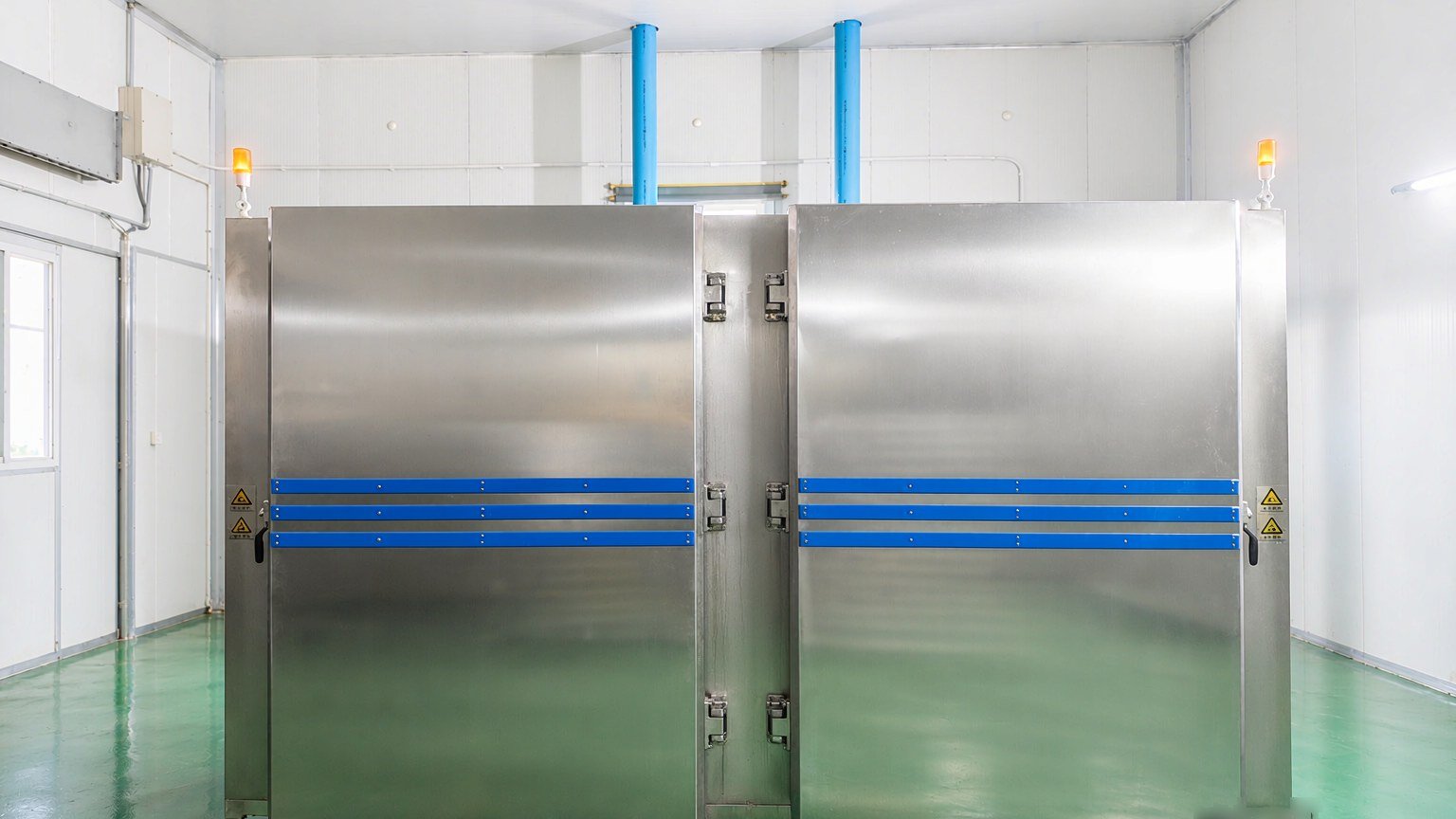
Maximum ice crystal formation zone: -1℃ to -5℃
Food science defines -1℃ to -5℃ as the maximum ice crystal formation zone, in which nearly 80% of the water can freeze into ice (Science Encyclopedia of China Popular Science). Ice crystals form and grow in this stage, and how large they grow depends on how long the food stays there.
The significance of quick freezing lies in this stage: by passing through in a shorter time, ice crystals have no time to grow large, and many fine crystals form within the tissue, causing little damage to cell structure; if the food stays too long, the extracellular water that freezes first becomes increasingly concentrated, intracellular water migrates outward, and large ice crystals finally form outside the cells, squeezing and piercing the cell walls. During thawing, this portion of juice cannot be retained.
How freezing rates are classified
According to the movement speed of the ice front, freezing is divided into three tiers (Kunning Cryo liquid nitrogen quick freezing technical document):
| Category | Ice front movement speed |
|---|---|
| Quick freezing | ≥ 5~20 cm/hour |
| Medium-speed freezing | ≥ 1~5 cm/hour |
| Slow freezing | ≥ 0.1~1 cm/hour |
The “quick freezing” defined by the food industry requires passing through the maximum ice crystal formation zone within 30 minutes, with the core temperature dropping from 0℃ to below -5℃, forming ice crystals smaller than 100 μm in diameter, and the finished product core temperature falling below -18℃.
Equipment side: cooling speed determines whether this time window can be won
The boiling point of liquid nitrogen at atmospheric pressure is -196℃, much lower than the refrigerants commonly used in mechanical refrigeration. Liquid nitrogen also exchanges heat by direct contact with food, and the initial cooling speed is the hardware condition that determines whether the equipment can quickly pass through the ice crystal zone.
| Model | Heat transfer method | Key cooling parameters |
|---|---|---|
| DKN-LFC-300 liquid nitrogen freezer | Liquid nitrogen vaporization + forced air circulation | No-load cooling not less than 20℃/minute; circulating air speed up to 10 m/s |
| DKN-LFC-600 liquid nitrogen freezer | Same as above, three long-shaft fans | No-load cooling not less than 20℃/minute |
| DKN-LFC-1200 liquid nitrogen freezer (four zones) | Liquid nitrogen vaporization + zoned circulation | No-load cooling ≤ 50℃/minute; four zones can be loaded separately by category |
| DKN-LFT-1206 liquid nitrogen freezing tunnel | Mesh belt conveying, upward and downward two-way injection + air field | No-load about 10℃/minute; conveying cycle adjustable from 6~30 minutes; thinner products can be frozen within 1 minute |
| DKN-RHV-2000L immersion chiller | Direct contact with food-grade freezing liquid | Working temperature ≤ -35℃; freezing liquid temperature can reach -50℃; tunnel circulation adjustable from 20~100 minutes |
The table above shows published parameters for each model. For the capability boundary of liquid nitrogen freezers, see liquid nitrogen freezer; for continuous production lines, see liquid nitrogen freezing tunnel; for the route of direct liquid heat exchange, see immersion chiller.
One reminder: the equipment’s rated value is the no-load cooling speed, which is not equal to the rate at which the product core temperature drops. The thicker the product and the higher the water content, the longer the time to pass through the ice crystal zone. What the equipment can do is provide sufficient heat exchange conditions—a sufficiently low ambient temperature, an air field that can reach into the gaps between trays, and a spread-out loading thickness.
Freezing rate and drip loss
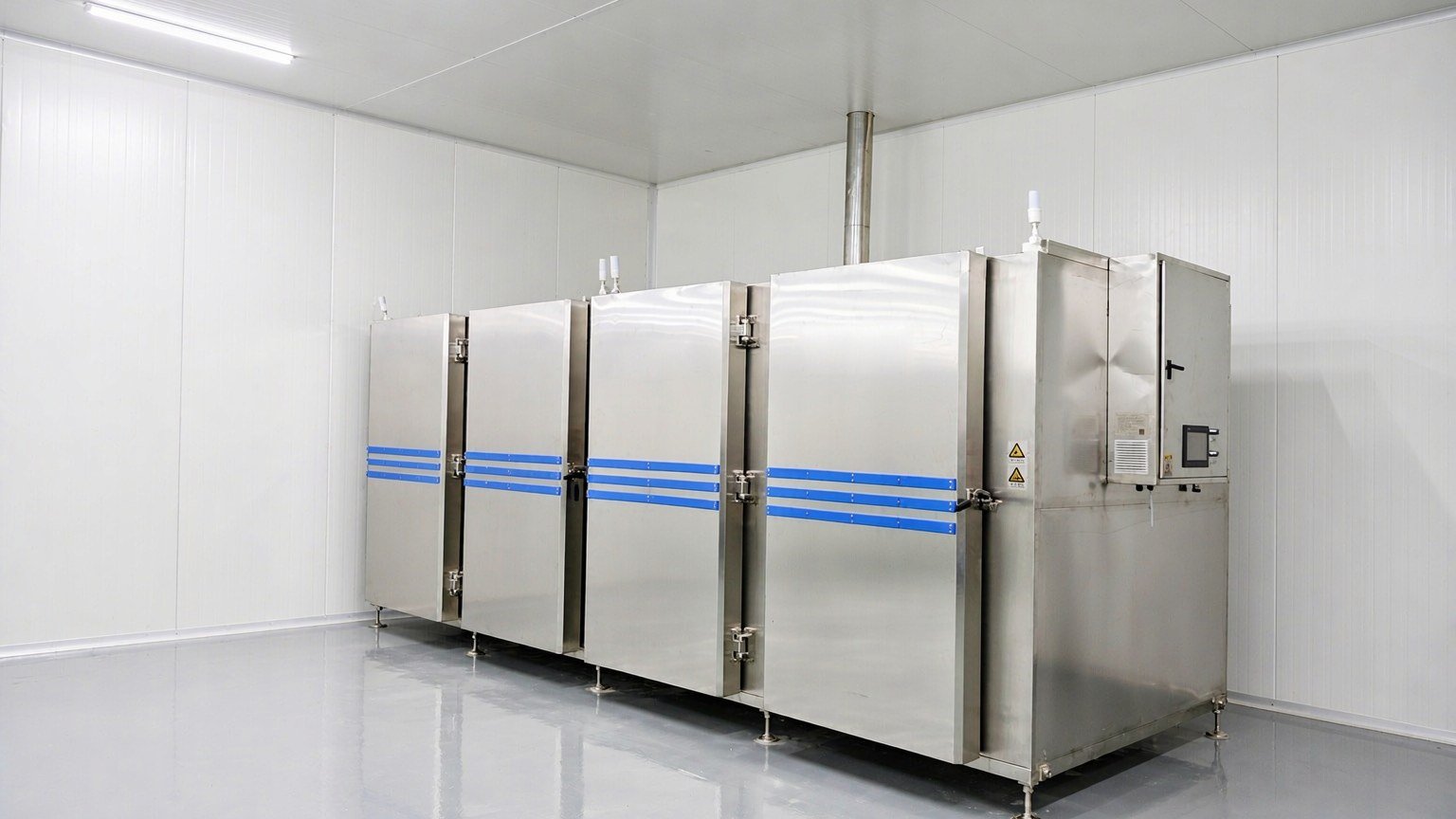
During freezing, moisture on the food surface sublimates or is carried away by airflow, and the weight loss is called drip loss. Traditional blast freezing rooms and freezing devices freeze slowly, with drip loss rates of 3%~6%; the drip loss rate of liquid nitrogen quick freezing is 0.25%~0.5% (Kunning Cryo liquid nitrogen quick freezing technical document). The difference comes from exposure time—the shorter the surface stays in the low-temperature airflow, the less moisture is carried away. For categories with relatively high unit prices, this item directly affects yield.
How to determine that freezing is complete
Freezing completion is not judged by how long the equipment has been running, but by the thermal center temperature of the food. The thermal center is the location that freezes last during the freezing process, generally the geometric center for regularly shaped foods. Industry practice uses the thermal center reaching the target temperature as the freezing endpoint; meat usually requires the core temperature to reach -15℃; frozen storage temperature is generally set at -18℃ to -25℃.
On the equipment side, this corresponds to temperature measurement and recording. Taking the DKN-LFC series as an example, platinum resistance temperature measurement is used, with a range of 200℃~-200℃, one for main control and one for monitoring; the tunnel line has emergency stops at the feed end, discharge end and electrical cabinet, and is equipped with oxygen concentration detection, with automatic alarm and power-off after the program ends. Whether data can be traced determines whether the previous batch’s parameters can be reviewed when changing product categories.
Frequently asked questions
What does the “plateau” on the freezing curve mean?
The plateau refers to a section during cooling where the temperature hardly changes. Water freezing into ice releases latent heat; if this heat is not removed, the temperature cannot drop, and the curve tends to flatten between -1℃ and -5℃. The longer the plateau lasts, the slower the passage through the ice crystal zone.
Is it better to set the quick freezing equipment temperature as low as possible?
No. Ice crystal size is determined by the speed of passing through the maximum ice crystal formation zone, not by the endpoint temperature. If the equipment temperature is set too low, thin products will be over-frozen and liquid nitrogen consumption will increase; for thick products, the core’s time to pass through the zone is limited by thickness, and no matter how low the ambient temperature is, it cannot be much faster. Parameters should be calibrated according to product type and thickness.
Why is there a big difference after thawing even when both are frozen to -18℃?
-18℃ is the frozen storage temperature, not the freezing rate. Slowly lowering over several hours and quickly passing through in tens of minutes can both eventually reach -18℃, but the ice crystal sizes differ: slow freezing forms large ice crystals that pierce cells, causing juice loss during thawing; quick freezing forms fine and uniform ice crystals, and the tissue is basically maintained.
What should be looked at to judge that freezing is complete?
Look at the thermal center temperature of the food, not the equipment running time. The thermal center is the location that freezes last during the freezing process, generally the geometric center for regularly shaped foods. Meat usually requires the core temperature to reach -15℃, and the frozen storage temperature is then set below -18℃.
Can thin products and thick products use the same set of parameters?
No. Thin slices and small particulate products can be frozen within 1 minute; for thick products, the core’s time to pass through the zone rises with thickness, and the mesh belt speed and loading thickness must be recalibrated. Before putting a new category into production, it is advisable to first conduct small-batch calibration and write the parameters into the work instruction.
To confirm the freezing process according to product type and thickness, you can send the material type, single-piece thickness, feed temperature and target core temperature, and we will provide a set of parameters according to actual conditions: Contact Kunning Cryo
The freezing rate tiers and drip loss rates in this article are quoted from the Kunning Cryo liquid nitrogen quick freezing technical document; the temperature range of the maximum ice crystal formation zone and the proportion of water freezing are quoted from Science Encyclopedia of China Popular Science, and the mechanism explanation is general knowledge of freezing processes.