
DKN-LFT-1212 is a 12-meter mesh-belt continuous production model in the Kunning Cryo liquid nitrogen quick-freezing tunnel line: mesh belt 12000 mm (total length) × 1200 mm (width), equipment outer dimensions 12000×2250×1670 mm, working temperature -150℃ to room temperature, temperature control accuracy ±2℃, no-load cooling 10℃ per minute, total power 18 kW, freezing capacity 1 m³/h. Suitable for continuous quick-freezing of aquatic products, meat and poultry, prepared dishes, and tray-packed liquid materials.
Technical Parameters
| Item | Parameter |
|---|---|
| Structure type | Mesh-belt tunnel continuous production line, integral lifting type |
| Tunnel mesh belt size | 12000 mm (total length) × 1200 mm (width) |
| Equipment outer dimensions | 12000 mm (length) × 2250 mm (width) × 1670 mm (height) |
| Working temperature | -150℃ ~ room temperature |
| Temperature control accuracy | ±2℃ |
| Cooling rate | No-load cooling 10℃ per minute (adjustable according to actual conditions) |
| Passage cycle | 5 ~ 25 minutes adjustable |
| Freezing capacity | 1 m³/h |
| Total power | 18 kW |
| Power supply specification | 380V/50Hz |
| Refrigerant | 5-8 bar liquid nitrogen (liquid nitrogen storage tank self-provided) |
| Oxygen concentration detection | Set value 19.5% ~ 21.5% |
Processing capacity varies with material form and placement method; actual capacity is calculated based on the material.
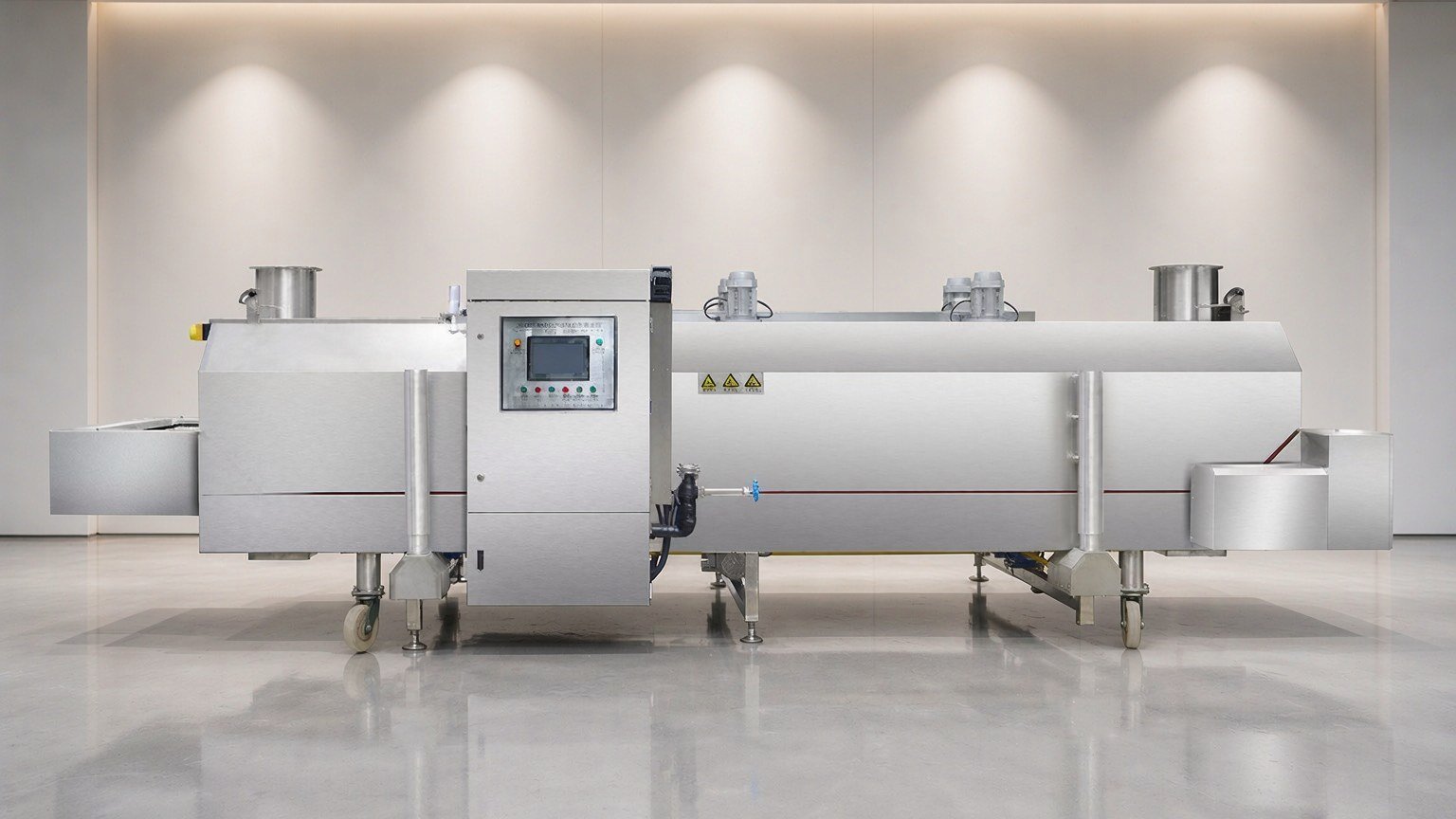
Cabinet and Insulation
- Integral lifting type body; inner and outer cavities are formed by shearing, bending, and double-side welding of SUS304 food-grade stainless steel plates; inner cavity is fully welded with no dead corners.
- Reinforcement ribs are SUS304 stainless steel square tubes, treated with low-temperature foaming.
- Insulation layer is a multi-layer adiabatic foaming structure, thickness 150 mm; sealing strips are custom-formed according to the equipment’s low-temperature working conditions.
- The body can be lifted as a whole for cleaning the mesh belt; the bottom is a shallow V-shaped design with a drainage outlet.
Conveying System and Mesh Belt
- The conveyor belt is made of high-elasticity SUS304 stainless steel mesh belt wire, equipped with a variable-frequency speed-regulating motor and self-adaptive tensioning device to maintain tension during low-temperature operation.
- The mesh belt is driven by a variable-frequency motor and reducer; speed is variable-frequency adjustable; the passage cycle at the inlet and outlet ends is adjustable from 5 to 25 minutes.
- Stainless steel supports are provided under the mesh belt, leaving cleaning space from the equipment bottom.
Freezing System and Cooling
- Liquid nitrogen is fed from an on-site storage tank (self-provided) through delivery pipes; the system includes solenoid valves, injection pipes and nozzles, low-temperature motor fans, and exhaust gas extraction fans; the extraction end requires self-provided exhaust ducts.
- Liquid nitrogen flow is controlled jointly by multiple solenoid valves and manual stop valves; injection devices are installed above and below the conveyor belt, which can be opened as a whole or independently, with adjustable injection angles.
- The top is equipped with low-temperature explosion-proof moisture-proof fully sealed long-shaft motors and axial flow fans to maintain convective cooling and uniform temperature field; exhaust gas extraction ports at the inlet and outlet ends are connected to fans.
For the influence of the liquid nitrogen heat exchange process and mesh belt speed on freezing time, see Tunnel Freezing Cycle and Mesh Belt Speed.
Control System and Safety Design
- Equipped with both automatic and manual refrigeration modes; touch screen input, PLC intelligent control, PID automatic adjustment; PT100 platinum resistance temperature measurement 200℃ ~ -200℃; 10-inch color screen can store multiple freezing processes, one-button operation.
- Safety design: dual-channel temperature sensors and feedback for main control and monitoring, over-temperature alarm; emergency stop switches at the feeding position, electrical control cabinet, and receiving position; the lifting mechanism is additionally equipped with a manual safety bolt; equipped with grounding wire, circuit breaker, and phase sequence protector.
- Oxygen content measuring instruments are installed at both ends, interlocked with the equipment.
Process Example
Taking a certain type of extract liquid material as an example (tray 300 × 30 × 30 mm): feeding at 50℃, after passing through the 12-meter tunnel, the core temperature drops to -50℃, freezing time is approximately 30 minutes, single batch 6 m³/6 hours, converted to approximately 1 m³/h, consistent with the equipment’s rated freezing capacity; other tray-packed materials requiring deep low-temperature short-time freezing can use the same configuration.
Applicable Scenarios
| Scenario | Description |
|---|---|
| Aquatic processing | Continuous IQF and block freezing of fish, shrimp, shellfish |
| Meat and poultry processing | IQF and block freezing of cut meat and poultry |
| Prepared dishes and ready meals | Multi-category switching, continuous feeding |
| Liquid and slurry materials | Tray-packed extracts, slurries |
| Central kitchens and group catering | Continuous quick-freezing linked with portioning rhythm |
For the trade-offs between tunnel and cabinet models, and the applicable boundaries of liquid nitrogen and mechanical refrigeration, see Comparison of Liquid Nitrogen Quick-Freezing and Mechanical Refrigeration; for tunnel model configurations, see Liquid Nitrogen Quick-Freezing Tunnel.
Installation Conditions
- Site: Reserve operating and maintenance space; leave material cart turnover passages at the inlet and outlet ends; consider the clearance for integral lifting.
- Power: 380V/50Hz; wire and ground according to total power and on-site distribution capacity.
- Liquid nitrogen: On-site self-provided storage tank and delivery pipes, supplied at 5-8 bar.
- Exhaust: Exhaust gas extraction ports at the inlet and outlet ends need to be connected to exhaust ducts; exhaust fans and piping are self-provided on site.
Warranty and After-Sales Service
Whole machine warranty for one year; proposal within 2 hours after receiving the request, on-site arrival within 24 hours, troubleshooting within 72 hours; one free on-site service per year, lifetime technical support.
Frequently Asked Questions
How is the freezing capacity of 1 m³/h for DKN-LFT-1212 derived?
It refers to the volumetric processing capacity during continuous operation; actual capacity is calculated based on material form, individual piece size, and target core temperature.
The mesh belt is 12 meters long; how is the freezing time determined?
The passage cycle is adjustable from 5 to 25 minutes, controlled by the variable-frequency motor and reducer adjusting the mesh belt speed; thinner products use higher belt speeds, while tray-packed or thick materials require lower belt speeds.
What are the temperature control accuracy and cooling rate?
Temperature control accuracy ±2℃, working temperature -150℃ to room temperature, no-load cooling 10℃ per minute; loaded freezing time is calculated based on material thickness and target core temperature.
Where does the liquid nitrogen come from? Does the equipment have a built-in storage tank?
The equipment does not include a liquid nitrogen storage tank; it is supplied from the user’s on-site storage tank through low-temperature delivery pipes at a working pressure of 5-8 bar; exhaust ducts are configured on site.
Why are oxygen concentration detectors installed at both the inlet and outlet ends?
Liquid nitrogen vaporization produces low-temperature nitrogen gas, which poses a risk of oxygen deficiency at low areas of the workshop; oxygen content measuring instruments are installed at both ends of the equipment, with a set value of 19.5%~21.5%, interlocked with the equipment.
To verify the model and mesh belt speed based on material and shift output, please visit Contact Us and provide material form, individual piece size, feeding temperature, and target core temperature for calculation.