Liquid nitrogen freezing cabinets and liquid nitrogen freezing tunnels are not two ways of doing the same thing. The former loads by batch, closes the door to cool down, opens the door to retrieve product, with the entire batch going in and out together; the latter relies on a mesh belt for continuous product flow, with product entering from the infeed end and exiting from the outfeed end, and freezing time determined by belt speed. The cost of choosing wrong usually only becomes apparent after production starts—a cabinet machine paired with a continuous production line leaves upstream and downstream processes standing around waiting for material; a tunnel line pulled in to handle many varieties in small batches means stopping the line to clean the mesh belt with every product changeover, with all the time spent on switching.
The dividing line mainly comes down to three things: batch weight and cycle time, product form and loading method, and site and liquid nitrogen supply conditions.
I. First Distinguish the Two Operating Conditions
| Comparison Item | Batch Type (Cabinet) | Continuous Type (Tunnel Line) |
|---|---|---|
| Infeed/Outfeed | Entire batch loaded on racks/trays, door opens for in/out | Individual pieces laid on mesh belt, continuous in/out |
| Freezing Time Control | Determined by the control program’s stepwise cooling and holding stages | Determined by mesh belt speed and tunnel length |
| Product Changeover | Change racks, wash trays, equipment does not stop | Adjust mesh belt speed and temperature program |
| Labor | Loading, pushing carts, retrieving product by batch | Placing product at infeed end, receiving at outfeed end, following the line |
| Capacity Expression | kg/batch or kg/h | kg/h (converted from loading density and speed) |
The cold source for both types of equipment is liquid nitrogen vaporization absorbing heat plus airflow circulation; the freezing mechanism is the same—the difference lies in how the material moves and at what pace.
II. Capability Boundaries of Cabinet Equipment
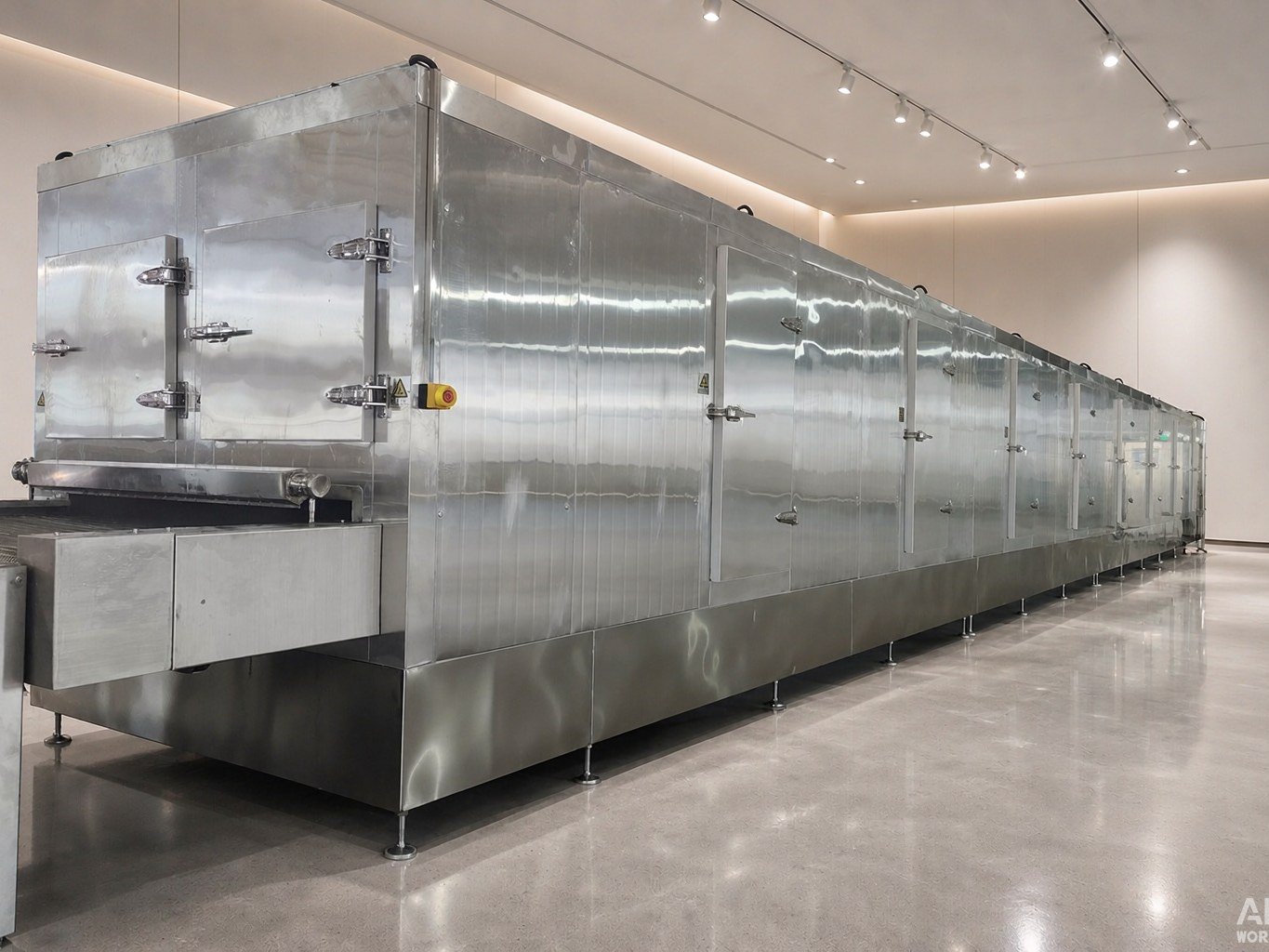
Kunning Cryo liquid nitrogen freezing cabinets (DKN-LFC series) range from small single-unit cabinets to large four-zone cabinets, covering different batch weights:
| Item | DKN-LFC-300 | DKN-LFC-600 | DKN-LFC-1200 (Four-Zone) |
|---|---|---|---|
| External Dimensions | 1740 × 1730 × 2220 mm | 2900 × 1700 × 2450 mm | 8730 × 2350 × 2170 mm |
| Operating Temperature | -150℃ ~ room temperature | -150℃ ~ room temperature | -150℃ ~ room temperature |
| Temperature Control Accuracy | ±1℃ | ±1℃ | ±2℃ |
| Temperature Uniformity | ±3℃ | ±3℃ | — |
| Cooling Rate | Not less than 20℃/min (no load) | Not less than 20℃/min (no load) | ≤ 50℃/min (no load, adjustable) |
| Total Power | 2.5 kW | 5 kW | 12 kW |
| Liquid Nitrogen Supply | 5-8 bar | 5-8 bar | 6-8 bar |
| Loading/Capacity | Freezing capacity 300 kg/h | Capacity 600 kg/h | Loading capacity 0~1200 kg/single zone |
Parameters are taken from the corresponding model technical documents; capacity varies with product and packaging method.
The LFC-300’s rack has a clear height of 1600 mm, width of 605 mm, and depth of 807 mm, with standard shelf spacing of 75 mm, and can hold 40 trays of 400 × 600 × 25 mm at a time. The value of this type of small cabinet lies in its low footprint and power distribution requirements (2.5 kW); thin products can be frozen through in a few minutes to a dozen or so minutes, and orders of a few hundred kilograms per batch do not need a production line.
The LFC-1200 is a four-zone structure; the four zones can be independently temperature-controlled and independently loaded, with 10 racks in two tiers. One unit is equivalent to four parallel batch lines, suitable for situations where batch weight is large and each zone needs to be set with different programs for different materials; the cost is an 8.7 m equipment width and 12 kW power distribution, as well as loading and unloading still requiring manual labor or carts. The cycle time ceiling of cabinet equipment depends on the number of door openings and loading speed—this is the essential difference between it and a continuous line.
III. What Tunnel Lines Are Suitable For
The DKN-LFT liquid nitrogen freezing tunnel line is a mesh-belt continuous production line, and the entire unit can be raised and lowered:
| Item | DKN-LFT-0908 | DKN-LFT-1206 | DKN-LFT-1212 | DKN-LFT-1612 |
|---|---|---|---|---|
| Mesh Belt Size | 8000 × 900 mm | 6000 × 1200 mm | 12000 × 1200 mm | 12000 × 1600 mm |
| External Dimensions | 8000 × 1750 × 1670 mm | 6000 × 2200 × 1750 mm | 12000 × 2250 × 1670 mm | 12000 × 2700 × 1950 mm |
| Temperature Control Accuracy | ±2℃ | ±2℃ | ±2℃ | ±2℃ |
| Cooling Rate | No load 10℃/min | No load 10℃/min | No load 10℃/min | No load 10℃/min |
| Total Power | Approx. 15 kW | 9 kW | 18 kW | 26 kW |
| Capacity/Speed Volume | — | — | 1 m³/h | Approx. 1000 kg/h |
Parameters are taken from the corresponding model technical documents. The LFT-1206’s running cycle from infeed end to outfeed end is adjustable from 6 to 30 minutes, with conveying speed flexibly set according to product; the unit’s designed lifting height is 550 mm, plus an inner cavity of 750 mm, facilitating parts replacement and maintenance, with a shallow V-shaped bottom with drainage outlet, making it easy to discharge cleaning residue and accumulated water. The LFT-1612’s liquid nitrogen supply pressure is recorded at 0.5~0.8 MPa.
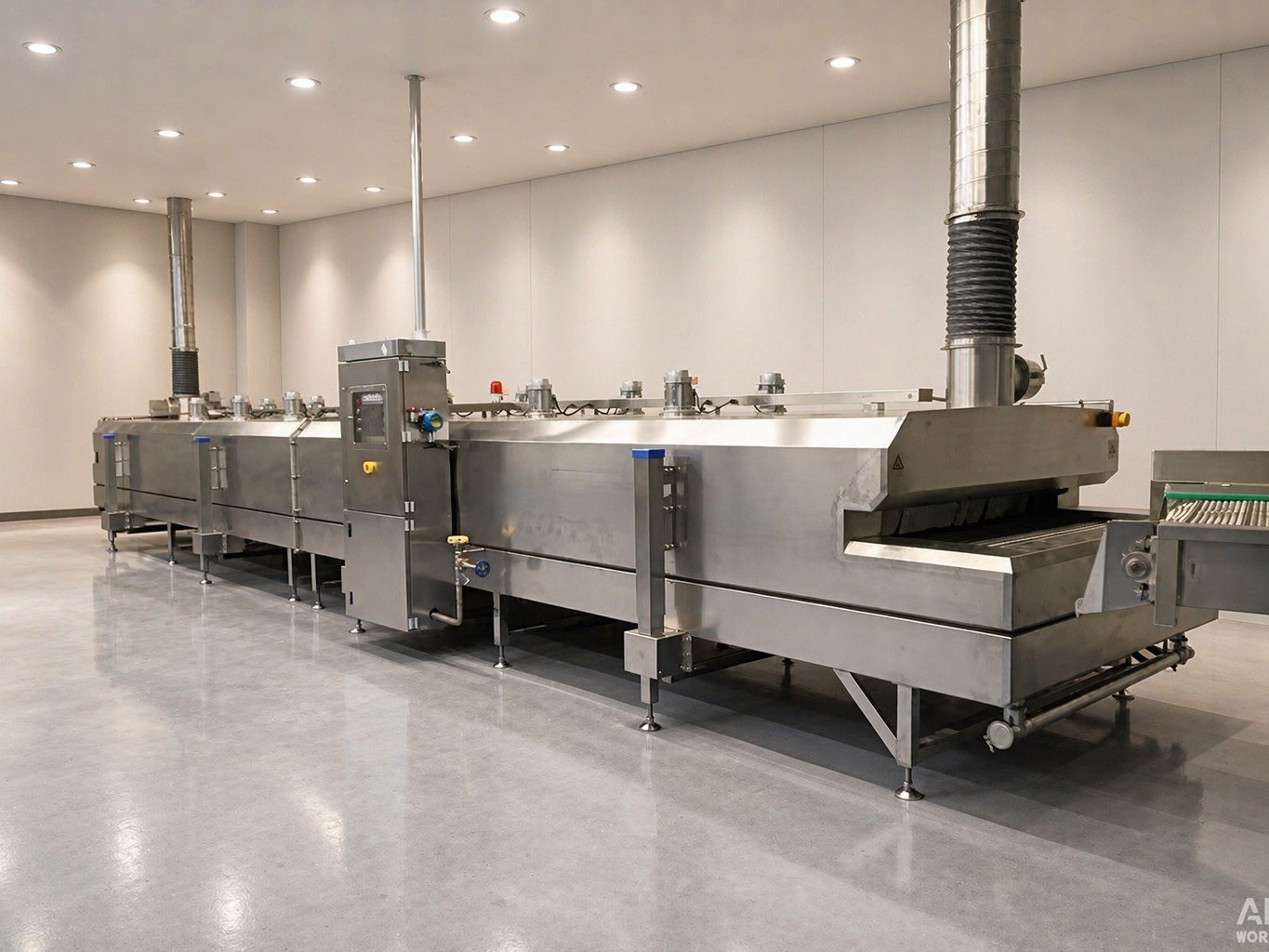
Mesh belt length directly corresponds to the available low-temperature residence time. A field example of the LFT-1212 is cordyceps extract: trays of 300 × 30 × 30 mm, requiring a drop from 50℃ to a center temperature of -50℃, processing 6 m³ within 6 hours, completed in approximately 30 minutes through a 12-meter tunnel. Materials that are relatively thick per piece, have high infeed temperature, and low target temperature need exactly this kind of longer low-temperature section on a long line. In terms of product form, anything that can be spread individually on the belt without sticking together (shrimp, fish fillets, cut poultry pieces, granular materials, pastries) can only run smoothly on a continuous line.
IV. Site and Supporting Conditions Differ
| Condition | Cabinet | Tunnel Line |
|---|---|---|
| Footprint Pattern | Concentrated in one area, operating space reserved according to cabinet external dimensions | Spread along the length direction, 6~12 m, inlet and outlet need to interface with upstream and downstream processes |
| Supporting Equipment | Liquid nitrogen storage tank and cryogenic transfer piping (user-supplied) | Same as above, plus mesh belt tensioning, deviation correction, and lifting maintenance space |
| Exhaust and Oxygen Concentration | Requires exhaust and oxygen concentration monitoring | Same as left, oxygen concentration alarm interlocked with liquid nitrogen valve |
| Floor and Drainage | Load-bearing calculated based on full load weight, cleaning drainage reserved | Load-bearing calculated based on full load weight, slope and trench along the entire length |
The oxygen concentration detection setpoint for both types of equipment is 19.5%~21.5%. Taking the LFT-1612’s safety design as an example: the oxygen concentration alarm is generally set at 18; when below the setpoint, it issues a command to cut off the liquid supply valve, simultaneously starts the exhaust fan, and the equipment gives audible and visual alarms and stops running; when the exhaust fan fails, the equipment stops running directly. The greater the liquid nitrogen usage, the more indispensable this interlock system becomes.
V. Three Decision Lines
| Operating Condition Characteristics | Recommended Direction |
|---|---|
| Single batch of a few hundred kilograms to several tons, daily batch count not fixed, varieties changed frequently | Cabinet (LFC-300 / 600), changeover only requires changing racks and washing trays |
| Large single batch and need for zone-based programs for different materials | Four-zone cabinet (LFC-1200) |
| Stable cycle time, continuous material flow for several hours daily, product can be laid individually on belt | Tunnel line (LFT-0908 / 1206 / 1212 / 1612) |
| Relatively thick per piece, high infeed temperature, requiring longer low-temperature residence | Long mesh belt tunnel (LFT-1212 / 1612) |
| Tight site, limited power distribution capacity | Cabinet, low single-unit power, concentrated footprint |
The differences in equipment form can be seen in the corresponding structural descriptions on the liquid nitrogen freezing cabinet and liquid nitrogen freezing tunnel line product pages. How to choose between liquid nitrogen refrigeration and compressor refrigeration is a question on another dimension, see Comparison of Liquid Nitrogen Freezing and Mechanical Refrigeration Freezing.
VI. Several Situations That Are Easy to Misjudge
Looking only at hourly capacity without considering loading density. Mesh belt width and length determine the available conveying area, not capacity. Capacity varies with individual piece weight, loading thickness, infeed temperature, and target center temperature; the same 1600 mm wide mesh belt handles shrimp and whole fish fillets very differently, and must be calculated based on actual product.
Looking only at the equipment configuration without calculating supporting investment. In addition to the main unit, a tunnel line requires upstream and downstream conveying interfaces, exhaust ductwork, oxygen concentration interlock, and longer floor treatment—all of which must be calculated together; the liquid nitrogen storage tank and cryogenic piping are supplied by the user.
Using a cabinet to match the cycle time of a continuous production line. The capacity ceiling of cabinet equipment is constrained by the cycle time of loading, opening the door, and retrieving product; the more door openings, the more obvious the cold loss and labor occupation. When production line cycle time requires stable continuous material flow, forcing a cabinet to match output usually comes at the cost of labor and quality consistency.
Forcing small-batch multi-variety production onto a tunnel line. Continuous line changeover requires stopping the line, cleaning the mesh belt, and resetting speed and temperature programs; the more fragmented the varieties, the more frequent the switching. For operating conditions of a few hundred kilograms per batch and three or four variety changes per day, a cabinet is more convenient.
Frequently Asked Questions
Which freezes faster, a liquid nitrogen freezing cabinet or a freezing tunnel?
Both have the same cold source—liquid nitrogen vaporization absorbing heat with airflow circulation—and what determines freezing speed is the heat exchange intensity the product surface can contact and the residence time. The tunnel’s advantage is that material travels continuously on the line, and the low-temperature residence time can be precisely arranged through mesh belt length and speed; cabinet equipment performs stepwise cooling and holding within a single chamber according to a program. Thin materials can be frozen through in a few minutes in a cabinet; when thick materials or high infeed temperatures require a longer low-temperature section, a tunnel line with sufficient length is more suitable.
For a batch of about 1 ton, should I choose a cabinet or a tunnel?
Look at cycle time, not the batch number. If the 1 ton is divided into several batches per day with other varieties in between, cabinet models like the four-zone cabinet or LFC-600 are more flexible; if it is stable material flow per hour with upstream and downstream processes running continuously, then it depends on whether the mesh belt length can provide the required low-temperature residence time—the DKN-LFT series is configured in tiers by mesh belt size.
Can a tunnel line handle small-batch multi-variety production?
It can, but you need to be prepared for changeover management. Mesh belt speed and temperature programs can be stored in multiple sets and recalled by program during switching; cleaning the mesh belt section and re-laying product require stopping the line. When variety switching frequency reaches a certain level, the line-stop loss will exceed the capacity benefit it brings.
Besides the equipment, what else is needed for a tunnel line?
The liquid nitrogen storage tank and cryogenic transfer piping are supplied by the user; the site needs reserved space for mesh belt inlet/outlet and upstream/downstream process interfacing, exhaust ductwork and oxygen concentration interlock devices, floor load-bearing and cleaning drainage conditions along the entire length, and the height required for unit lifting maintenance. These items should be considered together during the site planning stage—it is easier than supplementing after the equipment is in place.
How to estimate the capacity of cabinet equipment?
Cabinet equipment capacity is related to three quantities: single-batch loading capacity, freezing time, and loading/unloading time. Taking the DKN-LFC-300 as an example, the freezing capacity is recorded at 300 kg/h, with actual values varying with product and packaging method; the fuller the single batch and the shorter the freezing time, the higher the output per unit time, but the labor time for loading and unloading cannot be eliminated, and estimates should not only count the cooling stage.
Send us your product form, batch weight, daily throughput, site dimensions, and existing supporting conditions, and we will provide a configuration based on actual operating conditions: Contact Kunning Cryo
Source: Kunning Cryo “Fundamentals of Liquid Nitrogen Freezing Technology” and DKN-LFC-300 / 600 / 1200, DKN-LFT-0908 / 1206 / 1212 / 1612 model technical documents (external dimensions, operating temperature, temperature control accuracy, temperature uniformity, cooling rate, total power, liquid nitrogen supply pressure, capacity and speed volume, running cycle, lifting and drainage structure, oxygen concentration interlock settings). The LFT-1212 field example parameters in this article are taken from the application records documented in that model’s technical file.