
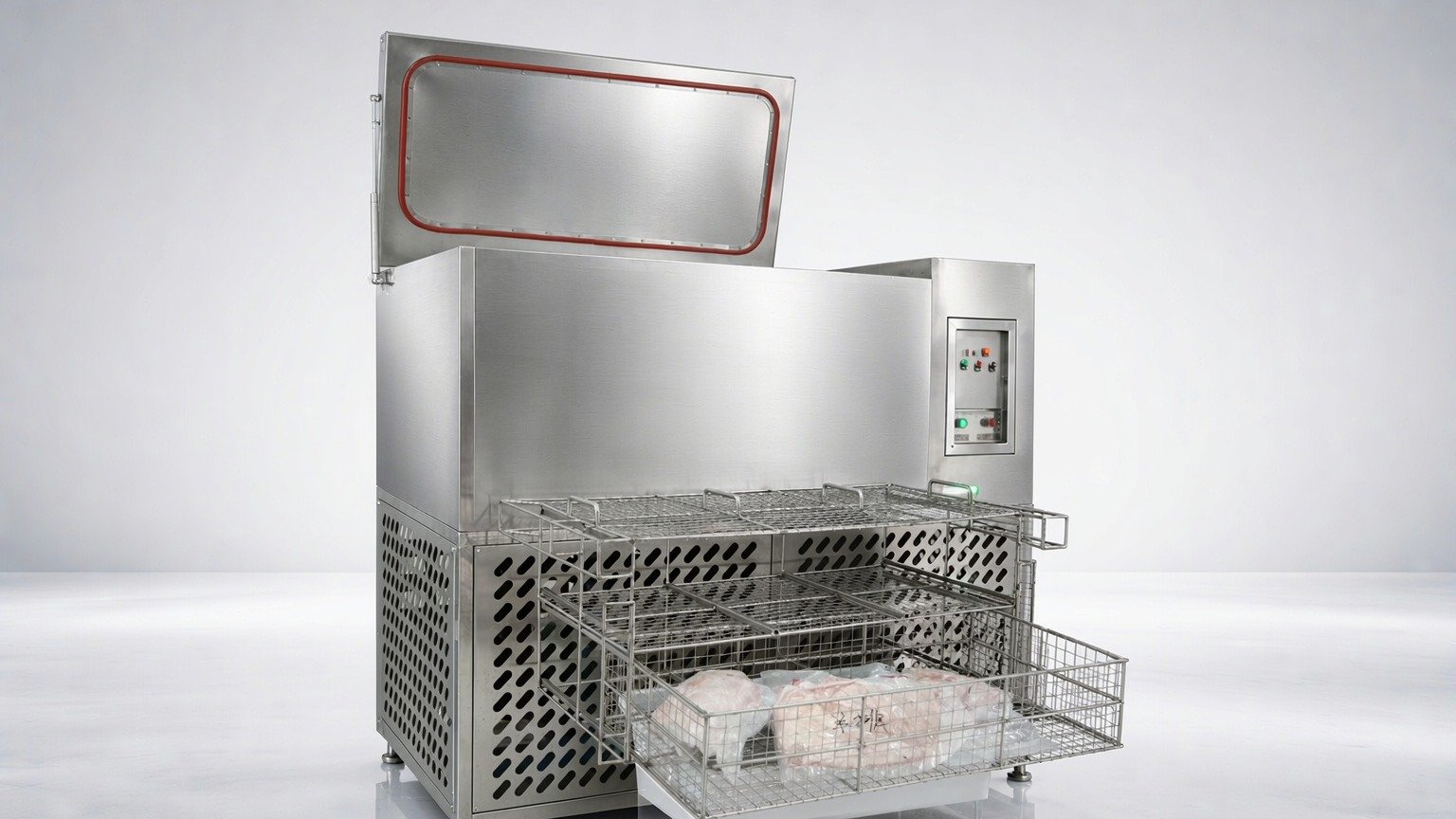
DKN-RHV-50 is the smaller single-batch capacity tier in the Kunning Cryo RHV series: cabinet structure, 50 kg per batch, products loaded in baskets and immersed in food-grade low-temperature freezing liquid for direct-contact heat exchange, with the series freezing liquid temperature as low as -50℃. The unit consists of an immersion tank, a compressor refrigeration unit, and a control system, with power supply 380V/50Hz three-phase five-wire, suitable for sites with small batches and frequent switching among multiple product categories.
50 kg is the nominal batch value; tank volume and actual loading per batch are calculated based on individual product weight, basket specifications, and loading arrangement.
Technical Parameters
| Item | Parameter |
|---|---|
| Product model | DKN-RHV-50 |
| Product line | Immersion rapid cooler (cabinet type) |
| Model meaning | RHV = compressor refrigeration · rapid cooling · tank; 50 = single-batch capacity 50 kg |
| Equipment form | Cabinet type, single-batch loading, products immersed in freezing liquid for heat exchange |
| Single-batch capacity | 50 kg/batch (nominal value, calculated per product and basket specifications) |
| Heat exchange medium | Food-grade freezing liquid (can contact food directly) + refrigerant |
| Freezing liquid temperature | Series freezing liquid temperature can be as low as -50℃ |
| Working temperature / temperature control accuracy | Confirmed per order (series design calculated at ±2℃ class temperature control) |
| Tank volume | Confirmed per order |
| Inner tank dimensions / external dimensions | Confirmed per order |
| Refrigeration method | Compressor refrigeration unit + coolant circulation, selected per single-batch capacity and target temperature |
| Condensing method | Confirmed per site conditions and order (air-cooled / water-cooled / evaporative) |
| Unit power | Confirmed per order |
| Control method | PLC + touchscreen, manual/automatic switching, PID automatic regulation |
| Temperature sensing element | PT100 platinum resistance |
| Power supply specification | 380V/50Hz, three-phase five-wire |
| Export configuration | If the export region requires 60Hz or other voltage levels, re-selection per order |
Loading capacity and cooling time vary with product type, individual weight, and inlet temperature.
Structure and Configuration
Tank and insulation
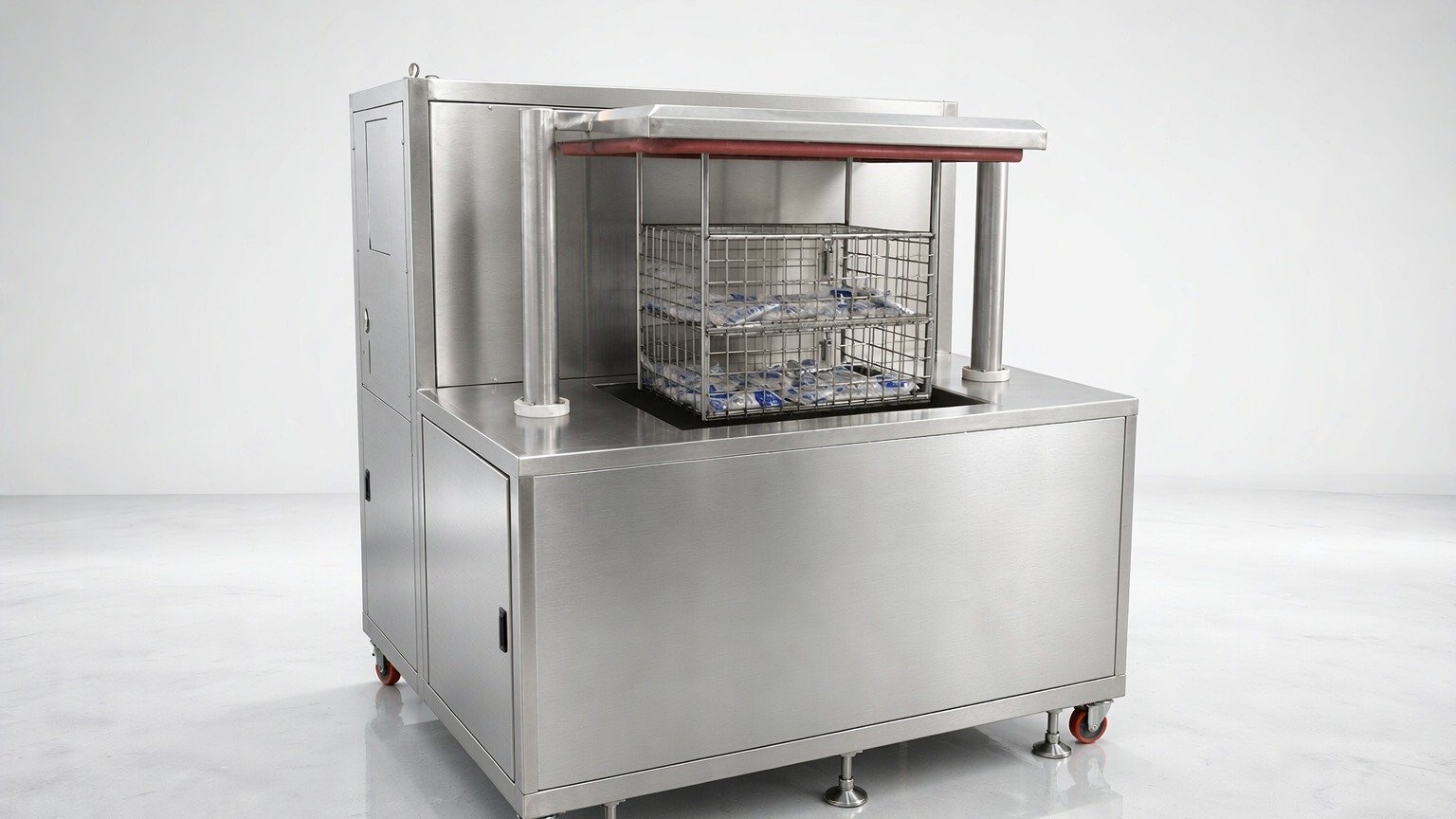
- The inner and outer walls of the tank are formed by welded SUS304 food-grade stainless steel plates, with reinforcing ribs at load-bearing positions to resist deformation under long-term load.
- The outside of the tank is provided with multi-layer adiabatic foam insulation to reduce heat absorption from the environment by the freezing liquid.
- The lower part of the tank is inclined for confluence, equipped with a drain pipe and shut-off valve, so liquid change and cleaning can drain to the bottom; the upper cover can be opened for easy basket loading and retrieval.
Refrigeration and freezing liquid circulation
- The refrigeration unit is compressor refrigeration with coolant circulation; cooling capacity is selected per single-batch capacity, inlet temperature, and target temperature.
- The circulation pump is matched to the tank volume to make the liquid temperature in the tank uniform and avoid local temperature differences prolonging cooling time.
- The freezing liquid is a food-grade medium that can contact food directly; concentration and cleanliness are monitored per working conditions in daily operation, and concentration fluctuations affect liquid temperature and heat exchange efficiency.
Control and safety
- Touchscreen input plus PLC intelligent control, PID automatic regulation, multiple process programs can be stored and called up by category with one touch.
- Temperature measurement uses PT100 platinum resistance; after the program ends, it automatically alarms and cuts power.
- Protection functions cover compressor overload and overcurrent, high/low pressure, over-temperature, phase sequence/phase loss, and antifreeze protection.
Application Scenarios
| Scenario | Description |
|---|---|
| Chain restaurant central kitchens | Batches out of the pot each meal period, tens of kilograms per batch |
| Canteen and group meal processing | Cooked food, soups, and braised items go directly into the tank after coming out of the pot, shortening the cooling time |
| Sauce-braised and cooked food back plants | Small batches with multiple varieties, changing varieties several times a day, switching processes by program |
| New product trial production | Verify the cooling curve first, then scale up to production line models |
The same series also has larger cabinet and continuous production line models, see Immersion Rapid Cooler; for a cabinet solution that does not use freezing liquid and relies on forced cold air, see Food Blast Chiller; for the trade-offs between the two methods, see Liquid Nitrogen Freezing vs. Mechanical Refrigeration Freezing Comparison.
Installation Conditions
- Site: Reserve space for basket loading, retrieval, and maintenance according to external dimensions; treat the floor for moisture resistance and provide drainage slope.
- Power: 380V/50Hz three-phase five-wire; wiring from the main line to the electrical control cabinet is to be laid by the buyer.
- Media: The site needs storage conditions for freezing liquid and refrigerant; when selecting the water-cooled configuration, reserve space for the cooling water tower and circulating water route (confirmed per order).
- Ventilation: Keep the installation location ventilated to avoid accumulation of freezing liquid volatiles in low-lying areas.
Warranty and After-Sales
The whole unit has a one-year warranty; after receiving fault information, a solution is provided within 2 hours, and if it cannot be resolved remotely, arrival on site within 24 hours and problem elimination within 72 hours; one free on-site service per year, and long-term technical support and spare parts supply after the warranty period.
FAQ
Is 50 kg a fixed capacity, and how many batches can be done per day?
50 kg is the nominal value of single-batch capacity, not hourly capacity. Daily throughput is converted by batch rhythm: single-batch cooling time plus loading, unloading, and cleaning time forms one cycle, multiplied by the number of cycles that can be scheduled per shift. Product thickness and target core temperature differ, so single-batch time varies greatly.
What is the difference between it and DKN-RHV-100 and RHV-200?
All three are cabinet models of the RHV series, differing in single-batch capacity: 50, 100, and 200 kg. Tank volume, refrigeration unit, and circulation pump scale up with capacity, and the power distribution capacity changes accordingly. For selection, first look at single-batch output and management rhythm.
Must products be packaged before entering the tank?
The freezing liquid can contact food directly, so bare products can be immersed directly for cooling; packaging is also acceptable, but packaging adds thermal resistance, and process time must be set separately. Do not mix the two methods with the same set of parameters.
What should be prepared in advance for the site and power distribution?
Power distribution is 380V/50Hz three-phase five-wire; unit power is confirmed per order before calculating capacity and wire diameter; the site should accommodate loading basket turnover according to external dimensions and provide drainage conditions for emptying and cleaning. When selecting the water-cooled configuration, a cooling water tower location is also required.
To calculate tank volume, refrigeration configuration, and cooling time according to products and shift rhythm, simply describe the product form, individual weight, single-batch loading, inlet temperature, and target core temperature: Contact Us.