
The electrical side of quick freezing equipment is simpler than many people think: liquid nitrogen itself consumes no electricity—only fans, drives, valves and the control system do. Liquid nitrogen freezing cabinets have a total power of 2.5~12 kW, tunnel lines 9~26 kW, with power distribution uniformly rated at 380V/50Hz; immersion chillers, which include compressor units, have a total power of 320 kW—a different order of magnitude. Low power does not mean it can be connected casually; the mistakes usually lie not in power but in cabinet location, safety circuits and power frequency.
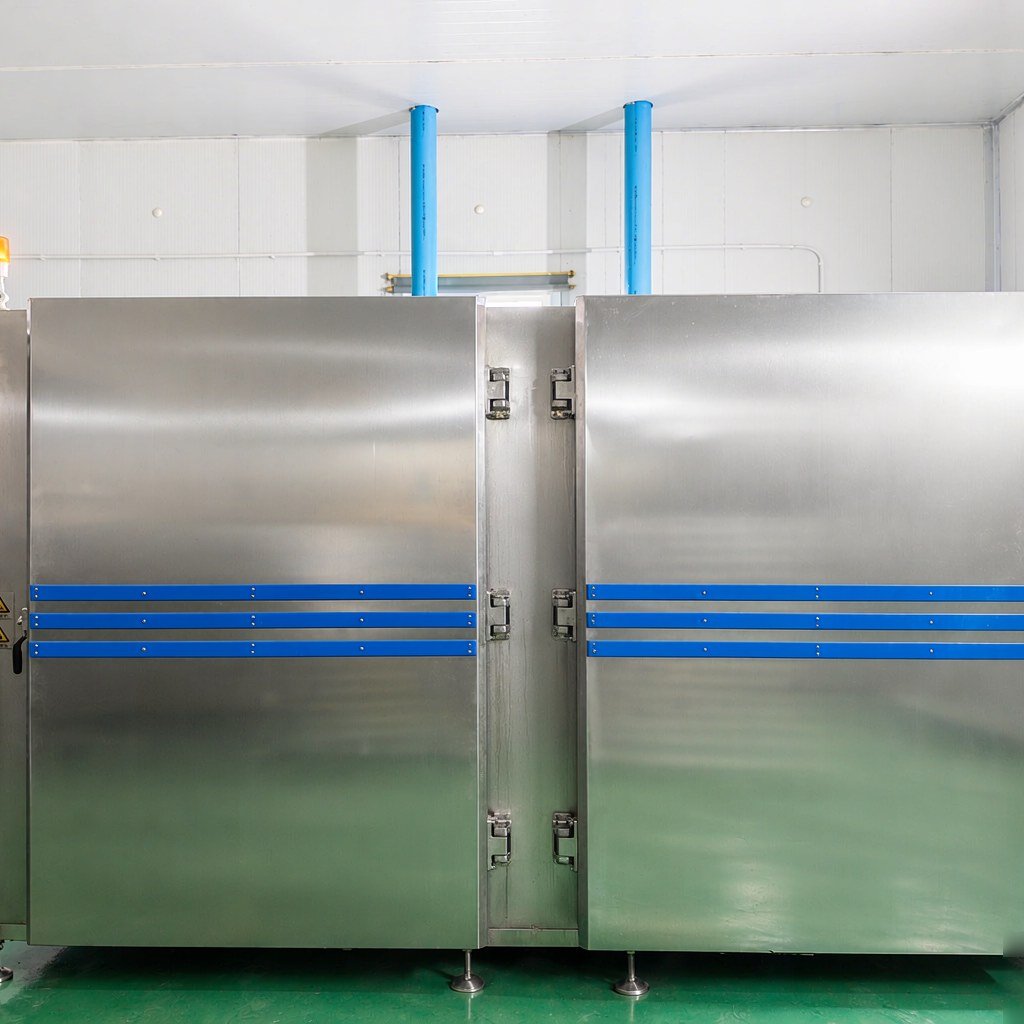
I. Match the Power First: Where Different Models Differ
For the same piece of equipment, total power is the sum of fans, mesh belt drive motors, valves and the control system, excluding liquid nitrogen. The table below is organized by current models; when selecting wire gauge and circuit breakers, allow margin based on total power—do not size according to measured current during operation.
| Model | Category | Total Power | Power Distribution |
|---|---|---|---|
| DKN-LFC-300 | Liquid nitrogen freezing cabinet | 2.5 kW | 380V |
| DKN-LFC-600 | Liquid nitrogen freezing cabinet | 5 kW | 380V |
| DKN-LFC-1200 | Liquid nitrogen freezing cabinet (four-zone) | 12 kW | 380V wide voltage |
| DKN-LFC-1500 | Liquid nitrogen freezing cabinet | 5 kW | 380V wide voltage |
| DKN-LFT-1206 | Liquid nitrogen freezing tunnel line | 9 kW | 380V/50Hz |
| DKN-LFT-0908 | Liquid nitrogen freezing tunnel line | approx. 15 kW | 380V/50Hz |
| DKN-LFT-1212 | Liquid nitrogen freezing tunnel line | 18 kW | 380V/50Hz |
| DKN-LFT-1612 | Liquid nitrogen freezing tunnel line | 26 kW | 380V/50Hz |
| DKN-RHV-2000L | Immersion chiller | 320 kW (approx. 270 kW in operation) | 380V/50Hz |
Cabinet-type and tunnel machines are both at the kW level; generally one 380V circuit in the workshop can carry them. The compressor unit of an immersion chiller is at the tens-to-hundreds of kW level, so incoming capacity, transformer margin and starting method must be calculated separately. For food quick chillers with a compressor power of 4.55 kW and total power of about 4.55 kW, the power cord specification is 2.5 mm², belonging to the same small-load tier.
II. From the Workshop Main Line to the Control Cabinet: Who Does This Section
When the equipment arrives on site, the electrical boundary must be clearly stated: the wiring between the power main line and the control cabinet is installed by the user, and the equipment side runs from the control cabinet downward. Writing this sentence into the technical proposal prevents on-site disputes over “who buys the cable, who installs the cable tray.”
In practice, three things need attention. First, the incoming line position—which end of the equipment the cabinet’s incoming port is on determines from which direction the cable tray comes; a tunnel line is 12 meters long, and the incoming end and discharge end are far apart, so the cable tray route must be planned together with the workshop traffic flow in advance. Second, grounding and circuit breakers—the equipment comes with a grounding wire and circuit breaker, and a phase sequence protector is also needed on the incoming side; if three phases are reversed the motor runs backward, and the protector will stop it the moment power is applied. Third, the division between inside and outside the cabinet—the cabinet and its internal components are shipped with the machine, and the wiring from the cabinet to each motor is already connected; on site only the incoming line is done, and the cabinet is not opened again.
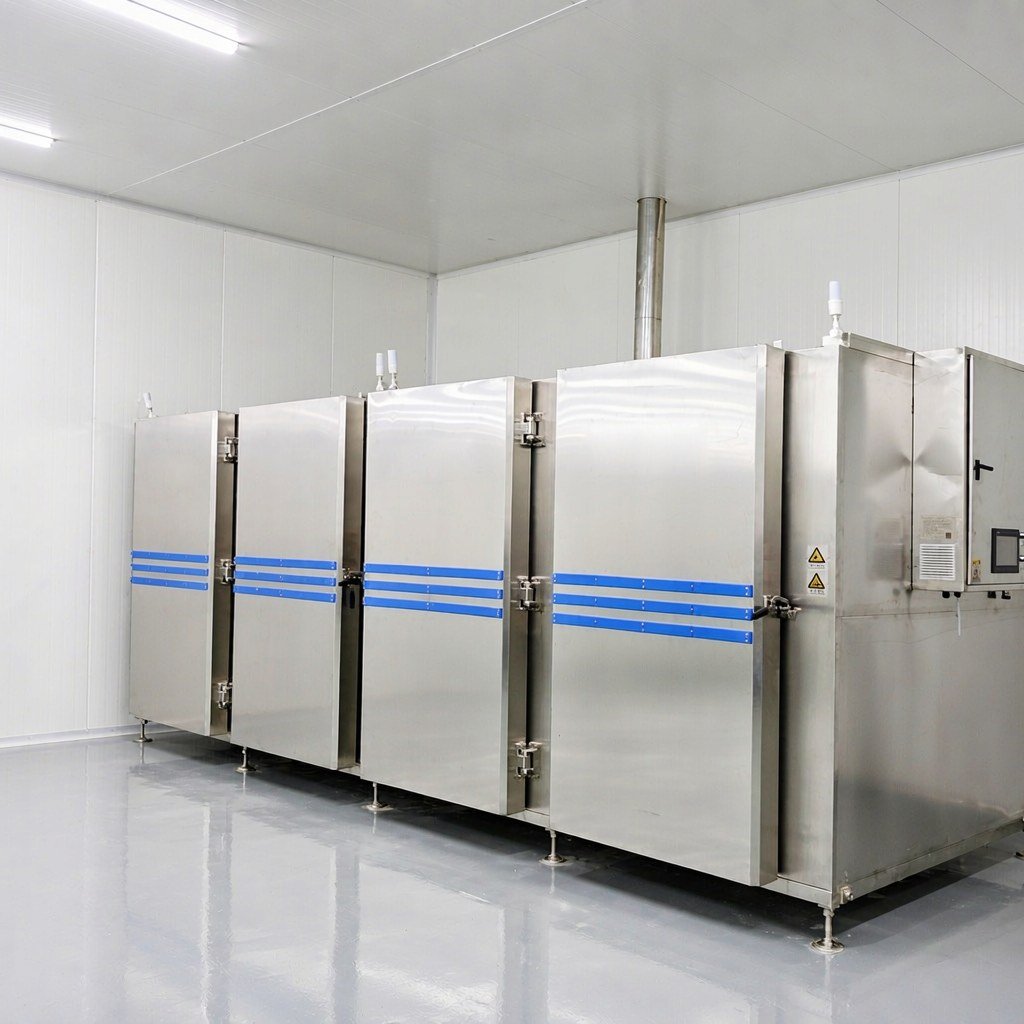
III. Where to Place the Control Cabinet: Location Affects Use More Than Components
Liquid nitrogen freezing cabinets use an integrated embedded control cabinet, with the operation screen embedded in the upper part of the box; tunnel lines use an integrated electrical cabinet that travels with the machine body. What these two approaches share is that the cabinet does not occupy separate floor space, but several placement rules still apply:
- Avoid water. Cleaning is a daily task; the cabinet must not be placed on surfaces directly hit by spray, and the cabinet door seal must withstand workshop humidity. The tunnel line body lifts as a whole for cleaning the mesh belt, and the cabinet must follow the lifting structure—it cannot be fixed at a low position where it would be hit by water.
- Avoid cold air. Low-temperature cabinet surfaces will condense; when the cabinet is close to the box body, leave room for heat dissipation and condensate drainage, otherwise condensation inside the cabinet in summer will trigger insulation alarms.
- Keep the operation face visible. The touch screen is embedded in the box body, so operators standing at the feed end can read data and change programs; tunnel lines have operating positions at both ends, and screen orientation should be set according to actual standing positions.
- Leave a maintenance access. Mesh belt drives, solenoid valves and oxygen concentration meters are all on the machine body; space around the cabinet must allow maintenance personnel to open the cabinet door and pull out drawer-type components.
IV. Control Logic and Temperature Measurement: How Processes Are Stored, How Curves Run
The control system is a combination of PLC and touch screen, 10-inch color screen, capable of both manual and automatic modes, with multiple sets of process parameters storable and one-key start. Cabinet-type models can run cooling and holding in ten steps, with automatic alarm and power-off after the program completes; the mesh belt speed of tunnel lines is variable-frequency adjustable, with a cycle from feed end to discharge end adjustable from 5~25 minutes, using belt speed to match freezing times for different product categories.
Temperature measurement uses PT100 platinum resistance, with a measurement range of 200℃~-200℃. This range covers the full span from hot product loading to deep-cold holding; choosing it is not for appearance—liquid nitrogen zone temperatures go as low as -150℃, where ordinary sensors drift. Temperature control accuracy is marked as ±1℃ or ±2℃ depending on model; whether the accuracy holds depends half on sensor position and half on the coordination of PID parameters with injection rhythm—this is something to watch during commissioning.
V. Safety Circuits: Emergency Stop, Over-Temperature and Oxygen Concentration
For the electrical safety of liquid nitrogen equipment, three circuits cannot be omitted:
- Emergency stop. Tunnel lines have an emergency stop switch at the discharge end, at the electrical cabinet and at the receiving end—three points covering the positions where operators may stand. Cabinet-type models have the emergency stop on the operation face side, and its position should be considered together with the door opening direction.
- Over-temperature alarm. The system has two sets of temperature sensors and feedback—main control and monitoring; on over-temperature it alarms and cuts off liquid nitrogen supply, preventing continuous injection from damaging the product.
- Oxygen concentration monitoring. Oxygen content meters are installed at the front and rear ends of the equipment, with a set value of 19.5%~21.5%. Nitrogen is colorless and odorless; leaks cannot be smelled by people, and this instrument is the one in the workshop that can give a number in advance.
Two other items are easily overlooked: besides the automatic safety device of the lifting system, there is also a manual safety pin for locking manually during maintenance; the mesh belt drive of tunnel lines is an independent variable-frequency motor, and after an emergency stop, confirm the belt has stopped before opening the door, to avoid reaching in with product on the belt.
VI. Export Projects: 50Hz and 60Hz Is Not Just Changing a Plug
380V/50Hz is the domestic standard for power distribution. When exported to 60Hz regions (North America, some Central and South American and Middle East projects), motor speed rises with frequency, and fan air volume, mesh belt linear speed and motor temperature rise all change accordingly; the selection of electrical components must also be redone. For such projects, the local voltage, frequency and number of phases must be written into the technical agreement at the quotation stage, and motors and electrical components re-selected for 60Hz—a 50Hz configuration cannot simply be shipped as is.
For voltage ranges and frequency differences in different markets, refer to Selection of Quick Freezing Equipment under Voltage and Frequency Differences in Export Markets; check item by item against that table during on-site verification.
FAQ
Does quick freezing equipment need a dedicated power circuit?
It depends on the model. Liquid nitrogen freezing cabinets at 2.5~12 kW and tunnel lines at 9~26 kW can share a circuit with other small loads in the workshop capacity-wise, but a dedicated circuit with an independent breaker is recommended, because cleaning may require a full power cut and maintenance requires lockout/tagout—a dedicated circuit makes isolation easier. Immersion chillers at 320 kW must have a dedicated incoming line with transformer margin calculated.
Can the control cabinet be moved to the workshop distribution room for centralized management?
Not recommended. Between the cabinet and the equipment run signal lines for programmable control and sensors—liquid nitrogen injection, over-temperature alarms and oxygen concentration interlocks all use these lines; moving it farther away increases signal attenuation and interference risk, and the emergency stop would no longer be within operators’ reach. The integrated cabinet-with-machine design is set up for “man and machine on the same side” in the first place.
Will liquid nitrogen keep spraying during a power outage?
No. Liquid nitrogen flow is controlled by solenoid valves, which close on power loss—a fail-safe direction. But note two points: after power is restored the equipment may continue running according to the original program, so confirm the state of the product in the box before restoring power; after a long outage before restarting, run a no-load cooling curve first and confirm valve action is normal before loading product.
What changes are needed for export equipment power distribution?
It depends on the destination grid. 50Hz regions use the 380V/50Hz configuration; 60Hz regions (such as 440V/60Hz, 480V/60Hz) require re-selection of motors and electrical components, with voltage, frequency and number of phases stated in the technical agreement. This step must be confirmed at the selection stage for liquid nitrogen freezing tunnel lines and liquid nitrogen freezing cabinets; changing it just before shipment is costly in both cost and time.
Once the power distribution and cabinet side are clear, on-site work is basically connecting the incoming line, checking phase sequence and running a no-load curve. For specific model power ratings, incoming line requirements and safety configurations, go to Contact Us to verify against your product and shift output.