
Equipment Overview
The heat exchange method of an immersion chiller differs from that of air-cooled equipment: materials are conveyed by a food-grade mesh belt and directly immersed in a low-temperature freezing liquid for heat exchange. The freezing liquid is a medium that can come into direct contact with food; its thermal conductivity and heat capacity are both higher than those of air, and the heat on the material surface is carried away directly through the liquid without relying on air blowing. The equipment is a tunnel-type continuous production line, where feeding, immersion heat exchange and discharging proceed continuously in rhythm, rather than being batch-by-batch intermittent operation.
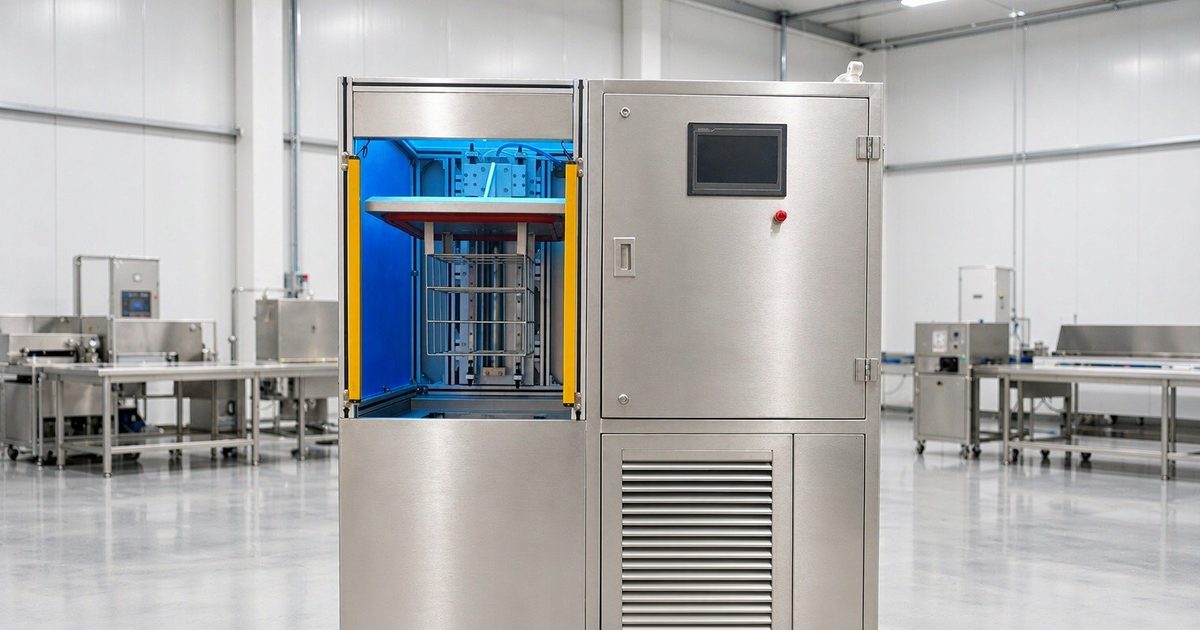
The complete machine consists of three parts: the quick-freezing tunnel line (cabinet, mesh belt, freezing liquid circulation), the compressor refrigeration unit, and the control system. The freezing liquid temperature, mesh belt speed and cycle time are all set on the control screen and executed automatically, with no manual intervention required during operation. The cabinet is equipped with an integral lifting structure, and the mesh belt upper cover can automatically flip to both sides, providing working space for maintenance and cleaning.
The applications of this product line cover both cooling and freezing processes. According to material thickness and target core temperature, the residence time of materials in the tank is determined by the mesh belt speed, and the tunnel cycle time is adjustable within the range of 20 to 100 minutes.
Industry requirements for quick-freezing and freshness-locking are increasing. In the “2026 Agricultural Main Promotion Technologies” issued by the Department of Agriculture and Rural Affairs of Guangdong Province on August 21, 2026, ultra-low temperature quick-freezing and freshness-locking technology for subtropical specialty agricultural products was included in the promotion catalog, with the technical path aimed at allowing materials to pass quickly through the ice crystal formation zone to reduce mechanical damage to cellular structures. During the same period, the Health Commission of Guangdong Province publicly solicited opinions on the revised drafts of the “Guangdong Province Local Food Safety Standard: Prepackaged Refrigerated and Frozen Meals” and the “Hygienic Specifications for the Production and Operation of Prepackaged Refrigerated and Frozen Meals,” and the production hygiene management requirements for refrigerated and frozen meals are being further refined. When selecting equipment, the temperature and residence time records of the cooling and freezing processes should correspond to these requirements.
Model and Parameters
Meaning of the DKN-RHV-2000L model: RHV stands for immersion chiller, 2000 is the throughput level (2000 kg/h class), and L indicates the continuous production line type.
| Item | Parameter |
|---|---|
| Equipment form | Tunnel-type continuous production line (mesh belt conveying + immersion heat exchange) |
| Throughput | 0 to 2000 kg/hour (capacity varies with different products) |
| Operating temperature | Not higher than -35℃ |
| Temperature control accuracy | ±2℃ |
| Freezing liquid temperature uniformity | ±3℃ |
| Tunnel cycle time | Adjustable from 20 to 100 min (mesh belt variable frequency speed control) |
| Tunnel inner cabinet dimensions | 23260 × 2360 × 570 mm (mesh belt effective width 2000 mm) |
| Equipment external dimensions (approx.) | 28000 × 3500 × 2280 mm |
| Insulation layer thickness | 120 mm |
| Mesh belt lifting stroke | 700 mm (mechanical screw lifting, lifting upper limit) |
| Power distribution specification | 380V / 50Hz (3-phase 5-wire) |
| Total machine power | 320 kW |
| Operating power | Approx. 270 kW |
| Heat exchange medium | Refrigerant + food-grade freezing liquid (can come into direct contact with food, freezing liquid temperature can reach -50℃) |
Configuration composition of the refrigeration system:
| Item | Parameter |
|---|---|
| Refrigeration unit | Single-machine two-stage secondary refrigerant compressor unit, 2 screw compressors |
| Cooling capacity | 404.6 kW |
| Unit power consumption | 258.5 kW |
| Condenser | Shell-and-tube water-cooled condenser, equipped with high-flow cooling water tower |
| Evaporator | Corrosion-resistant and low-temperature-resistant shell-and-tube evaporator |
| Circulation pump | Dual circulation pump system, food-grade low-temperature circulation pump |
| Refrigerant | R22 or R507, expansion valve control |
| Design conditions | Summer outdoor calculated average temperature 35℃, relative humidity 65% |
| Control method | PLC + touch screen, PID automatic adjustment, supports remote monitoring |
The parameters in the above table are taken from the Kunning Cryo immersion chiller technical data and the official website immersion chiller product page. Several notes:
- The throughput range is 0 to 2000 kg per hour, and the rhythm is determined by actual measurement according to the material and target temperature.
- The table lists the 380V 50Hz configuration; for export to 60Hz regions or other voltage levels, the selection of compressors, water pumps and motors must be redone and confirmed according to the order.
- The equipment external dimensions are approximately 28 meters long, 3.5 meters wide and 2.28 meters high. The site should be calculated accordingly for passages, floor height and maintenance space, with reserved positions for the refrigeration unit and cooling water tower.
- The total machine power is 320 kW (operating power approximately 270 kW). The power distribution capacity should be calculated accordingly, not wired according to the average value.
- Component brands and specification models are not listed on this page; the factory nameplate and the contract technical annex shall prevail.
Main Configuration
Cabinet and Insulation
- Inner and outer cavities are formed by shearing, bending and welding of 304 stainless steel plates, with reinforcing ribs added at load-bearing positions
- Insulation layer 120 mm, multi-layer adiabatic foaming process, slow temperature recovery of the freezing liquid
- The tunnel upper cover is an insulated heat-retaining cover that automatically flips to both sides and is detachable, facilitating process inspection
- The lower part of the freezing tank converges at an incline, equipped with a freezing liquid discharge pipe and shut-off valve
Mesh Belt and Conveying
- Food-grade low-temperature dedicated conveying mesh belt, equipped with a variable frequency speed control motor and an automatic mesh belt tension adjustment device
- The mesh belt surface is equipped with a pressure belly belt; the effective working space between the mesh belt and the pressure belly belt is approximately 350 mm, ensuring stable material immersion
- Segmented lifting mesh belt, with rapid lifting conveying at the tail, reducing product temperature recovery and condensate backflow into the tank
- The mesh belt and support can be mechanically lifted, with a lifting stroke of 700 mm, facilitating maintenance and cleaning
Heat Exchange and Circulation
- The circulation tank is designed with special convection; spray pipes are arranged for circulation at the bottom and both sides of the mesh belt, making the temperature distribution in the tank more uniform
- Dual circulation pump system, food-grade low-temperature circulation pump
- The freezing liquid pipeline inside the tunnel adopts sanitary quick-connect fittings, detachable for maintenance
- Equipped with online freezing liquid concentration detection, automatically replenishing freezing liquid according to liquid level and concentration (optional)
- Inner surface coating reduces water vapor aggregation; the moisture isolation design reduces moisture in the air entering the tank
Discharging and Water Removal
- A spray device is provided at the discharge port, which can be manually opened and closed
- Two air knife devices at the discharge end plus high-pressure airflow for water removal, with adjustable angles
- Tail air knife blow-drying with a freezing liquid recovery device, reducing medium carry-out
Refrigeration and Control System
- Single-machine two-stage secondary refrigerant compressor unit, 2 screw compressors, equipped with siphon oil cooler, external oil separator and oil filter
- The high-pressure side is equipped with an economizer, liquid receiver, liquid supply filter and shut-off valve; the return gas side is equipped with a gas-liquid separator and low-pressure liquid injection device
- Control is PLC plus touch screen, PID automatic adjustment, switchable between manual and automatic, supports remote monitoring
- The temperature measuring element is a platinum resistor; the program automatically alarms and cuts off power upon completion
- Protection functions: compressor overload and overcurrent protection, high and low pressure protection, over-temperature protection, phase sequence and phase loss protection, anti-freeze protection
Application Scenarios
The adaptation conditions for an immersion chilling line are that materials can be fed continuously and can come into direct contact with food-grade freezing liquid, or use packaging that permits immersion. The following directions all belong to industry application solutions, and specific configurations are determined by material testing.
| Application direction | Typical materials | Position in the production line |
|---|---|---|
| Aquatic processing | Shrimp, fish fillets, shellfish | Freezing process, preceded by cleaning and grading, followed by packaging |
| Prepared dishes and frozen meals | Prepared meat products, semi-finished dishes | Cooling or freezing process after cooking |
| Cooked foods and braised foods | Braised products, roasted meats, braised meats | Rapid cooling stage after coming out of the pot |
| Central kitchens and group meals | Meal portions, semi-finished products | Cooling stage before portioning |
| Continuous production line renovation | Projects with existing front-end and back-end conveying lines | Replacing intermittent cooling equipment, connecting front and rear processes |
Usage of the equipment by process:
- Aquatic processing: For single-piece frozen products such as shrimp and shellfish, the front-end processing line discharges continuously, and the tunnel line is used for continuation without manual transfer. The loading methods for shell-on and shelled materials differ, and the height of the mesh belt pressure belly belt should be confirmed together.
- Prepared dishes and frozen meals: Materials coming out of the cooking process have high temperatures; before entering the tunnel, the packaging form and the contact method with the freezing liquid should be confirmed. The thermal resistance of bare materials and vacuum-packaged materials differs greatly, and the cycle time should be determined separately.
- Cooked foods and braised foods: For scenarios where materials enter the line in baskets after coming out of the pot, the focus is on the continuity of the cooling stage, avoiding piling up and waiting in the workshop. The production line should be managed as a cooked clean area, separated from the raw material area.
- Central kitchens: The continuous tunnel needs to align with the portioning rhythm. For occasions with a few hundred kilograms per batch and frequent category switching, the intermittent food blast chiller is easier to arrange; for scenarios requiring lower temperatures and shorter freezing times, see the liquid nitrogen freezer cabinet and liquid nitrogen quick-freezing tunnel.
- Site and supporting facilities: The tunnel line occupies a long area and also requires positions for the cooling water tower and refrigeration unit; the cooling water quality and circulation volume of the water-cooled condenser should be determined in advance, rather than adding piping after the equipment arrives.
Information to be confirmed for model selection:
| Item | Description |
|---|---|
| Material type and form | Bare or packaged, single-piece dimensions, single-piece weight and thickness |
| Throughput | Continuous throughput, in kg per hour, or converted by batch |
| Inlet temperature | Temperature of the material when entering the tunnel |
| Target temperature | Core temperature required to be reached at discharge |
| Packaging and contact method | Whether the material can come into direct contact with the freezing liquid, packaging material and sealing method |
| Site and power supply | Available length, width, floor height, power supply specification and capacity |
| Export region | Voltage and frequency system; 60Hz requires re-selection |
To calculate the tunnel length and refrigeration configuration according to your materials and production line rhythm, describe the material form, single-piece thickness, inlet temperature, target core temperature and site conditions, and we will provide a solution according to actual needs: Contact us
Frequently Asked Questions
For a 2000 kg/hour immersion chilling line, what are the cabinet dimensions and power?
The tunnel inner cabinet dimensions are 23260 × 2360 × 570 mm, with a mesh belt effective width of 2000 mm; the equipment external dimensions are approximately 28000 × 3500 × 2280 mm, and the site should be calculated accordingly for passages, floor height and maintenance space. Power distribution is 380V / 50Hz three-phase five-wire, with a total machine power of 320 kW and an operating power of approximately 270 kW.
What can the operating temperature and tunnel cycle time of the immersion chiller be set to?
The freezing liquid temperature can reach -50℃, the equipment operating temperature is not higher than -35℃, the temperature control accuracy is ±2℃, and the freezing liquid temperature uniformity is ±3℃. The residence time of materials in the tank is determined by the mesh belt speed, and the tunnel cycle time is adjustable within the range of 20 to 100 minutes, set according to material thickness and target core temperature.
What does the refrigeration system of this equipment consist of, and how many compressors are equipped?
The refrigeration system is a single-machine two-stage secondary refrigerant compressor unit, with 2 screw compressors, equipped with a shell-and-tube water-cooled condenser and cooling water tower. The refrigerant is R22 or R507, controlled by an expansion valve. The cooling capacity is 404.6 kW, and the unit power consumption is 258.5 kW. The control method is PLC plus touch screen, PID automatic adjustment, supporting remote monitoring.