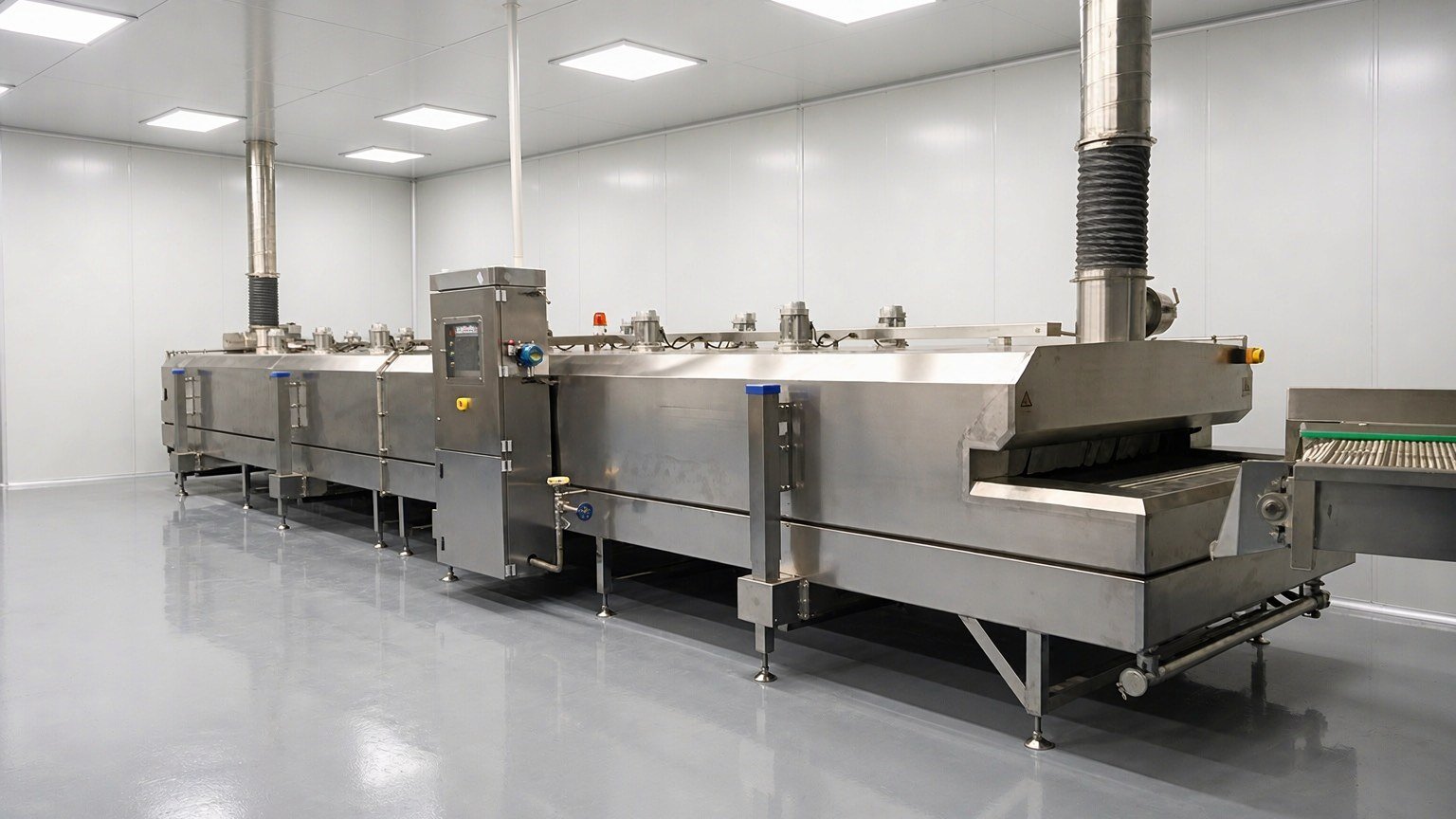
Downtime between two batches is dominated not by freezing but by four segments: raising the body, clearing residue, temperature recovery and first-piece confirmation. With equipment that has an integral lifting body, bottom drainage and quick-connect liquid nitrogen valves, cleaning can reach the bottom, water drains away completely, and both changeover time and batch consistency are more stable; on fixed-chamber machines, the same set of actions often requires disassembly to complete.
1. Where the four segments of changeover time go
Only by separating the time between two batches by action can you see where it can be compressed.
| Segment | Main actions | What determines the time |
|---|---|---|
| Stopping feed and clearing out | Remaining product on the belt runs through, racks in the cabinet cleared | Product length at the end of the freezing cycle, belt speed |
| Raising the body and clearing residue | Lifting mechanism raises, cleaning of cavity, belt and bottom | Whether the structure can be lifted as a whole, whether the bottom can drain |
| Cooling back down | Empty machine cooled to setpoint after cleaning | Empty-load cooling capacity, time doors are open and cold is lost |
| First-piece confirmation | Core temperature and appearance of first batch confirmed | Temperature measurement points, recording method |
Of the four segments, the second and third are the ones truly tied to equipment capability. The first segment depends on production scheduling and tail-end handling habits, and the fourth on the recording system.
2. How far cleaning can go depends first on body structure
On a tunnel line the belt runs between two rows of nozzles, and product residue and condensate fall onto the belt surface, cavity side plates and bottom. Whether this can be done in one pass depends on three structural points:
- Whether the body can be lifted as a whole. DKN-LFT-1612 has an integral lifting body, with a lift stroke of 550 mm and a cavity height of 750 mm. Once raised, the belt, nozzles and side plates are all directly reachable without removing the belt.
- Whether the bottom has a slope and drain outlet. The bottom is made as a shallow V with a drain outlet, so wash water and residue exit from the low point instead of pooling into a layer inside the cavity.
- Whether the liquid nitrogen line can be disconnected. The liquid nitrogen valve is designed with a quick-connect interface, disconnected before cleaning and reconnected after, without touching the main line.
The cavity and belt are made of food-grade stainless steel, double-sided welded, so routine cleaning can be done by direct water rinsing and brushing without extra anti-corrosion treatment. The insulation is 150 mm multi-layer foamed insulation; one precondition for no condensation on the outer surface is that the insulation does not take in water, so wash water must go through the drain outlet and not seep in through door frames or cable penetrations.
3. How to estimate cooling-back time
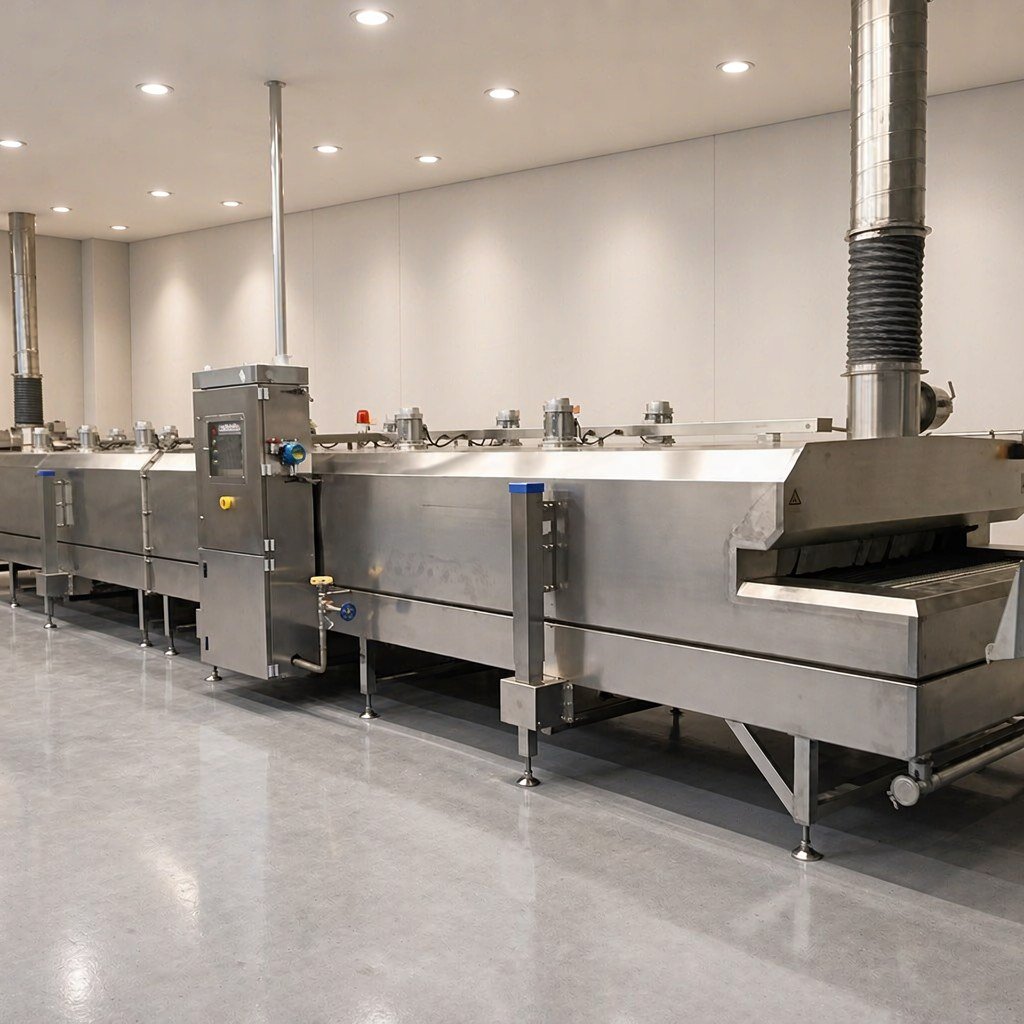
During cleaning the cavity temperature returns to near room temperature, and afterwards it must be brought back to setpoint before feeding. This step can be estimated from the empty-load cooling capacity given for the equipment: DKN-LFT-1612 has an empty-load cooling rate of 10℃ per minute, adjustable according to actual conditions. That is, scheduling from room temperature down to the working temperature range follows this order of magnitude, without guessing from experience.
There is no fixed number to apply to the recovery segment; it depends on workshop temperature, how long doors are open, wash water volume and whether compressed air is used for blow-drying. The practice on site is to record the recovery process on screen during the first changeover, then schedule later runs according to the actual curve of one’s own workshop, which is more reliable than copying someone else’s times.
Once cooling is complete, check two figures:
| Item | Reference value |
|---|---|
| Working temperature range | -150℃ ~ room temperature |
| Temperature control accuracy | ±2℃ |
| Oxygen concentration detector setpoint | 19.5% ~ 21.5% |
| Power supply specification | 380V / 50Hz |
| Total power (DKN-LFT-1612) | 26 kW |
| Liquid nitrogen supply pressure | 0.5 ~ 0.8 MPa |
The ±2℃ control accuracy is the equipment’s control capability under stable operation; after changeover the first batch fluctuates more than at steady state, so judging whether it is truly ready requires both the screen recovery reading and the first-piece measurement to agree — checking only one easily leads to misjudgment.
4. Changeover checklist: seven points, confirmed one by one
| Point | What to do at changeover | Judgment criterion |
|---|---|---|
| Belt | After raising, rinse the belt surface and mesh gaps, check tension | No residue on belt surface, no sign of tracking deviation during operation |
| Nozzles and spray pipes | Check whether nozzles are blocked by oil or debris | Cold flow pattern from each group is consistent |
| Fans and air ducts | Clear frost and debris adhering to impellers | No imbalance on blades, no abnormal noise |
| Door seals and gaskets | Wipe clean, press to check rebound | No gaps when closed, no continuous white mist |
| Bottom water collection groove | Rinse clean, confirm drainage is unobstructed | No backflow, no standing water |
| Temperature probe | Position fixed, surface free of frost cover | Deviation from measured value within control accuracy |
| Oxygen concentration probe | Position unchanged, calibrated per cycle | Reading within 19.5% ~ 21.5% |
The oxygen concentration probe is easily overlooked. At changeover the inlet and outlet are opened for cleaning convenience; if the probe is knocked out of position or its surface is coated with residue, the reading drifts — and the equipment’s safety logic cuts off the supply valve and starts exhaust when oxygen concentration falls below the setpoint, so an inaccurate reading means this protection layer is ineffective.
5. Three things easily missed between batches
First-piece core temperature. The criterion for quick freezing is that the core temperature passes from 0℃ down to below -5℃ in about 30 minutes, and after freezing is complete the core temperature reaches below -18℃. After changeover the first batch’s temperature conditions differ from steady state, so the first piece must be measured; the previous batch’s data cannot represent this batch.
Records must connect. The downtime in the middle of changeover is also part of traceability. Downtime start and end, cleaning actions, recovery curve and first-piece temperature are best kept in the same record, so that afterwards it is clear which batch after resumption this one is.
Exhaust first, equipment second. The existing interlock logic is that the equipment does not run unless the exhaust fan starts; when restarting after changeover, follow this order and do not start the equipment before the exhaust to save time. This relates to ventilation and oxygen concentration in freezing workshops, and operation follows the same sequence.
6. Which lines need finer changeover most
On a line running only one category and one specification a day, with changeover once a week, the focus is on cleaning thoroughly; on a line switching two or three specifications a day with small batches each, changeover time directly eats capacity, and the liftable structure, quick-connect interfaces and drainage slope matter more than anything.
For multi-category rotation lines, the number of changeover actions should be counted at the selection stage: whether the body can be lifted, whether the belt must be removed, whether the liquid nitrogen line is disconnected, where wash water drains. At the same capacity, these determine how many specifications can be run each day.
For specific model parameters and configuration differences, see the product page for liquid nitrogen tunnel freezers; for process-side temperature control points, see ice crystal band control in freezing curves.
FAQ
Must the body be raised for cleaning at changeover?
Not necessarily, but raising it saves the time of disassembly. With an integral lifting body raised, the belt, nozzles, side plates and bottom can all be cleaned directly, and wash water and residue drain from the bottom outlet; with a fixed chamber you can only reach in through the open door, and the underside of the belt and inner side plates are often out of reach — over time residue accumulates, brings odors and tends to block nozzles.
How long after cleaning before feeding can resume?
Schedule by the equipment’s empty-load cooling rate. DKN-LFT-1612 has an empty-load cooling capacity of 10℃ per minute; from the recovery state after cleaning down to the working temperature range can be estimated at this rate, with workshop temperature and door-open cold loss also to be considered. To judge whether feeding can start, check that the screen recovery has reached setpoint and the first-piece measured temperature meets requirements — start feeding only when both are satisfied.
Must the liquid nitrogen line be emptied at changeover?
When cleaning and checking nozzles, close the liquid nitrogen main valve and confirm the supply pipe section is depressurized. The liquid nitrogen valve is a quick-connect interface, easy to remove and refit; operation follows the equipment’s manual liquid nitrogen mode procedure without modifying the main line. When restarting, restore ventilation and oxygen concentration monitoring first, then open the valve gradually in automatic mode.
For multi-spec small-batch production, how short can changeover time be?
There is no universal number to apply. What can be determined are the control points: whether the body can be lifted as a whole, whether the belt is removal-free, whether the bottom has drainage, whether the liquid nitrogen valve is quick-connect, and whether the recovery rate is stable. When all five are present, changeover leaves mainly cleaning and recovery; missing one adds a segment of disassembly or waiting.
For specific working conditions on changeover and washdown, you can describe your product category, specification switching frequency and current equipment cleaning method at contact us; we will give configuration suggestions based on site conditions.