
Acceptance after equipment installation is not “it powers on, so it’s fine.” The core indicator of quick freezing equipment is whether it can bring the product core temperature down to the target value under a given batch size, so acceptance must be designed around the cooling process. The whole process is done in three steps: no-load, full-load, and curve verification.
1. No-Load Trial Run
The purpose is to confirm that equipment installation and electrical wiring are correct, and that mechanical parts run normally. Check items:
| Check item | Content | Criteria |
|---|---|---|
| Electrical | Nameplate matches on-site power supply, grounding reliable | No abnormal heating, no odor |
| Rotation direction | Fan, pump rotation direction correct | Consistent with marked direction |
| Running current | No-load current of each motor | Within rated range |
| Vibration and noise | Any abnormal vibration, abnormal sound | Stable, no periodic impact |
| Control | Temperature control, alarm, interlock action | Action normal, signals correct |
| Insulation | Door seal fit, any condensation or frost | No obvious cold leakage |
If door seal leakage or fan abnormal noise is found during the no-load stage, it must be addressed before proceeding to full-load, otherwise it will interfere with subsequent judgment.
Step Two: Full-Load Trial Run
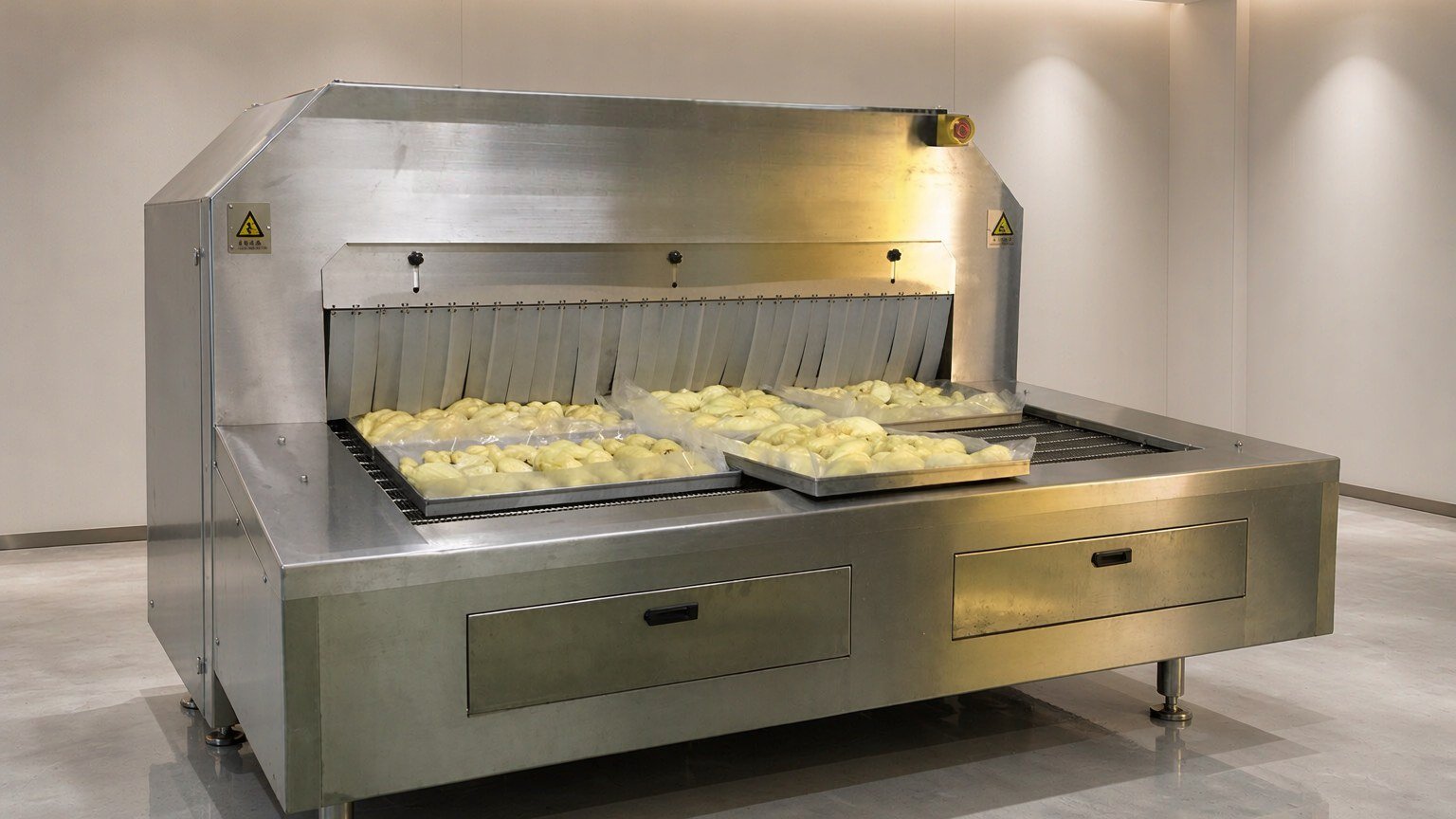
Use the customer’s actual product, actual packaging, and actual loading method for the trial run; this is the representative step.
Confirm before trial run: product name, net weight per batch, inlet temperature, target core temperature, loading method (number of rack layers, amount per tray), liquid supply method and set temperature. These parameters are the baseline for subsequent production.
Record items:
- Inlet temperature and target core temperature;
- Cooling time from start to core reaching target;
- Liquid nitrogen consumption for this batch (read from meter);
- Operating parameters (liquid supply pressure or flow rate, set temperature);
- Product appearance and frozen state (any cracking, dry loss, sticking).
Step Three: Cooling Curve and Core Temperature
The acceptance criterion is not “it looks frozen,” but that the core temperature drops to the target value within the specified time, and the curve meets process requirements.
| Verification item | Method | Description |
|---|---|---|
| Core temperature | Probe inserted into the geometric center of the product, take a larger piece | Judge whether it is truly frozen through |
| Cooling curve | Record temperature change over time | Observe time passing through the ice crystal formation zone |
| Surface temperature | Surface probe | Check for cracking caused by over-freezing |
| Repeatability | Run three batches consecutively with same parameters | Check batch-to-batch stability |
Why the curve matters: freezing quality depends on the speed at which the material passes through the ice crystal formation zone. The faster the cooling, the smaller the ice crystals, and the less damage to cells and tissues. This is directly related to water retention and mouthfeel after thawing; for the relevant principles see Freezing Curve and Ice Crystal Formation Zone.
Common Adjustment Directions When Trial Run Fails
| Phenomenon | Possible cause | Adjustment direction |
|---|---|---|
| Core reaching target takes too long | Loading too dense, insufficient airflow field, insufficient liquid supply | Adjust tray spacing, increase air volume, verify liquid supply amount |
| Surface over-frozen, cracking | Liquid supply concentrated in local area, front section cooling too aggressive | Adjust distributor and liquid supply rhythm |
| Batch consumption on the high side | Door seal leakage, insulation damp, low loading relative to heat leakage | Check sealing and insulation, re-calibrate with full-load trial run |
| Large batch-to-batch fluctuation | Uneven loading, unstable inlet temperature | Standardize loading and upstream processes |
After adjustment, run another round of three-batch verification; acceptance passes only after it is stable.
Acceptance Documents and Baseline Retention
After acceptance passes, save the following items as documents to serve as the comparison baseline for subsequent production:
- Trial run record sheet (parameters and results);
- Cooling curve chart;
- Liquid nitrogen unit consumption for this batch;
- Loading method description and photos;
- Personnel involved and date.
With a baseline, when anomalies in unit consumption or cooling time occur later, it is possible to judge whether it is an equipment issue or a process change. For how to record unit consumption, see How to Measure Liquid Nitrogen Consumption and Freezing Energy Consumption; for other on-site matters during commissioning and operation, see Sea Freight Packing and On-Site Installation Preparation for Quick Freezing Equipment.
FAQ
Must acceptance use the customer’s own product?
It is recommended. Different products vary greatly in moisture content, shape, packaging, and initial temperature; using other materials or substitutes for trial runs means the results cannot be directly transferred to mass production. If there are genuine difficulties, similar materials can be used for preliminary verification first, and an actual product verification added before mass production.
How to measure core temperature accurately?
Insert the probe into the geometric center of the product, take a larger and thicker piece from the whole batch; the probe must be inserted fully, avoiding proximity to the surface. Measure at least two pieces per batch and take the worse reading.
How many batches of full-load trial run count as passing?
Generally, run three batches consecutively with the same parameters; verification passes only when core reaching-target time and unit consumption are stable between batches. Single-batch data can only serve as reference.
Is liquid nitrogen consumption during the trial run stage normal?
Consumption during pipeline pre-cooling and the first round of commissioning will be higher than normal production; mark this part separately in records, and do not mix it into the product unit consumption baseline.
Acceptance items and trial run record sheets after equipment arrival can be provided according to model and product; send us your product, batch size, and target core temperature, and we will give the corresponding trial run plan: Contact Kunning Cryo
The acceptance methods and criteria in this article are general engineering practices in this industry and can be supplemented according to project requirements; the relationship between freezing quality and the ice crystal formation zone is cited from general industry principles, and equipment parameters are subject to the technical parameters of the corresponding model.