
DKN-RHC-60D-80 is the deep-cryo model in the Kunning Cryo food blast chiller range: dual-cabinet, two cabinets with independent doors, normal-pressure forced cold-air circulation, cabinet temperature down to -80℃, compressor power 9.05 kW, power supply 380V, 30 standard trays per cabinet, about 200 kg total for both cabinets, 1~2 hours per batch, loading 60~90℃, discharge 3~10℃ adjustable.
It shares the same structure as DKN-RHC-60D-45, with identical outer dimensions, single-cabinet inner dimensions, tray count and load capacity; the difference lies only in the refrigeration configuration and the achievable cabinet temperature. Model selection is based on the final temperature requirement: for cooked food, baking and catering that only need a discharge temperature of 10~25℃, the -45℃ model is sufficient; if the product requires a lower final temperature, or the process needs to pass through a deeper cooling stage, choose the -80℃ model. For a comparison of the two models, see the food blast chiller product page.
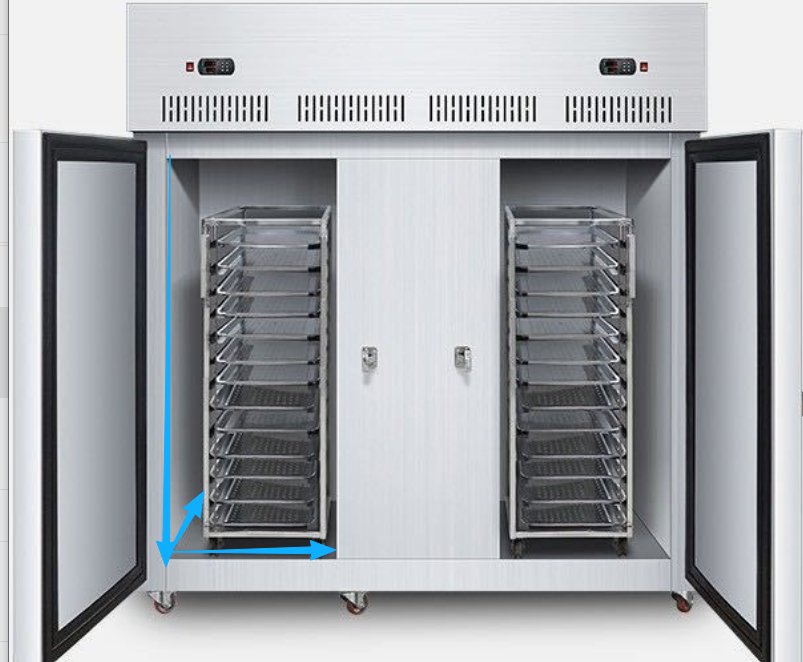
Technical Parameters
| Item | Parameter |
|---|---|
| Equipment form | Dual-cabinet, two cabinets with independent doors |
| Cooling method | Forced cold-air circulation (evaporator + fan air supply), normal pressure, no vacuum system |
| Cabinet temperature | -80℃ |
| Evaporating temperature | Confirmed per order |
| Cooling capacity | Confirmed per order |
| Overall outer dimensions | 1900 mm × 940 mm × 2150 mm |
| Single-cabinet inner dimensions | 580 mm × 720 mm × 1430 mm |
| Rack dimensions | 460 mm × 600 mm × 1370 mm |
| Trolley dimensions | 2000 mm × 1040 mm × 2250 mm |
| Compressor power | 9.05 kW |
| Total power | Approx. 9.05 kW |
| Condensing method | Air-cooled (confirmed per order when a water-cooled configuration is required on site) |
| Cabinet interior material | 304 stainless steel |
| Power supply | 380V/50Hz |
| Gross weight | 500 kg |
Loading and cooling parameters:
| Item | Single cabinet | Both cabinets total |
|---|---|---|
| Standard tray count | 30 pcs | 60 pcs |
| Load per tray | 3~5 kg | — |
| Throughput | Approx. 100 kg | Approx. 200 kg |
| Cooling time per batch | 1~2 hours | — |
| Loading temperature | 60~90℃ | — |
| Discharge temperature | 3~10℃ (adjustable) | — |
Throughput varies with product type, piece weight and packaging method, and is determined according to the customer’s material and capacity requirements.
Cabinet and Insulation
- Dual-cabinet structure, two cabinets with independent doors, the two cabinets staggered in rhythm: one cabinet cooling, one cabinet loading.
- Cabinet interior is 304 stainless steel, insulation layer is PU polyurethane integral foam.
- 30 standard trays per cabinet, rack 460 × 600 × 1370 mm, materials enter and exit the cabinet as a whole with the trolley.
Refrigeration System and Cooling
- Forced cold-air circulation: the evaporator brings the cabinet down to low temperature, the fan drives the cold air circulation and blows it over the food surface, and heat is carried away by convection and conduction.
- The cabinet interior is at normal pressure, with no vacuum pump or vacuum chamber components, and no consumable medium such as liquid nitrogen is needed.
- The evaporator is finned-tube type with forced-circulation fans; condensing is air-cooled (with built-in fans), and a water-cooled configuration on site is confirmed per order.
- Compressor power 9.05 kW, total power approx. 9.05 kW, configured for 380V; defrosting is electric heating or hot-gas defrosting.
- The evaporating temperature and cooling capacity of the -80℃ model are not recorded in the technical data and are confirmed per order.
Control System and Operation
- Thermostat or PLC with touch screen, automatically runs after the target temperature is entered, discharge temperature 3~10℃ adjustable.
- Core temperature is measured by inserting a probe thermometer into the center of the material; an infrared thermometer reads the surface temperature.
- After cooling is completed, the material is transferred to the 0~4℃ cold storage stage as soon as possible.
Application Scenarios
| Scenario | Description |
|---|---|
| Cooked food and braised processing | Braised products, roast meats and braised meats enter the cabinet with the trolley after coming out of the pot, target temperature 10~25℃ |
| Baking and pastries | Bread, cakes and mooncakes are packaged after passing through the cooling stage, target temperature 20~25℃ |
| Central kitchen and catering | Prepared dishes and catering are cooled in batches by shift, target temperature 10~20℃ |
The two cabinets are used staggered by rhythm, one cabinet cooling, one cabinet loading; in the cooked food workshop, products enter the cabinet with the trolley after coming out of the pot, replacing natural spread cooling. For single-batch loading of several hundred kilograms or more, or for continuous production with packaging, see the liquid nitrogen blast freezer; for materials that need to be cooled by contact with a liquid medium, see the immersion cooler.
Installation Conditions
- Site: reserve operating and maintenance space according to the overall outer dimensions 1900 × 940 × 2150 mm, and align the trolley passage with the cabinet door opening direction.
- Power supply: 380V/50Hz, wire and ground according to the total power of approx. 9.05 kW and the on-site distribution capacity.
- Medium: electrically driven refrigeration, no consumable medium such as liquid nitrogen is used; refrigerant is charged by the manufacturer according to the configuration.
- Exhaust: the condenser is air-cooled, and the installation position needs to leave an airflow channel for heat dissipation.
Warranty and After-Sales
One-year warranty for the whole machine; a solution is provided within 2 hours after receiving the request, arrival on site within 24 hours, and troubleshooting within 72 hours; one free on-site service per year, with lifetime technical support.
Frequently Asked Questions
How to choose between DKN-RHC-60D-80 and DKN-RHC-60D-45?
The two models have the same structure, with identical outer dimensions, cabinet inner dimensions, tray count and throughput. The difference lies in the refrigeration configuration and the achievable cabinet temperature: the -45℃ model is equipped with a 4.55 kW compressor and can be powered by 220V / 380V; the -80℃ model is equipped with a 9.05 kW compressor and is configured for 380V. For cooked food, baking and catering that only need a discharge temperature of 10~25℃, the -45℃ model is sufficient; when the product requires a lower final temperature, choose the -80℃ model.
How much material can be loaded per batch, and how long does cooling take?
30 standard trays per cabinet, 3~5 kg per tray, about 100 kg per batch; about 200 kg total for both cabinets. Cooling time per batch is 1~2 hours, depending on the food type and loading temperature; when the loading temperature is high, the piece thickness is large, or the trays are placed densely, the time will increase. Before production, conduct an actual test with the real material.
How to set the loading and discharge temperatures?
The loading range is 60~90℃, and the discharge temperature is 3~10℃ adjustable, set according to the product process target. Braised products, roast meats and braised meats commonly use 10~25℃, while bread and mooncakes can use 20~25℃.
What distribution capacity is required?
The total power of the whole machine is approx. 9.05 kW, power supply 380V/50Hz; the on-site distribution capacity and wire diameter are determined according to the equipment installation requirements.
What are the evaporating temperature and cooling capacity of the -80℃ model? Is liquid nitrogen needed?
These two items are not recorded in the technical data, and no speculative values are given on this page; they are confirmed per order. The equipment does not use liquid nitrogen: the blast chiller uses electrically driven refrigeration plus normal-pressure forced cold-air circulation, and does not need a liquid nitrogen storage tank or transfer piping.
To verify the model according to your material and capacity, go to contact us and provide the single-batch loading amount, piece thickness, loading temperature, target final temperature and site dimensions.