
Two Hours After the Cooked Food Leaves the Pot: From 60℃ to 10℃, How to Configure an Immersion Chiller
A pot of braised food, a batch of steamed meat, a bucket of soup—the core temperature when leaving the pot is usually above 70℃. The period that follows is not easy to arrange: it cannot go directly into the cold storage, nor can it sit open in the workshop. Food safety regulations constrain time, while equipment selection constrains the heat exchange method. These two matters should be discussed separately.
Problem
Where does the two-hour figure come from
Article 6.6 of GB 31654-2021, the National Food Safety Standard—General Hygienic Code for Catering Services, sets out the cooling requirement: perishable food that needs to be frozen (refrigerated) after cooking should be cooled promptly, and measures such as cutting the food into small pieces, stirring, cold water baths, or using dedicated rapid cooling equipment may be adopted to cool the food as quickly as possible. The standard leaves “what to use” to the enterprise’s own judgment, and the time pressure remains in the process.
The specific scale of time is clearer in industry codes. In a food trade recommendation issued by the Centre for Food Safety of Hong Kong in September 2026, it is stated: if pre-cooked food is to be stored frozen, it should be cooled from 60℃ to 20℃ within two hours, then placed in the freezer, and cooled from 20℃ to 4℃ within the following four hours. In the context of central kitchens and cold chain distribution, this means the cooling stage must be scheduled by the hour or even by the minute.
Three common practice problems
Using the cold storage as a cooling room. The storage temperature is the ambient temperature, and the material cools through surface heat exchange. The thicker the stack, the slower the core cools. The storage reaching -18℃ and the material core reaching 10℃ are two completely different indicators.
Packaging before cooling without asking whether the packaging can go that way. Hot material is bagged and vacuum-sealed, leaving almost no air in the bag. Heat can only escape through film conduction plus the contact surface, so the cooling time will be longer than for bare material. To design for post-packaging cooling, the loading thickness and medium temperature must be recalculated.
Treating rapid cooling and quick freezing as the same thing. Rapid cooling lowers the material to the refrigerated range of 0℃ to 4℃, without crossing the ice crystal formation zone; quick freezing requires the core temperature to reach below -18℃. The target temperatures, equipment structures, and energy consumption compositions of the two are different. If the raw material needs refrigeration but is selected with quick freezing equipment, it will later be constrained by capacity and process.
Principles and key parameters
The difference between air cooling and immersion cooling lies in the heat exchange path
Air-cooled cabinets use forced cold air circulation: the evaporator cools down, and the fan sends cold air into the cabinet to blow over the material surface. Heat is carried away by convection and conduction. Racks can be pushed into the cabinet as a whole, and both packaged and bare material can be placed inside. Kunning Cryo food rapid cooling cabinets belong to this category, with published parameters of a minimum cabinet temperature of -45℃, an evaporation temperature of -40℃, and a dual-cabinet push-rack structure.
Immersion cooling takes another path: the material exchanges heat through direct contact with a liquid medium. The convective heat transfer intensity of liquid is higher than that of air, so under the same temperature difference, heat can be carried away from the surface faster. The cost is stricter contact conditions—the material must be able to be bare or use packaging permitted to contact the medium, and the medium must be food-grade, odorless, and washable and reusable.
Several quantities that determine the actual cooling speed
- Medium temperature: the upper limit of the heat transfer temperature difference, determined by material characteristics.
- Medium circulation method: a relatively stagnant liquid film forms on the material surface. Only when stirring or pump circulation keeps the medium flowing over the material surface can heat transfer intensity be discussed.
- Single-piece size and stacking thickness: heat must travel from the core to the surface; the longer the path, the slower it is. This is the main source of differences in cooling time among the same batch of materials.
- Matching of single-batch throughput and tank volume: if the loading ratio is too high, the medium cannot flow between the materials, and the measured cooling curve will be noticeably worse than under no load.
- Medium compatibility: for bare material, confirm that the medium does not conflict with taste or color; for packaged material, confirm that the packaging is temperature-resistant and that the seal does not fail.
Source of models and parameters
The models of immersion chillers are compiled according to DKN-RHV-main parameter, where the main parameter is the single-batch throughput (kg), and production line models add L after the parameter. For example, the difference between DKN-RHV-500 and DKN-RHV-500L lies in standalone versus production line matching. Items such as tank dimensions, medium type and temperature, and refrigeration system configuration vary with material form, single-batch weight, and target temperature, and are determined when preparing the equipment technical proposal according to customer requirements; fixed values are not listed on the public product page. Do not write speculative values for numbers that cannot be found.
Selection and configuration points
Define four numbers first. Single-batch feed amount or hourly output, incoming material core temperature, target core temperature, material form (bare or packaged, and single-piece size). Tank volume, medium temperature, and refrigeration configuration are all derived from these four numbers. The model is the result, not the starting point.
Leave the heat exchange surface open. Do not compact or pile the material dead in the tank. The perforation rate of the basket should leave a path for the medium to flow over the material surface from the bottom and sides; stacking thickness should be controlled by the distance from the material core to the surface, not by total weight alone.
The medium side must be manageable. The medium temperature should be stable, and the cooling capacity should match the single-batch heat load; medium filtration, cleaning, and replacement cycles should be written into the operating procedures to avoid debris deposition and microbial accumulation affecting heat exchange and hygiene.
Records should follow the cooling process. Record the cooling start time, end time, medium temperature, and product core temperature. The core temperature should be measured with a probe thermometer inserted into the center of the material, not replaced by an infrared thermometer—infrared measures surface temperature. Records are both the basis for traceability and the foundation for acceptance and process reproduction.
Perform acceptance once under no load and once under full load. No-load data can only indicate equipment capability. The actual cooling curve should be measured under production loading conditions; measurement points should cover at least the upper layer, middle layer, and basket corner positions.
Move on immediately after cooling. Cooled material should enter the refrigeration (0℃ to 4℃) stage as soon as possible, and should not stop in the workshop waiting to warm back up; cooling and temporary storage should be timed separately for the schedule to be calculated accurately.
Confirm site conditions in advance. Immersion equipment involves tank drainage, anti-slip flooring, medium recovery, and cleaning access. Space for a person to stand should be left on the tank maintenance side. Site and power conditions should be confirmed according to the actual layout; do not wait until the equipment arrives to modify the floor.
Application scenarios
| Application stage | Typical materials | Key judgment points |
|---|---|---|
| Central kitchen and catering supply chain | Cooked dishes, braised food, soups | Batch size and hourly intermittent rhythm; configure the tank by single-batch feed amount |
| Prepared dish production | Semi-finished products requiring refrigeration after cooking | Bare or post-packaging cooling; packaging form determines the cooling path |
| Meat processing | Cut meat after steaming and braising | Large differences in single-piece size; control stacking thickness rather than only total weight |
| Aquatic product processing | Cooked shrimp, shellfish, fish products | Small single pieces and regular shapes; medium flow conditions are relatively good |
| Baking and fillings | Fillings and semi-finished products requiring rapid cooling | For oil-containing or sticky materials, first confirm medium-material compatibility |
Which category a batch of product falls into depends on whether the material can directly contact the medium, how large the single batch is, and whether continuous entry and exit along the production line is required. For workshops with whole-box packaging, push-rack loading, and many small-variety batches, you can first look at food rapid cooling cabinets, then compare loading conditions with immersion chillers.
Whether the cooling stage can hold the two hours ultimately comes down to three checkable items: the distance from the material core to the surface, the stability of the medium temperature, and the cooling records under actual loading conditions. Writing these three items clearly in the technical agreement is more useful than adding another row of numbers to the parameter table.
To check the cooling rhythm against your material, you can describe the material form, single-piece size, single-batch feed amount, incoming and target core temperatures, and we will provide a configuration plan according to actual conditions: Contact us
Web sources:
- GB 31654-2021, National Food Safety Standard—General Hygienic Code for Catering Services (issued by the National Health Commission and the State Administration for Market Regulation, issued 2021-02-22, implemented 2022-02-22), Article 6.6 Cooling https://sppt.cfsa.net.cn:8086/staticPages/67EFDFCA-4B26-4E64-9301-BF8F1507C1D9.html
- Centre for Food Safety of Hong Kong food trade recommendation (2026-09-14) https://www.cfs.gov.hk/sc_chi/whatsnew/whatsnew_sfpa/whatsnew_sfpa.html
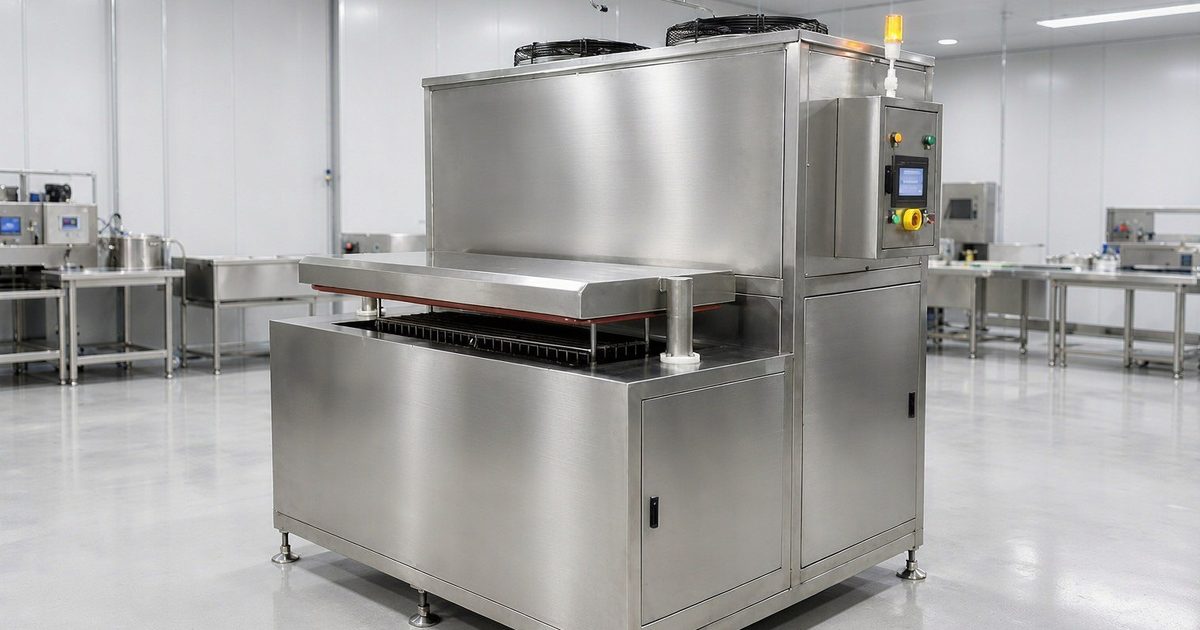
Image requirements: photos of the immersion chiller tank and basket loading, photos of the medium circulation piping and refrigeration unit, and an example of the core temperature record table during cooling.
FAQ
Why must cooked food be held to two hours from 60℃ down to 10℃ after leaving the pot?
Article 6.6 of GB 31654-2021 requires perishable food to be cooled promptly, and measures such as cold water baths or dedicated rapid cooling equipment may be used. The Centre for Food Safety of Hong Kong recommendation is more detailed: if pre-cooked food is to be stored frozen, it should be cooled from 60℃ to 20℃ within two hours, and from 20℃ to 4℃ within the following four hours.
For the same batch of cooked food, why do an immersion chiller and an air-cooled cabinet cool at different speeds?
The difference lies in the heat exchange path. Air-cooled cabinets use a fan to send cold air into the cabinet to blow over the material surface, and heat is carried away by convection and conduction; immersion cooling brings the material into direct contact with a liquid medium, and the convective heat transfer intensity of liquid is higher than that of air. The cost is that the material must be able to be bare or use packaging permitted to contact the medium, and the medium must be food-grade, odorless, and washable and reusable.
Are rapid cooling and quick freezing the same thing?
No. Rapid cooling lowers the material to the refrigerated range of 0℃ to 4℃, without crossing the ice crystal formation zone; quick freezing requires the core temperature to reach below -18℃. The target temperatures, equipment structures, and energy consumption compositions of the two are different. If the raw material needs refrigeration but is selected with quick freezing equipment, it will later be constrained by capacity and process.