
How to Determine the Freezing Cycle of a Liquid Nitrogen Quick-Freezing Tunnel: Coordination of Mesh Belt Speed, Load Capacity, and Feed Temperature
The technical data for the DKN-LFT-1612 lists approximately 1000 kg/h, and the DKN-LFT-1212 lists 1 m³/h. Both figures are followed by a note: capacity varies with product and packaging method. A tunnel is a continuous production line, and capacity is derived from the cycle time. A technical parameter table cannot provide a fixed number that can be directly used for production scheduling. This article breaks down the cycle time: how the freezing cycle is converted to mesh belt speed, how load density converts speed to output, and at which step feed temperature rewrites the cycle.
Problem
Nominal capacity comes with preconditions
The capacity figures in the documentation are based on the premise of product type, individual thickness, packaging method, and feed temperature. The same tunnel running 30 mm thick tray-packed prepared foods versus whole cut poultry parts will differ in output per unit time by several times. Taking the nominal value directly for production scheduling typically results in discovering insufficient capacity within the first month of operation.
Three common misjudgments
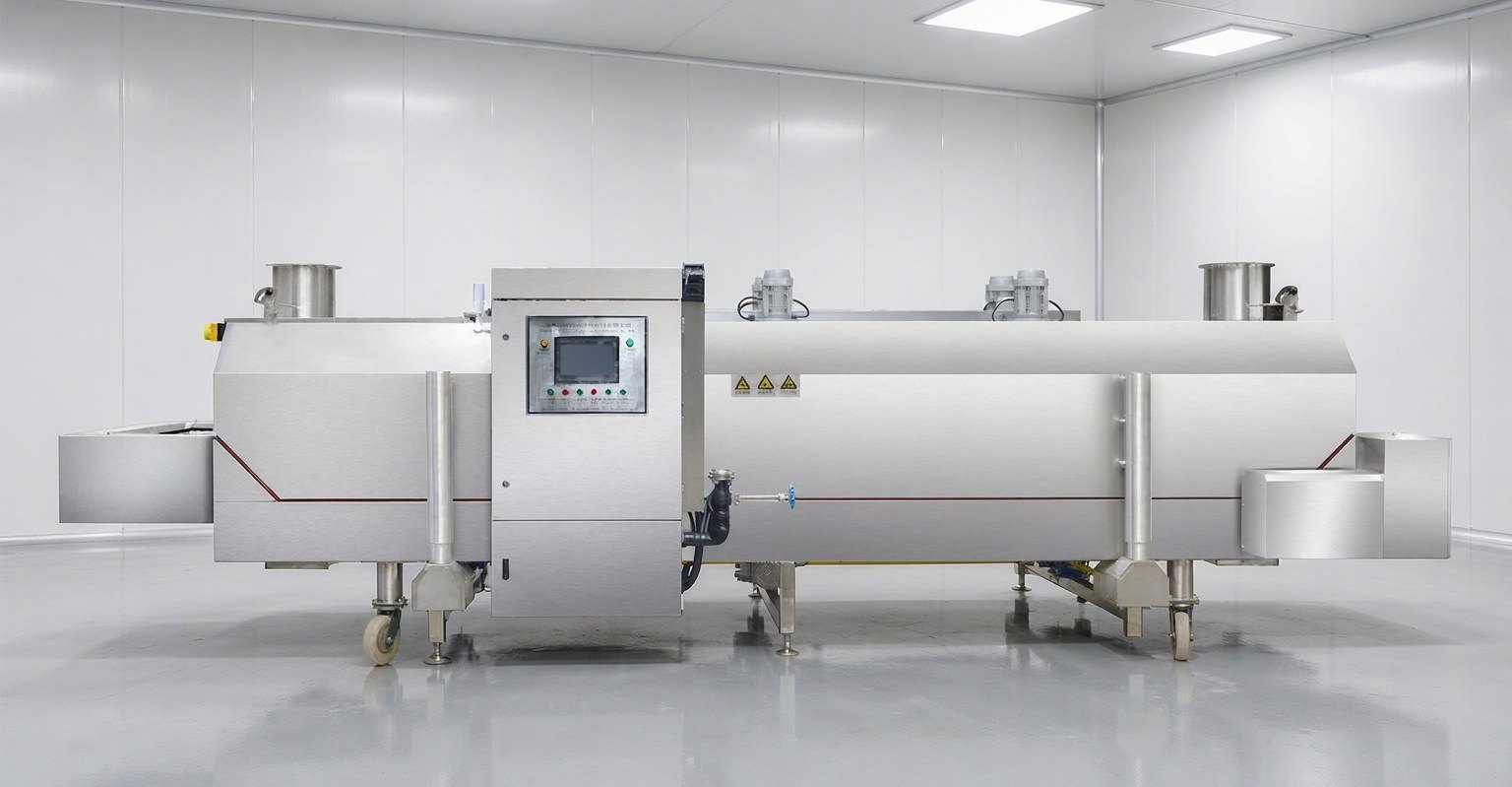
One is treating tunnel length as capacity. Length only indicates the travel distance of the mesh belt within the equipment. Actual output also depends on belt speed and how much material is loaded on the belt surface. Both the DKN-LFT-1212 and DKN-LFT-1612 are 12 meters long, with a belt width difference of 400 mm, and the load per unit length is not the same.
Another is speeding up the mesh belt to increase output. Mesh belt speed determines how long the product stays in the tunnel. When speed is increased, the freezing cycle is compressed. Thin products can still hold up, but thick items and packaged products may exit before the core temperature reaches -18℃, then go into cold storage for supplementary freezing. Ice crystals have already grown coarse, and the time saved earlier must be paid back in quality.
The third is looking only at output without considering cycle time. The tunnel is connected after the cooking, portioning, or packaging line, and its cycle time must match the upstream and downstream processes. Otherwise, material piles up at one end while the other end waits.
Principles and Key Parameters
Public definition of quick-freezing
According to a public response from the Shenzhen Municipal Market Supervisory Authority, quick-freezing is the process of placing pre-treated food in equipment at -30℃~-40℃, passing through the ice crystal formation zone within 30 minutes, with the food core temperature reaching below -18℃ (Source: Shenzhen Municipal Government Portal, 2024-11-20 response, https://www.sz.gov.cn/hdjlpt/detail?pid=3036296 ). This 30 minutes is the process baseline. The actual residence time in the tunnel must be increased with margin based on product thickness and feed temperature.
Converting freezing cycle to mesh belt speed
The cycle from feed end to discharge end for the DKN-LFT series is variable-frequency adjustable. Mesh belt speed equals mesh belt length divided by cycle time.
| Model | Mesh belt dimensions (L×W) | Freezing cycle (feed end to discharge end) | Converted mesh belt speed |
|---|---|---|---|
| DKN-LFT-1206 | 6000×1200 mm | 6~30 minutes adjustable | 0.2~1.0 m/min |
| DKN-LFT-1212 | 12000×1200 mm | 5~25 minutes adjustable | 0.48~2.4 m/min |
| DKN-LFT-1612 | 12000×1600 mm | 8~40 minutes adjustable (customizable on request) | 0.3~1.5 m/min |
The belt speeds in the table are converted from mesh belt length and cycle time, used for comparing cycle times. Actual settings are based on measured core temperature results of the product. The series also includes a DKN-LFT-0908, with a mesh belt of 8000×900 mm, external dimensions of 8000×1750×1670 mm, and total power of approximately 15 kW, suitable for sites with limited space and lower single-line output.
Load density converts speed to output
Once belt speed is set, output still requires one more variable: how much material is loaded per meter of belt surface. Trays laid flat, baskets stacked, and loose items spread in a single layer—these three loading methods differ in output by several times at the same belt speed. Conversely, once the output target is set, the loading method defines the belt speed range, which in turn defines the required tunnel length. Model dimensions and configurations can be directly referenced on the liquid nitrogen quick-freezing tunnel product page.
The DKN-LFT-1212 has a set of field parameters for reference: the frozen product is tray-packed extract liquid, tray 300×30×30 mm, feed temperature 50℃, required core temperature to -50℃, 6 cubic meters completed within 6 hours, converted to approximately 1 m³/h, actual quick-freezing time approximately 30 minutes, using a 12-meter tunnel. For this type of material, the feed temperature is near room temperature and the target temperature is lower than conventional frozen products, so the cycle falls in the longer range.
Other variables affecting the cycle
- Temperature control accuracy ±2℃, operating temperature -150℃~room temperature, no-load cooldown of 10℃ per minute, adjustable on site.
- The DKN-LFT-1206 refrigeration system is equipped with low-temperature long-shaft motors and nylon axial flow fans, air volume 6000 m³/h, air pressure 65 Pa, with airflow direction and guidance arranged by zone.
- Liquid nitrogen nozzles are located above and below the mesh belt, can be fully opened or individually opened, with adjustable upper and lower spray angles. The freezing difference between the upper and lower surfaces of the product is leveled by this layer.
- The cabinet insulation layer is 150 mm thick, and the mesh belt is equipped with a variable-frequency speed control motor.
Selection and Configuration Points
Define three variables first, then discuss length
The order should be correct: first look at the freezing time (minutes) given by the product process, then look at individual thickness and loading method (load per meter), and arrive at the output target (kg/h or m³/h). Once these three variables are defined, the selectable tunnel length and belt speed range converge. Defining length first and then fitting the product means the cycle does not match, and speed adjustment is the only recourse.
Leave margin in the belt speed range
The adjustable cycle range is not infinite. The DKN-LFT-1206’s 6~30 minutes, the DKN-LFT-1212’s 5~25 minutes, and the DKN-LFT-1612’s 8~40 minutes are all process setting ranges. During selection, place the product’s cycle requirement in the middle of the range, so that upstream process fluctuations or temporary product specification changes do not push it to the boundary.
Cold air and safety at both ends of feed and discharge
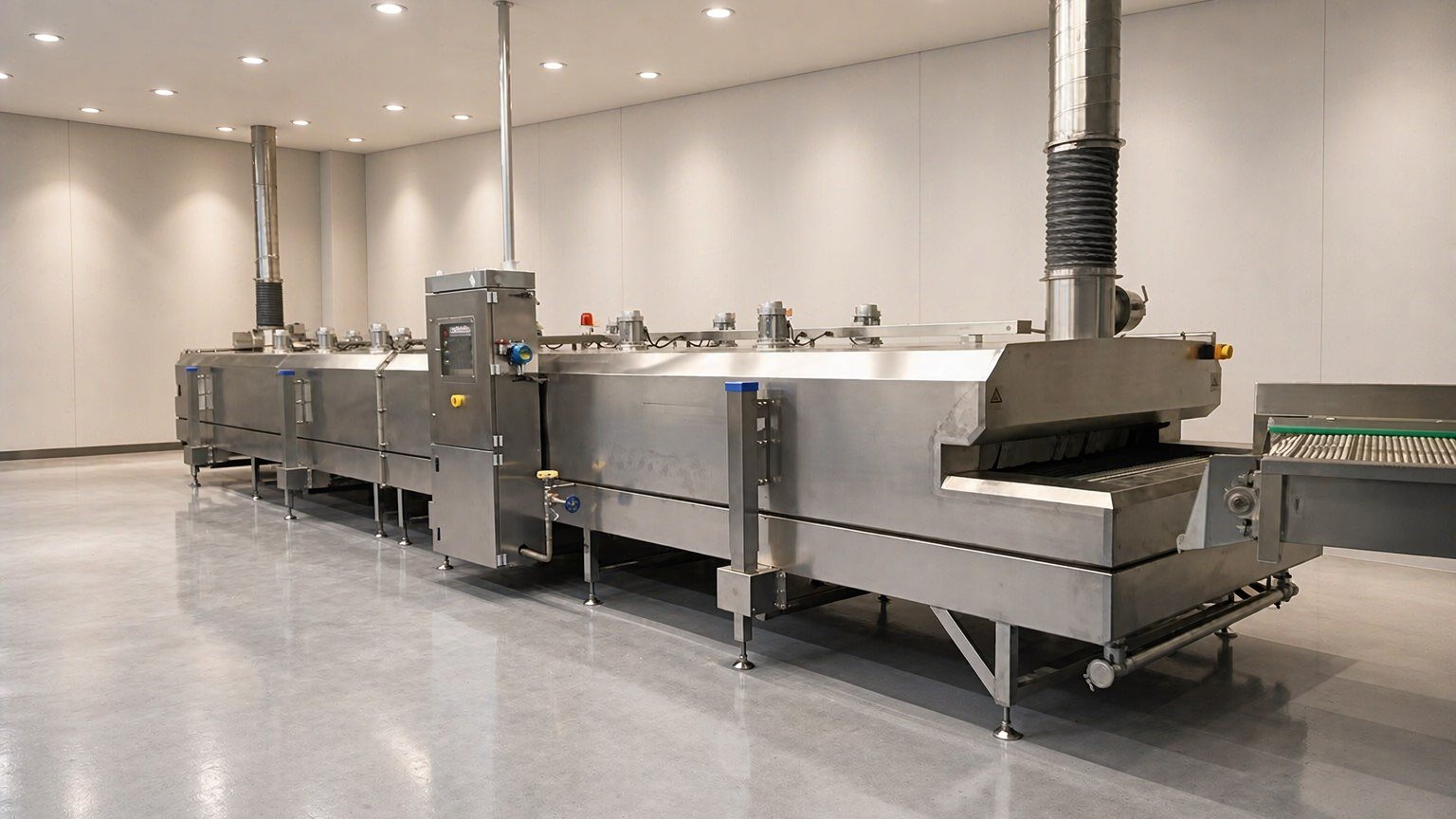
The tunnel feed and discharge openings are where cold air escapes. Both ends are equipped with exhaust gas extraction ports connected to high-flow exhaust fans. The equipment includes a fresh air exhaust system to reduce liquid nitrogen waste and workshop low temperatures. Liquid nitrogen supply pressure is selected by model: DKN-LFT-1206, 1212, and 0908 are 5~8 BAR, DKN-LFT-1612 is 0.5~0.8 MPa. Storage tanks and delivery piping are provided by the user.
On the safety side, oxygen content measuring instruments are installed at the front and rear ends of the equipment, with oxygen concentration setpoint at 19.5%~21.5%. The oxygen concentration alarm is interlocked with the liquid nitrogen valve. When concentration falls below the setpoint, the supply is cut off, exhaust is started, and audible and visual alarms are activated. Emergency stop switches are provided at the discharge end, electrical cabinet, and receiving end. The exhaust fan is interlocked with the equipment; the equipment does not run if the exhaust fan is not started.
Cleaning and maintenance
The tunnel features an overall lifting design with a lifting stroke of 550 mm and an inner cavity of 750 mm. The mesh belt and machine inner cavity can be fully exposed for cleaning. The bottom of the machine body has a shallow V-shaped drainage outlet for centralized discharge of cleaning wastewater. The liquid nitrogen control valve has quick-connect interfaces, and wear parts can be replaced individually.
Application Scenarios
Prepared food and prefabricated dish production lines: the tunnel is connected after portioning, with cycle time aligned to upstream processes. Thin products can complete freezing within minutes from feed end to discharge end. For aquatic products such as shrimp and fish fillets requiring individual quick freezing, single-layer spreading on the belt surface and zoned nozzle control reduce sticking. Poultry cut products requiring core temperature below -18℃ have longer cycles, so long tunnels with wide mesh belts are selected. For tray-packed frozen products such as extract liquids and paste materials, where feed temperature is near room temperature and target temperature is lower than conventional frozen products, configure the cycle according to the working conditions of the DKN-LFT-1212 field parameters.
The division of labor between tunnels and quick-freezing cabinets can be directly compared: continuous production, stable categories, and high output requirements go to tunnels; multiple categories in small batches with frequent product changes go to cabinets. Both use the same liquid nitrogen quick-freezing principle, with differences in feed/discharge method and cycle time organization. This layer can be seen in Differences between liquid nitrogen quick-freezing and mechanical quick-freezing, and the trade-off between production line space and capacity can be referenced in Capacity and space of liquid nitrogen quick-freezing tunnels for seafood.
Frequently Asked Questions
Is the tunnel’s nominal capacity a fixed number?
The documentation provides reference values with product and packaging preconditions. The DKN-LFT-1612 lists approximately 1000 kg/h, and the DKN-LFT-1212 lists 1 m³/h, both based on this premise. Actual capacity requires weighing and timing with your own product.
Can increasing mesh belt speed increase output?
When speed increases, the residence time of the product in the tunnel shortens. Thin products still have room, but thick items and packaged products may not reach a core temperature of -18℃. Whether speed can be increased depends on the core temperature of the product at discharge, not the belt speed reading.
What range can the freezing cycle be adjusted to for a product?
The DKN-LFT-1206 is 6~30 minutes, the DKN-LFT-1212 is 5~25 minutes, and the DKN-LFT-1612 is 8~40 minutes and customizable on request. These are the upper and lower limits of variable-frequency adjustment. The specific cycle for a particular product is determined by actual measurement.
Who provides the liquid nitrogen storage tank and exhaust ducting?
The liquid nitrogen storage tank, liquid nitrogen delivery piping, and exhaust ducting after extraction are provided by the user. The equipment side provides exhaust gas extraction ports at the feed and discharge ends, a fresh air exhaust system, and exhaust fan interfaces. Supply pressure is set by model.
How to choose between a tunnel and a quick-freezing cabinet?
For continuous production, stable categories, and high output requirements, use a tunnel; for multiple categories in small batches with frequent product changes, use a quick-freezing cabinet. Both types use the same liquid nitrogen system principle, with differences in feed/discharge cycle time and floor space.
Before determining the model, organize the four figures—freezing time, individual thickness, loading method, and output target—and contact Kunning Cryo’s technical engineers for matching: https://www.kunningcryo.com/en/contact/