
Food Blast Chillers DKN-RHC-60D-45 and DKN-RHC-60D-80: Parameters and Configurations of Two Models
Equipment Overview
Food blast chillers use forced cold-air circulation: the evaporator brings the cabinet down to a low temperature, and fans drive cold air to circulate inside the cabinet and blow directly across the food surface, with heat removed by convection and conduction. The cabinet interior is at normal pressure, and there are no components such as vacuum pumps or vacuum chambers in the cabinet. The equipment is a dual-cabinet trolley-type structure, with the two cabinets opening independently; after cooked food comes out of the pot, it can be pushed into the cabinet together with the trolley for cooling, without waiting for the material to cool naturally in the open.
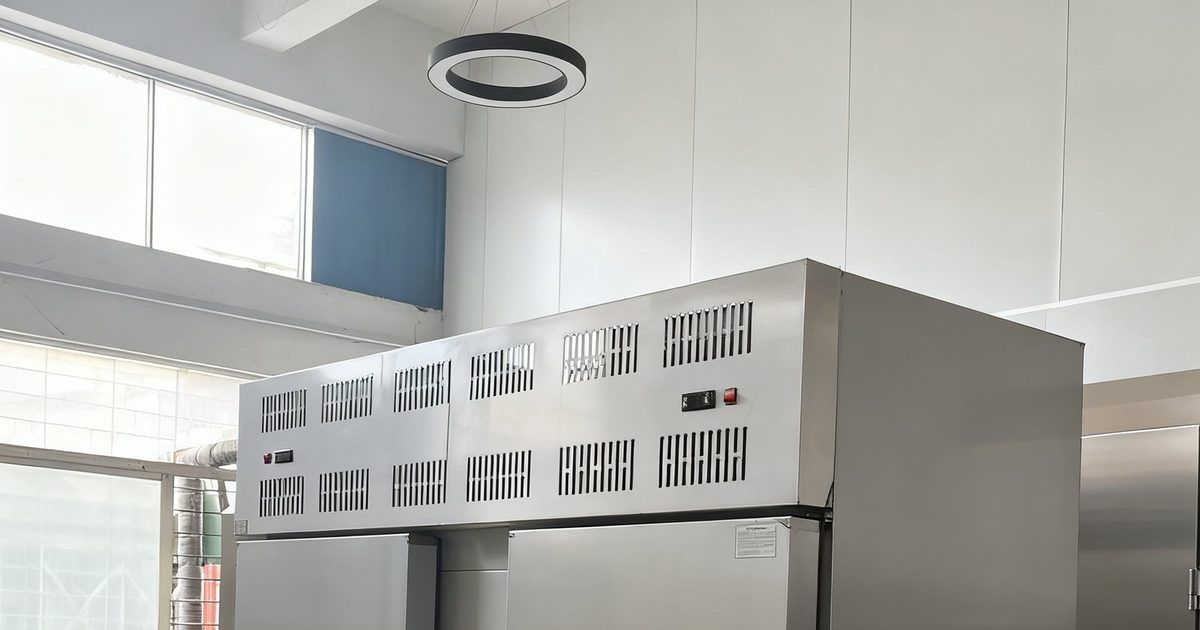
According to Kunning Cryo equipment numbering rules, the model of the blast chiller product line consists of two parts: the main parameters and the suffix. The main parameters are the total number of trays and the number of cabinets, the letter at the end distinguishes single-cabinet from dual-cabinet, and the minimum temperature inside the cabinet serves as the suffix. The two models in this article have the same structure, and differ in refrigeration configuration and the minimum temperature achievable inside the cabinet.
Requirements on the industry side are tightening. In the expert interpretation of the “Shandong Province Review Plan for Production Licenses of Refrigerated Prepared Conditioning Foods” by the Shandong Provincial Administration for Market Regulation, it is stated: for products with a thermal processing step, rapid cooling should be carried out after thermal processing, and rapid cooling equipment should be provided, with the purpose of avoiding massive proliferation of microorganisms at suitable temperatures. This interpretation was published on December 10, 2025.
The time scale of the cooling stage also has quantitative criteria. An article on process control of braised meat published on Meat360 on September 1, 2026 lists the execution standard: after cooking and coming out of the pot, the core temperature should drop below 25℃ within 2 hours and below 10℃ within 4 hours; natural standing cooling is listed as a practice that should not be adopted. Equipment selection must land on these time points before the process can be arranged according to the specifications.
Models and Parameters
The models and main parameters of the two models are compared in the table below. According to Kunning Cryo equipment numbering rules, the number in the last segment of the model is the minimum temperature inside the cabinet.
| Item | DKN-RHC-60D-45 | DKN-RHC-60D-80 |
|---|---|---|
| Equipment form | Dual-cabinet, two cabinets opening independently | Dual-cabinet, two cabinets opening independently |
| Minimum temperature inside cabinet | -45℃ | -80℃ |
| Evaporating temperature | -40℃ | Not marked in technical data |
| Cooling method | Forced cold-air circulation (evaporator + fan air supply) | Forced cold-air circulation |
| Overall external dimensions | 1900 × 940 × 2150 mm | 1900 × 940 × 2150 mm |
| Single cabinet internal dimensions | 580 × 720 × 1430 mm | 580 × 720 × 1430 mm |
| Single cabinet volume | 0.597 m³ | 0.597 m³ |
| Total volume of two cabinets | 1.194 m³ | 1.194 m³ |
| Rack dimensions | 460 × 600 × 1370 mm | 460 × 600 × 1370 mm |
| Trolley dimensions | 2000 × 1040 × 2250 mm | 2000 × 1040 × 2250 mm |
| Compressor | France Tecumseh | France Tecumseh |
| Compressor power | 4.55 kW | 9.05 kW |
| Total power | Approx. 4.55 kW | Approx. 9.05 kW |
| Condensation method | Air-cooled | Air-cooled |
| Cabinet interior material | 304 stainless steel | 304 stainless steel |
| Power supply | 220V / 380V optional | 380V |
| Gross weight | 450 kg | 500 kg |
Loading and cooling parameters:
| Item | Single cabinet | Total of two cabinets |
|---|---|---|
| Number of standard trays | 30 pcs | 60 pcs |
| Load per tray | 3~5 kg | — |
| Processing capacity | Approx. 100 kg | Approx. 200 kg |
| Single-batch cooling time | 1~2 hours (depending on food type and inlet temperature) | — |
| Inlet temperature | 60~90℃ | — |
| Outlet temperature | 3~10℃ (adjustable) | — |
The parameters in the table above come from Kunning Cryo food blast chiller technical data and the official website food blast chiller product page. Several notes:
- The number of trays and the load per tray determine the single-batch input. For a single cabinet at 30 trays and 3~5 kg per tray, a single batch is about 100 kg, and a dual cabinet about 200 kg; if the material shape and placement method change, the actual input must be recalculated.
- The single-batch cooling time of 1~2 hours is the range recorded in the technical data. With a high inlet temperature, large single-piece thickness, and densely arranged trays, the time will go up; test with your own material before production.
- For the model with a cabinet temperature of -80℃, the evaporating temperature and cooling capacity are not recorded in the technical data; this article does not write speculative values, and they are confirmed per order.
- The two models have the same external and internal cabinet dimensions, and differ in compressor and power supply: the 4.55 kW model can be 220V / 380V optional, and the 9.05 kW model is configured at 380V.
Overall configuration notes: the brand and place of origin of the evaporator, condenser, insulation layer and control system are not recorded item by item in the original technical data; this table does not fill in speculative values, and the factory nameplate prevails.
Main Configurations
Insulated cabinet
- Inner and outer panels are stainless steel, and the cabinet interior is 304 stainless steel
- The insulation layer is PU polyurethane integral foaming
- Dual-cabinet structure, the two cabinets open independently, and a single cabinet can be opened and used separately
- Cabinet door seals are checked periodically according to operating conditions; a poor door seal directly affects the cooling speed inside the cabinet
Refrigeration and condensation system
- The compressor is France Tecumseh; the model with a cabinet temperature of -45℃ is equipped with a 4.55 kW compressor, and the -80℃ model with 9.05 kW
- The evaporator is finned-tube type, with forced circulation fans for air supply
- The condensation method is air-cooled (with its own fan); when on-site conditions require it, a water-cooled configuration can be changed to, confirmed per order
Air supply and control system
- The evaporator fan drives the cold-air circulation inside the cabinet, and the air duct guide plates distribute the air supply
- The temperature controller or PLC with touch screen runs according to the set outlet target temperature, and the outlet temperature is adjustable within the range of 3~10℃
Defrosting and loading utensils
- The defrosting method is electric heating or hot gas defrosting, and the defrosting cycle is set according to operating conditions
- Rack 460 × 600 × 1370 mm, 30 standard trays per cabinet
- Matching trolley 2000 × 1040 × 2250 mm, and the material enters and exits the cabinet as a whole together with the trolley
Application Scenarios
The usage differs considerably across stages; first look at the food type and inlet temperature:
| Industry | Typical foods | Inlet temperature | Target temperature |
|---|---|---|---|
| Cooked food processing | Braised products, roast meats, braised meats | 85~95℃ | 10~25℃ |
| Bakery foods | Bread, cake, mooncakes | 80~90℃ | 20~25℃ |
| Meat processing | Ham, sausage, meatballs | 75~85℃ | 10~15℃ |
| Central kitchen | Prepared dishes, catering meals | 80~90℃ | 10~20℃ |
| Fast food chains | Rice, side dishes | 80~90℃ | 15~25℃ |
Looking at the usage of the equipment by stage:
- Meal preparation stage of central kitchens and chain catering: centralized cooking and batch cooling before store peak hours; the dual cabinets can be used in a staggered manner, with one cabinet cooling and one cabinet loading, which fits the production rhythm better than a single cabinet.
- Cooked food and braised meat workshops: after coming out of the pot, the food enters the cabinet together with the trolley, replacing natural standing cooling. The cabinet belongs to the cooked clean area and is cleaned per shift; do not share it with the raw material area.
- Bakery and pastries: bread and mooncakes need to quickly pass through the cooling stage before packaging, and the target temperature is higher than that of cooked food; setting 20~25℃ is sufficient, and it is not necessary to use the minimum cabinet temperature.
- Catering meals and group meals: intermittent production of around 200 kg per batch, using dual cabinets in batch rotation. For single batches of several hundred kilograms or more, or for continuous production with packaging, see liquid nitrogen blast freezer cabinet and liquid nitrogen blast freezing tunnel.
- Scenarios where materials need to be cooled by contact with a liquid medium: the blast chiller is normal-pressure forced air cooling, and heat exchange relies on air; if the material can be bare-packed, or can use packaging permitted to contact the cooling medium, you can also look at the immersion cooler.
Usage conditions:
- Leave passage space around the equipment for trolley entry and exit and for cabinet door opening, and leave ventilation and heat dissipation distance around the air-cooled condenser.
- The two power supply forms of 220V and 380V are selected according to the site, and the power cord specification is configured according to the overall power.
- After cooling is completed, the material should be transferred to the 0~4℃ refrigeration stage as soon as possible; do not leave it in the workshop waiting.
- The core temperature is measured by inserting a probe thermometer into the center of the material; an infrared temperature gun reads the surface temperature and cannot replace it.
To check the cabinet type according to your product and batch weight, state the single-batch input, single-piece weight and thickness, inlet temperature, target temperature and site dimensions, and we will configure the number of trays and cabinet type according to the actual production rhythm: Contact us
Web sources:
- Shandong Provincial Administration for Market Regulation, “Expert Interpretation: Shandong Province Review Plan for Production Licenses of Refrigerated Prepared Conditioning Foods” (December 10, 2025): http://amr.shandong.gov.cn/art/2025/12/10/art_76527_10315480.html
- Meat360, “Core Causes of Excessive Microorganisms in Braised Meat” (September 1, 2026): https://www.meat360.cn/all/detail/892546.html
Image requirements: photos of the front of the food blast chiller and the two cabinets open, photos of the cabinet racks and trolley in the loaded state, and photos of the control panel temperature setting interface.
FAQ
What is the difference in cabinet temperature between DKN-RHC-60D-45 and DKN-RHC-60D-80?
According to Kunning Cryo equipment numbering rules, the number in the last segment of the model is the achievable temperature inside the cabinet: DKN-RHC-60D-45 is -45℃, and DKN-RHC-60D-80 is -80℃. The two models have the same external dimensions and single cabinet internal dimensions, and differ in refrigeration configuration and the achievable temperature inside the cabinet.
How much material can one blast chiller hold per batch, and how long does cooling take?
A single cabinet is equipped with 30 standard trays, with 3~5 kg loaded per tray, and the single-batch processing capacity is about 100 kg; the dual cabinet totals 60 trays, about 200 kg. The single-batch cooling time is 1~2 hours, depending on the food type and inlet temperature; with a high inlet temperature, large single-piece thickness, and densely arranged trays, the time will go up.
Cooked food enters the cabinet at 60~90℃; what should the outlet temperature be set to?
The inlet temperature range is 60~90℃, and the outlet temperature is adjustable within the range of 3~10℃; the equipment runs according to the set outlet target temperature. Cooked foods such as braised products, roast meats and braised meats commonly use 10~25℃, and bread and mooncakes can be set at 20~25℃. After cooling is completed, the material should be transferred to the 0~4℃ refrigeration stage as soon as possible.