
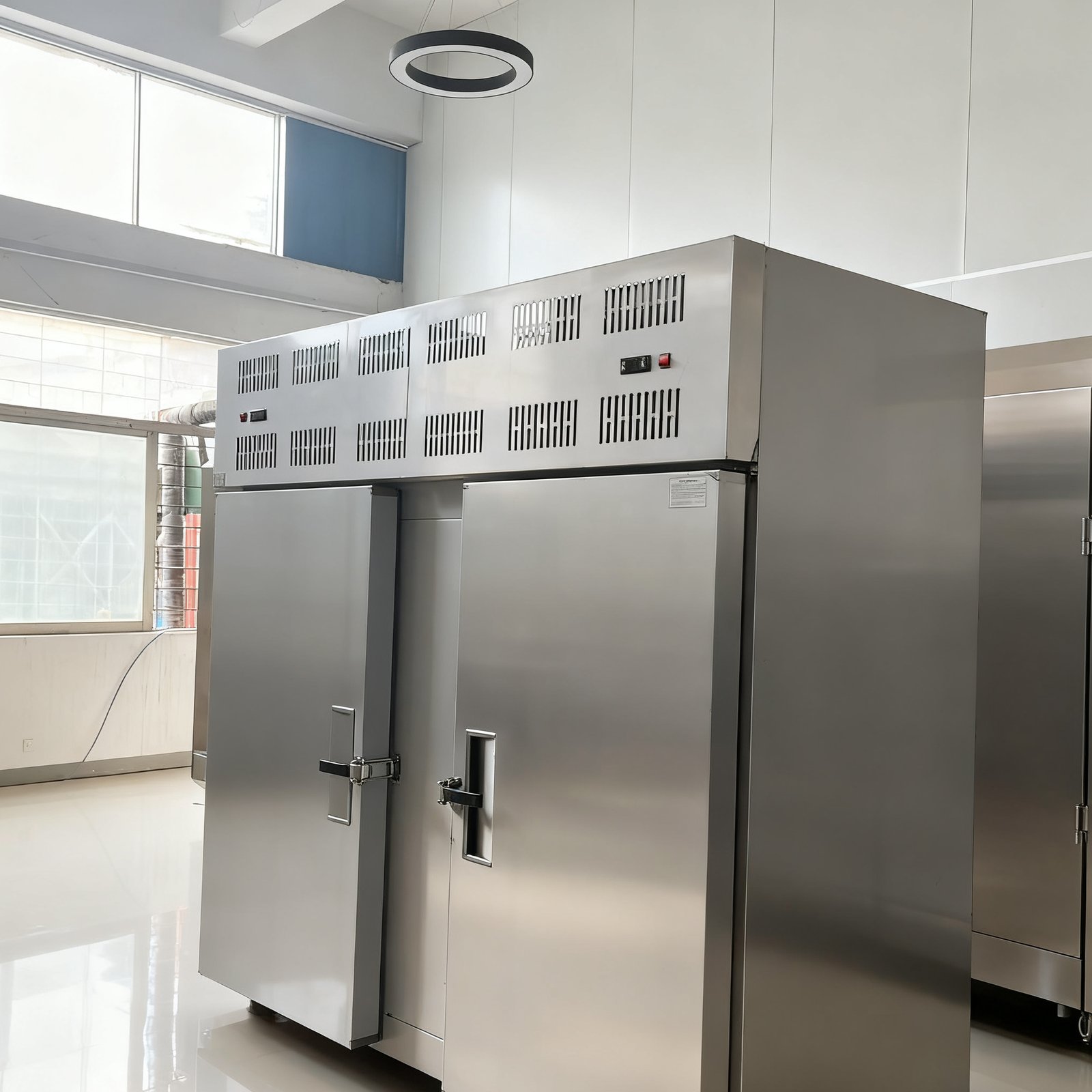
Why the Cooling Speed of a Food Blast Chiller Varies from Batch to Batch: Airflow Path, Tray Load Thickness and Evaporator Frosting
A central kitchen installs a blast chiller, and during acceptance testing a single batch of 200 kg is measured, with the time falling within the 1 to 2 hour range stated in the technical documentation. One month into production, with the same product and the same quantity, operators begin reporting that it now takes two and a half hours.
The equipment is not broken, and no parameters have been touched. What has changed is how the contents are arranged inside the cabinet, and how much frost has accumulated on the evaporator.
Forced cold-air cooling sounds simple: the evaporator brings the air down to a low temperature, and fans blow the cold air across the food surface to carry away heat. What really determines how long a batch takes to cool is how much time the heat spends traversing each segment of this path. This article goes through the path segment by segment.
The Problem
Single-batch cooling time is not a fixed value
The single-batch cooling time of 1–2 hours in the technical documentation comes with conditions attached: loading temperature, food type, loading method. The equipment nameplate gives the refrigeration capacity and the temperature achievable inside the cabinet, which does not equal “no matter what is loaded, it can be brought to target within one hour.”
Cooked food with a loading temperature of 60–90℃ and bakery semi-finished products loaded at 40℃ differ by orders of magnitude in heat content; braised beef and braised dried tofu of the same kilogram weight differ by a factor of two in individual piece thickness, and the time for the core to reach the same temperature also differs considerably. So with the same cabinet, a change in time when the batch changes is normal; to judge whether the equipment has a problem, you need to look at whether the time is also getting longer for the same batch and the same arrangement.
Two common misjudgments
One misjudgment is treating the cabinet temperature as the food core temperature. Cabinet temperature refers to the temperature of the circulating air, which drops quickly, while the food core temperature drops slowly. The discharge decision must be based on core temperature, measured by inserting a probe thermometer into the center of the product; an infrared thermometer reads surface temperature, and the surface temperature of product just taken out of the cabinet is lower than the core temperature, so using it to judge discharge will lead to early removal.
Another misjudgment is loading it full first and asking questions later. A single cabinet holds 30 trays at 3–5 kg per tray; this is the loading capacity figure, not the cooling capacity figure. If trays are placed flush against each other, product is piled above the tray rim, or material is stacked in front of the return air inlet, the cold air will bypass them, the tray surfaces will not receive airflow velocity, the cooling time for the whole batch will rise, and yet the equipment load is clearly not maxed out. Adding refrigeration capacity cannot solve this situation; what needs to change is the arrangement.
Principles and Key Parameters
In forced cold-air cooling, heat must travel through three segments:
- Inside the food: heat conducts from the core to the surface. The time scale of one-dimensional unsteady heat conduction is proportional to the square of the thickness; double the thickness, and the core takes roughly four times as long to reach the same temperature. This segment cannot be changed by the equipment, only by the process—cut into smaller pieces, spread into shallow trays, do not stack.
- Food surface: cold air exchanges heat with the food surface, and the heat exchange effectiveness follows the airflow velocity. Fans deliver the low-temperature air from the evaporator side to the tray surfaces, distributed in between by duct guide vanes. This segment is what on-site arrangement can influence.
- Evaporator: the air carries heat back to the fins and transfers it to the refrigerant. Only when the fin surfaces are clean and the airflow volume is sufficient can the cooling capacity be delivered.
The equipment-side parameters of Kunning Cryo food blast chillers are as follows, taken from the product technical documentation and the official website food blast chiller product page:
| Item | DKN-RHC-60D-45 | DKN-RHC-60D-80 |
|---|---|---|
| Equipment form | Dual-cabinet, two cabinets with independent doors | Dual-cabinet, two cabinets with independent doors |
| Achievable inside cabinet | -45℃ | -80℃ |
| Evaporating temperature | -40℃ | Not stated in technical documentation |
| Cooling method | Forced cold-air circulation (evaporator + fan air supply) | Forced cold-air circulation |
| Compressor | France Tecumseh | France Tecumseh |
| Compressor power | 4.55 kW | 9.05 kW |
| Total power | Approx. 4.55 kW | Approx. 9.05 kW |
| Condensing method | Air-cooled | Air-cooled |
| Overall external dimensions | 1900 × 940 × 2150 mm | 1900 × 940 × 2150 mm |
| Single cabinet internal dimensions | 580 × 720 × 1430 mm | 580 × 720 × 1430 mm |
| Rack dimensions | 460 × 600 × 1370 mm | 460 × 600 × 1370 mm |
| Single cabinet volume | 0.597 m³ | 0.597 m³ |
| Total volume of two cabinets | 1.194 m³ | 1.194 m³ |
| Standard tray quantity | 30 per cabinet, 60 for dual cabinet | 30 per cabinet, 60 for dual cabinet |
| Load per tray | 3–5 kg | 3–5 kg |
| Single-batch processing capacity | Approx. 100 kg per cabinet, approx. 200 kg for dual cabinet | Same as left |
| Single-batch cooling time | 1–2 hours (depending on food type and loading temperature) | Same as left |
| Loading temperature | 60–90℃ | 60–90℃ |
| Discharge temperature | 3–10℃ (adjustable) | 3–10℃ (adjustable) |
| Defrost method | Electric heating / hot gas defrost | Electric heating / hot gas defrost |
| Power supply | 220V / 380V optional | 380V |
| Gross weight | 450 kg | 500 kg |
The frosting segment: why cooling gets slower and slower
At an evaporating temperature of -40℃, the fin surface temperature is far below the freezing point of water. When cooked food with a loading temperature of 60–90℃ first enters the cabinet, moisture evaporates quickly, the moisture content of the air inside the cabinet is high, and water vapor desublimates directly into frost on the fins.
The frost layer has two effects, both in the same direction:
- Frost is a poor conductor of heat. Coating the fins is equivalent to adding a layer of thermal resistance between the air and the refrigerant; the heat exchange temperature difference is unchanged, but the cooling capacity that can be delivered into the cabinet decreases.
- As frost thickens, it narrows the fin spacing, the passage for air through the evaporator becomes narrower, and the airflow volume decreases. A decrease in airflow volume affects both ends at once—the airflow velocity delivered to the tray surfaces is lower, and surface heat exchange weakens accordingly; the heat carried back to the evaporator is also reduced.
These two effects combine to show a cooling curve that flattens out more and more: the first half of the batch cools quickly, the second half slows down, and the overall batch time is stretched out.
Therefore the defrost cycle is an operating parameter, not a maintenance item. The equipment runs on electric heating or hot gas defrost, with the cycle set according to on-site conditions; at sites with high heat loads, frequent door openings, and materials with high moisture vapor, frost grows faster and the defrost interval should be shortened accordingly.
Opening the cabinet door steps on both points at once: cooling capacity is lost directly, and once humid workshop air enters, frost grows faster. The more frequently batches are changed on manual-door models, the more times the cabinet temperature rises again.
Selection and Configuration Points
Determine cabinet type and number of cabinets by individual piece thickness and single-batch loading quantity, not by loading to the tray-count limit. A single cabinet of 30 trays at 3–5 kg per tray corresponds to a single-batch processing capacity of about 100 kg, and about 200 kg for a dual cabinet. If the quantity to be cooled exceeds this range, or the required time is shorter than 1–2 hours, adding trays cannot solve it; that falls under a different category of equipment (see the application scenarios below).
Leave duct spacing between trays. Trays should not be placed flush against each other, should not be higher than the tray rim, and space should be left in front of the return air inlet. Once air bypasses, the tray surfaces will not receive airflow velocity, and no amount of refrigeration capacity will help.
Drain moisture-heavy materials first, and cover or film them inside the cabinet. Reducing the amount of moisture vapor entering the cabinet slows frost growth, allowing the defrost interval to be extended. This is especially noticeable for braised items and prepared dishes with sauce.
Judge discharge by core temperature. Insert a probe thermometer into the center of the product to measure, record temperature and time, and build your plant’s own cooling curve. Only with a curve can you determine whether it is an arrangement problem or an equipment problem.
The heat rejected by the air-cooled condenser needs somewhere to go. If the heat dissipated by the condenser stays in the cooling room, it is equivalent to adding another heat load to the cooling room. This is especially important at sites where the blast chiller is placed in a small room: connect the exhaust to the outdoors, or change to a water-cooled configuration according to on-site conditions (confirmed per order). Leave ventilation and heat dissipation clearance around the condenser according to installation requirements.
Include the door gasket in routine inspections. If the door seal is not tight, humid air from outside the cabinet continuously leaks in, which both increases cooling capacity loss and makes the evaporator frost faster. This item requires no instruments; just take a look during each cleaning.
Transfer materials to the 0–4℃ cold storage stage as soon as cooling is complete. Completion of cooling does not mean it can sit in the workshop; the time for process handover also counts in food safety management.
Application Scenarios
By industry, the loading temperature and common target temperature differ for various materials:
| Industry | Typical foods | Loading temperature | Target temperature |
|---|---|---|---|
| Cooked food processing | Braised products, roasted meats, soy-braised meats | 85–95℃ | 10–25℃ |
| Bakery products | Bread, cake, mooncakes | 80–90℃ | 20–25℃ |
| Meat processing | Ham, sausage, meatballs | 75–85℃ | 10–15℃ |
| Central kitchen | Prepared dishes, plated meals | 80–90℃ | 10–20℃ |
| Fast-food chains | Rice, side dishes | 80–90℃ | 15–25℃ |
By process stage, the usage is:
- Meal preparation stage in central kitchens and chain restaurants: centralized cooking before peak hours, cooled in batches. The advantage of a dual cabinet is that the two cabinets can be used alternately, one cooling while the other is being loaded, which fits the production rhythm better than a single cabinet and also reduces the number of door openings per cabinet.
- Deli and soy-braised workshops: after coming out of the pot, the carts go straight into the cabinet, replacing natural spread cooling. Materials in the cooling stage have high moisture vapor, and the defrost cycle should be set for this condition. The cabinet body belongs to the cooked clean area, cleaned per shift, and not shared with the raw material area.
- Bakery and pastry: bread, mooncakes and similar products need to quickly pass through the cooling stage before packaging; the target temperature is higher than for cooked food, and a setting of 20–25℃ is sufficient—there is no need to use the lowest temperature the cabinet can reach, nor is there any need to.
- Plated meals and group catering: intermittent production of around 200 kg per batch, using a dual cabinet rotating by batch. For single batches of several hundred kilograms or more, or for continuous production with packaged goods, see liquid nitrogen blast freezer cabinet and liquid nitrogen blast freezing tunnel.
- Scenarios where materials may contact liquid media: the blast chiller is atmospheric-pressure forced air cooling, with heat exchange through air. If materials can be packaged bare, or can use packaging permitted to contact cooling media, you can also look at immersion cooler.
Industry requirements for cooling time have clear references to compare against. The rapid cooling method given by the Centre for Food Safety of Hong Kong in its food trade cooling guidelines is: after cooking, divide food into small portions in shallow containers, then immediately place in a blast chiller, cooling to 4℃ within 90 minutes; the same guideline also recommends dividing cooked food into small portions or placing it in shallow trays and putting it in a place with cold air circulation to accelerate cooling. The mainland “Catering Service Food Safety Operation Specifications” require for cooling high-risk perishable food: the core temperature drops from 60℃ to 21℃ within 2 hours, then to 8℃ over another 2 hours or less; measures can include cutting into small pieces, stirring, cold water baths, or the use of dedicated rapid cooling equipment.
Both sets of references point to the same thing: cooling is a process step with a time scale that can be measured, and it relies on both equipment capability and on-site practices being in place at the same time.
To verify the cabinet type against your product and batch weight, describe the single-batch loading quantity, individual piece weight and thickness, loading temperature, target temperature and site dimensions, and we will configure the number of trays and cabinet type according to the actual production rhythm: Contact us
Web sources:
- Centre for Food Safety of Hong Kong, “Cooling” (Food Trade Safety and Hygiene page): https://www.cfs.gov.hk/tc_chi/trade_zone/safe_kitchen/cooling.html
- Mingxi County People’s Government Portal, “Mingxi County Major Event Food Safety Work Guide (Trial) (Draft for Comments)” (August 10, 2026): http://www.fjmx.gov.cn/zwgk/gggs/zh/202608/t20260818_2272610.htm