
When building a quick-freezing production line, the question of “how many units are needed” cannot be answered by guesswork. The calculation process is not complicated; the key is that the input data must be correct: output, product, batch size, single-unit cycle time. Once these four items are determined, the number of units has a basis.
1. Determine Per-Shift Output and Takt
First, clarify the production target: how much product to process per shift (or per day), and whether the production rhythm is continuous or intermittent.
| Input Item | Source | Description |
|---|---|---|
| Per-shift / per-day output | Production plan | Determined by capacity demand, not back-calculated from existing equipment capability |
| Shifts and effective operating time | Scheduling | Actual running hours after deducting changeover, cleaning, and breaks |
| Production rhythm | Product mix | Continuous (tunnel) or intermittent (cabinet) |
Effective operating time must be calculated based on actual conditions, not by counting the full shift duration. The time occupied by changeover and cleaning is considerable when there are many product varieties.
Step 2: Define Product and Batch Size
Capacity calculation must be tied to specific products, because different products have very different processing capacities on the same equipment.
- Product name and unit weight;
- Batch weight (the amount loaded into one unit per batch);
- Inlet temperature and target core temperature;
- Packaging form and tray specifications;
- Loading method (number of rack layers, load per tray).
These items determine the “single-batch cycle time” of a single unit.
Step 3: Calculate the Cycle Time of a Single Unit
Single-unit cycle time = loading time + cooling time + unloading time.
| Component | Description |
|---|---|
| Loading time | Tray arrangement, feeding; related to labor and structure |
| Cooling time | From loading to core temperature reaching target; find process parameters by product number and batch size |
| Unloading time | Discharging, transfer to next process |
Cooling time is the largest component, determined jointly by equipment capability and product characteristics. Equipment selection looks at “whether the core temperature can be reduced to the target value within the specified time at a given batch size,” not just at the equipment’s nominal capacity.
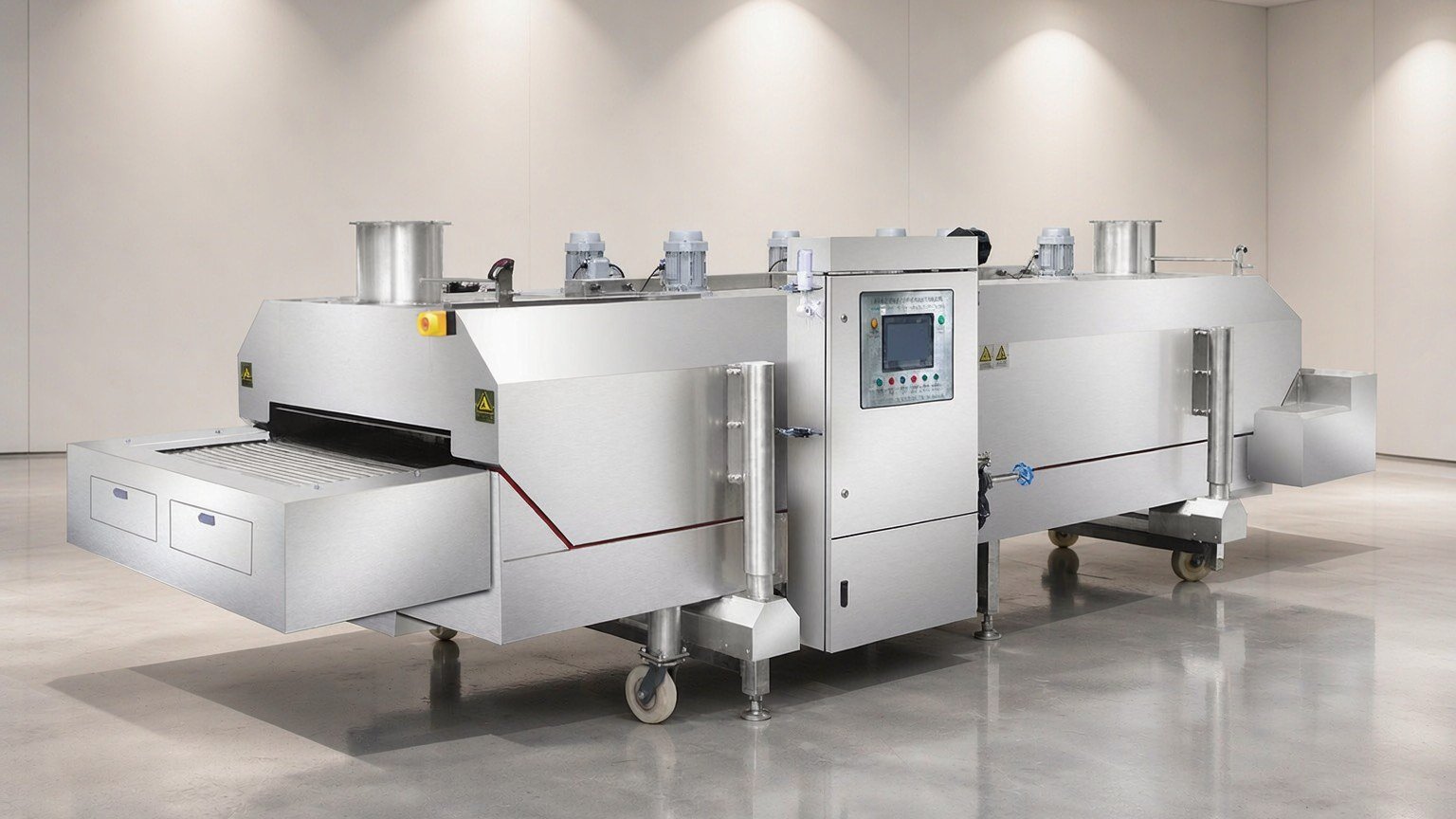
Intermittent cabinet units calculate cycle time per batch. Continuous tunnels express processing capacity as output per unit time (e.g., kg/h). Line takt is determined by belt speed and loading density. Related parameters can be found at liquid nitrogen quick-freezing tunnel.
Step 4: Calculate Number of Units and Reserve Margin
With single-unit capacity established, the number of units is easy to calculate:
Required units = Per-shift output ÷ (Single-unit batch weight × Batches achievable per shift)
Or for continuous equipment:
Required units = Per-shift output ÷ (Single-unit output per unit time × Effective operating time)
After calculating, a margin must be reserved for three reasons:
- Product changeover: When producing multiple varieties, changeover and cleaning occupy operating time;
- Peak fluctuations: When incoming materials are concentrated or orders are added temporarily, surplus capacity is needed;
- Maintenance: The capacity gap during equipment maintenance requires backup.
How much margin to reserve depends on production stability. Lines with a single variety and stable plans can reserve less; lines with many varieties and fluctuating orders should reserve sufficient margin.
Step 5: Convert to Configuration Plan
After the number of units is determined, the configuration form must also be decided:
| Decision Item | Options | Considerations |
|---|---|---|
| Equipment form | Cabinet / Tunnel / Hybrid | Variety, output, site, takt |
| Single-unit capacity | Selected by batch size | Matched to batch weight; too large means high heat leakage ratio per batch, too small means many units |
| Automation level | Manual / Semi-automatic / Automatic loading and unloading | Labor cost, consistency requirements, investment capability |
| Liquid supply method | Centralized supply / Per-unit supply | Number of units, site, liquid nitrogen supply conditions |
There is no fixed answer for configuration form; the same output can have several feasible plans. Providing multiple alternatives based on actual conditions during selection is more reliable than forcing one standard.
Input Data Checklist for Calculation
Having the following data ready allows the calculation to be done correctly in one pass:
| Category | Data |
|---|---|
| Output | Per-shift / per-day target output, shift arrangement |
| Product | Product name, unit weight, number of categories |
| Process | Inlet temperature, target core temperature, batch weight |
| Packaging | Packaging form, tray specifications |
| Site | Available area, ceiling height, aisles |
| Utilities | Power supply conditions, liquid nitrogen supply, exhaust and cooling water conditions |
With complete data, the plan has a basis; filling in missing items by experience tends to lead to rework later.
Frequently Asked Questions
Must equipment models be determined before capacity calculation?
No, that is the reverse order. First calculate the required capacity based on output and process requirements, then select models accordingly. Determining models first and then matching output easily leads to selecting too large or too small.
Is it better to choose a larger single-unit capacity or multiple smaller units?
It depends on the production structure. With a single variety and high output, large-capacity equipment is more efficient; with many varieties and fluctuating orders, multiple smaller units offer flexible changeover. The two approaches involve trade-offs in investment, energy consumption, and site occupation, to be decided by actual conditions.
How much margin is appropriate?
There is no universal ratio. Lines with a single variety and stable plans can reserve less; lines with many varieties and fluctuating orders should reserve more. The basis for judgment is changeover frequency, incoming material fluctuation range, and maintenance scheduling.
Can equipment be added if output increases?
Yes, but expansion space (site, power supply, liquid supply, exhaust) must be reserved in the initial layout. Considering the expansion plan during the design stage is easier than retrofitting later.
Send us your per-shift output, product and batch size, and site conditions, and we will provide capacity calculation and equipment configuration alternatives based on actual needs: Contact Kunning Cryo
The capacity calculation method in this article is a general engineering practice; equipment capability parameters are cited from Kunning Cryo liquid nitrogen quick-freezing equipment technical documents, and data for each model is subject to the corresponding technical parameters.