
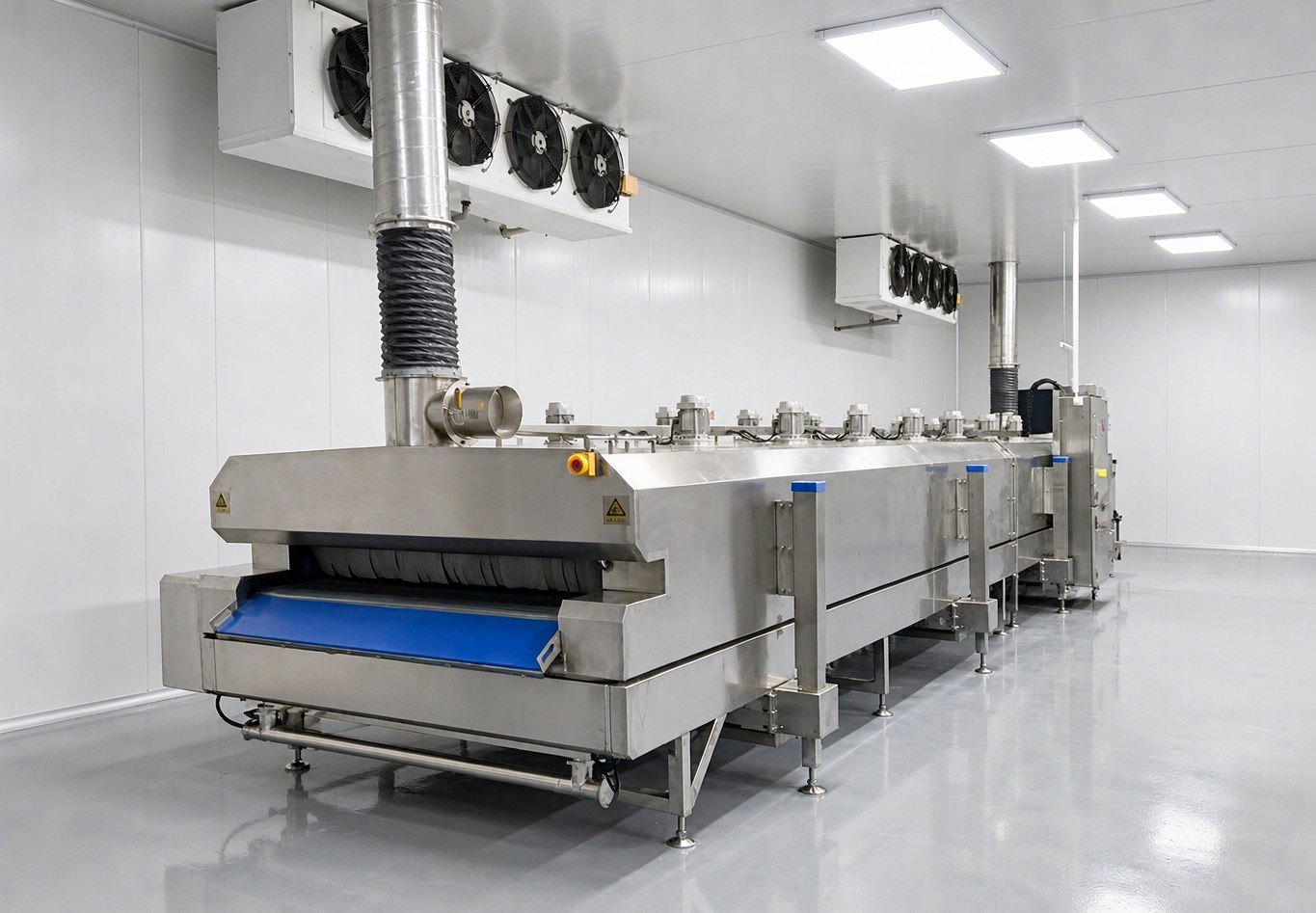
A prepared dish processing enterprise in East China mainly produces ready-to-heat pouches, sauce-braised products, and block-shaped dishes. After cooking, products need to be frozen as quickly as possible. The workshop handles a wide variety of products, batch sizes are not large, and manpower is tight. The arrangement of loading and transfer, and consistency between batches, are the two key points this configuration needs to address. For comparable capacity, the available model is the DKN-LFT-1206 liquid nitrogen quick-freezing tunnel line, with a mesh belt of 6000 × 1200 mm and a total power of 9 kW. Operating parameters are determined during the commissioning stage according to the actual product.
I. Application Background
Ready-to-heat prepared dishes have one unavoidable process characteristic: after cooking, the temperature is still high, and the shorter the exposure time to ambient conditions, the better, so freezing should begin as soon as possible. Product forms also vary greatly—sauce-type products come packaged with high moisture content, block-type products such as braised pork and beef brisket have uneven thickness, and shredded or sliced products are thin as individual pieces but become thick when stacked. The common factor is that they are frozen with packaging, thickness is unpredictable, and a single set of parameters for loading and belt speed cannot be applied across the board.
Most production lines in such plants already have cooking, filling, and packaging processes scheduled, and quick-freezing is often inserted at a later stage, with limited floor space and manpower available. Therefore, equipment selection is first constrained by workshop space and on-site manpower, and capacity becomes a secondary consideration.
II. Process Challenges
The loading section is labor-intensive. There are several approaches to feeding prepared pouches into the tunnel, each with its own trade-offs. Spreading them flat directly on the mesh belt by hand, piece by piece, means efficiency depends on how many people are stationed there. Pushing them in as a whole batch using racks or trays keeps placement orderly and rhythm stable, but the racks need to be able to enter and exit. Using transfer carts pushed to the infeed end and then tipped onto the belt saves one handling step, but the carts take up space when parked, and workshops with narrow aisles cannot accommodate the turning.
Batch changes easily cause inconsistency. When switching product categories, thickness, moisture content, and packaging all differ. If belt speed is not adjusted accordingly, the core temperature of products coming off the same belt will vary. Carrying over the previous batch’s parameters may seem convenient, but batch consistency often suffers here.
Safety is the item that requires long-term attention. Cooling inside the tunnel relies on liquid nitrogen, which displaces oxygen in the air. The equipment includes oxygen concentration monitoring, but loading, unloading, maintenance, and belt cleaning all take place beside the equipment. Only when procedures are solid and people follow them can stability be achieved.
III. Solution Configuration
This scenario is suited to the DKN-LFT-1206 liquid nitrogen quick-freezing tunnel line. Parameters are cited from product technical documents:
| Item | Parameter |
|---|---|
| Name | Liquid nitrogen quick-freezing tunnel line |
| Tunnel mesh belt | 6000 mm (length) × 1200 mm (width) |
| External dimensions | 6000 × 2200 × 1750 mm |
| Operating temperature | -150℃ ~ room temperature |
| Temperature control accuracy | ±2℃ |
| Cooling rate | No-load cooling of 10℃ per minute |
| Total power | 9 kW |
| Refrigerant | 5-8 BAR liquid nitrogen (liquid nitrogen storage tank self-provided) |
| Oxygen concentration monitoring | Oxygen concentration setpoint 19.5%-21.5% |
External dimensions are 6000 × 2200 × 1750 mm. Positioning must be calculated clearly: this line will occupy a 6000 mm-long section of aisle, 2200 mm wide, and an operating face must be reserved at each end. During the planning stage, draw this aisle on the workshop floor plan first to see whether it would be cut off by columns, electrical boxes, or drainage channels. If the aisle cannot be reserved, nothing else matters.
The mesh belt is 6000 mm long and 1200 mm wide, suitable for scenarios where the plant has limited depth but requires continuous product flow. The 1200 mm belt width is sufficient for prepared pouches: arrange several columns side by side with gaps between individual pieces. Loading density is adjusted through belt width rather than stacking layers. The line is not particularly long, and the distances for the infeed, deep-freezing, and outfeed sections are moderate. Belt speed has room for adjustment, so there is no need to push the entire machine to extremely low temperatures to force the rhythm.
Total power is 9 kW, and the cooling source is 5-8 BAR liquid nitrogen, with the liquid nitrogen storage tank provided by the user. This must be determined together during the plant renovation stage: where the tank is placed, how the piping runs, and how far it is from the tunnel line directly affect the convenience of future refilling.
IV. Process Key Points
Decide the loading method first, then decide manpower. For product categories where manpower is tight and placement requirements are not high, racks can be pushed in as a whole batch to reduce on-site placement time. For individual pieces that cannot be compressed and must be separated, spreading flat on the mesh belt is the way to go. The two methods have different requirements for how many people stand at the infeed end and how much space is needed, so this must be decided together with the workshop during the planning stage—not tested after the equipment arrives.
Reserve buffer positions at both ends for transfer. Once products pile up at the outfeed end, already-frozen products will press against each other and soften. The number of cart parking positions and transfer containers should be matched to the single-batch loading volume. Infeed and outfeed should be separated as much as possible so that personnel movement does not conflict, and rhythm is not disrupted by mutual interference.
Judge core temperature by reading, not by time. Products just out of the tunnel still have residual heat in the core, so measurement should wait until the temperature stabilizes. The measurement point should be at the geometric center of the product or the thickest part. Surface readings cannot be used as results; otherwise, the actual core temperature of the entire batch may not yet be on target.
Pass quickly through the maximum ice crystal formation zone. During the temperature range in which moisture in the material freezes, the longer the residence time, the coarser the ice crystals grow, affecting cell structure and causing water release during thawing. The approach is to first determine the placement method based on product thickness, then adjust belt speed to shorten this residence time while bringing the outfeed core temperature on target. These two objectives require trial runs to find the balance point. Operating parameters are determined during the commissioning stage according to the actual product and cannot be copied from other categories.
Execute oxygen concentration by range. The oxygen concentration inside the tunnel is set at 19.5%-21.5%. After loading, unloading, maintenance, or mesh belt cleaning, confirm that the concentration has returned to the range before entering. In the event of an alarm, evacuate personnel first, then address the issue. This has higher priority than rushing production.
V. Applicable Users and Selection Recommendations
This line is suitable for prepared dish processing scenarios where product categories rotate among several types of prepared dishes, orders are continuous, and there is a desire to reduce manual placement: ready-to-heat pouches, sauce-braised products, block and shredded dishes, and other cooked foods of similar types.
For choosing between a cabinet-style and tunnel-style unit, three points are sufficient. First, whether orders are continuous—batch after batch without stopping—so that the value of zoned cooling and continuous product flow in the tunnel can be realized. Second, whether the workshop aisle can be reserved—the 6000 mm line body plus operating faces at both ends is a hard requirement; if it cannot be reserved, choose a liquid nitrogen quick-freezing cabinet, which occupies less space and offers flexible material changes. Third, how many times specifications change per day—for mixed specifications, small batches, and frequent switching, a cabinet-style unit allows program changes without moving the line, which is actually more convenient.
Before selection, clarify the following: material form and whether stacking is allowed, target core temperature, single-batch loading volume, daily cumulative volume, and the aisle width and power supply conditions the workshop can provide. Operating parameters such as loading layers, belt speed, and nitrogen replenishment volume must be confirmed during the commissioning stage according to the actual product. For model comparisons and tunnel technical details, see the liquid nitrogen quick-freezing tunnel product page. For conversion between belt speed and freezing cycle, see How to Determine the Freezing Cycle. Practices from similar industries are also being compiled in customer cases.
Frequently Asked Questions
Should loading be done by manual placement or rack pushing?
It depends on product form and production line manpower. For categories where individual pieces cannot be compressed and must be separated, manual spreading on the mesh belt is more suitable, but personnel must be stationed at the infeed end. For products with low placement requirements and orderly batches, pushing racks in as a whole batch can save labor. The two methods have different requirements for floor space and transfer containers, so this must be decided together with the workshop during the planning stage.
Does belt speed need to be re-adjusted when changing product categories?
Yes. Different product thickness, moisture content, and packaging require different residence times to reach the same core temperature. Carrying over the previous batch’s parameters saves commissioning effort, but the cost is inconsistent freezing between batches. When changing materials, clean the mesh belt first, then re-determine placement and belt speed based on product thickness.
Once oxygen concentration monitoring is installed, is there nothing more to manage?
Monitoring is a standard configuration with a set range of 19.5%-21.5%, but beyond the equipment, there must be operational procedures that are properly executed: before and after loading, unloading, maintenance, and mesh belt cleaning, confirm that the concentration has returned to the range before entering. In the event of an alarm, evacuate personnel first, then address the issue. These actions rely on systems and records for implementation; the equipment itself cannot replace them.
What hard requirements does the tunnel line have for the workshop?
External dimensions are 6000 × 2200 × 1750 mm, requiring a 6000 mm-long, 2200 mm-wide aisle with operating faces at both ends, plus consideration of the liquid nitrogen storage tank position and piping route. For workshops where the aisle is cut off by columns or drainage channels and operating positions cannot be reserved at both ends, choosing a cabinet-style model is more reliable.
Customer information has been anonymized. Model configurations are selection recommendations for comparable capacity.