
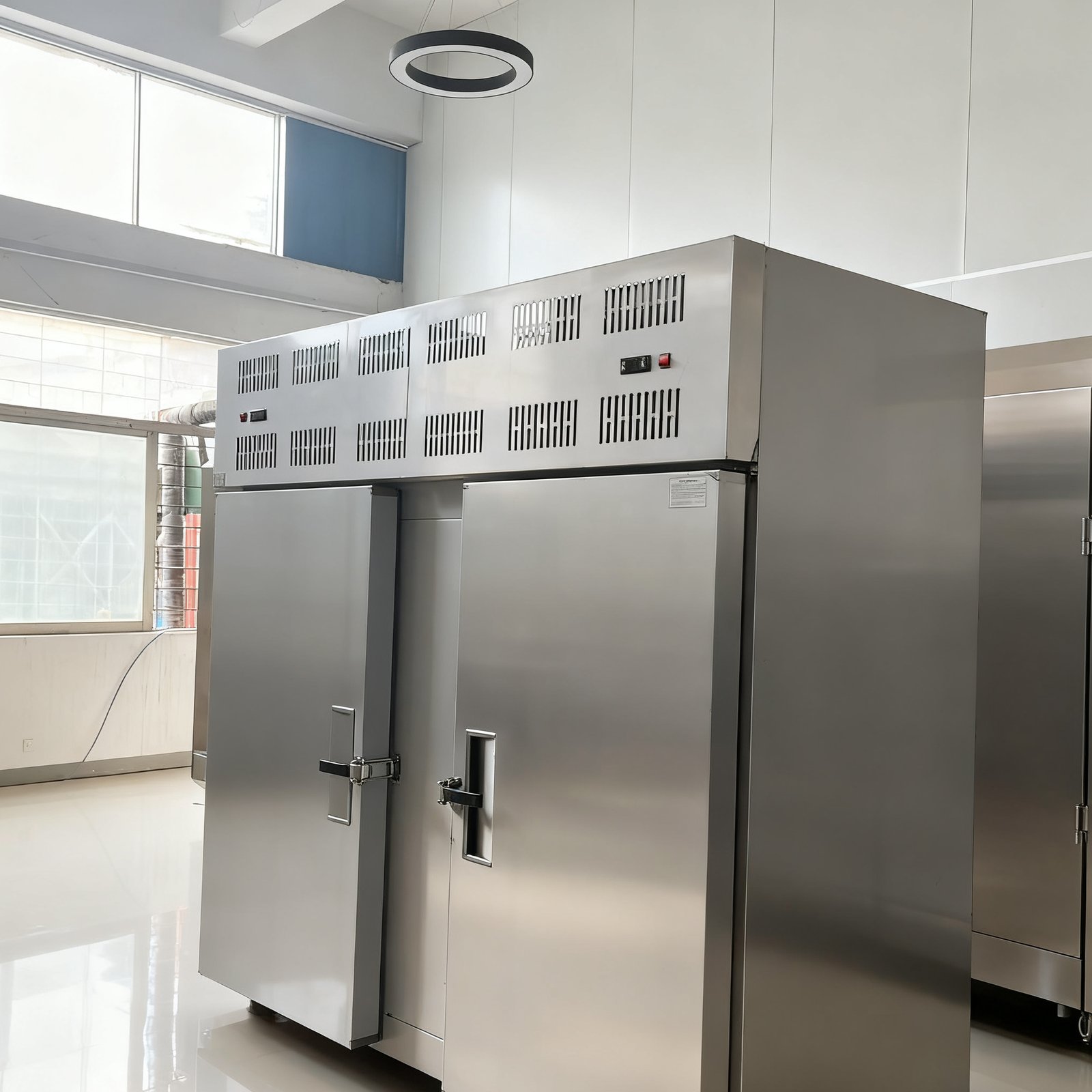
A pasta and central kitchen supply chain enterprise in East China runs a production line mainly for cooked pasta, prepared meals, and central kitchen semi-finished products. When products come out of the pot, the core temperature is still at 60–90℃. The workshop handles a wide variety of products with small batch sizes, and the cooling stage takes up both space and labor. For comparable capacity, an available model is the DKN-RHC-60D-45 food blast chiller: dual-cabinet, forced cold air circulation, atmospheric operation, approx. 200 kg per batch, cooling time 1–2 hours, bringing inlet 60–90℃ down to outlet 3–10℃ (adjustable). Below is a section-by-section breakdown of how to make this cooling stage efficient, and how it relates to downstream freezing and cell integrity.
I. Application Background
The product forms in pasta and central kitchen operations vary considerably: steamed buns, dumplings, and pastry items have fillings and wrappers, while prepared meals and semi-finished products are mostly pre-portioned cooked dishes. The common point is that after cooking, the temperature is high, and the core temperature needs to be brought down in as short a time as possible. These enterprises typically take orders from group catering, chain stores, and supermarkets, with product varieties switching weekly or even daily. Batch sizes are small, yet the outlet temperature of every batch must hold steady.
The floor space for the product cooling stage is usually not generous. Upstream are stir-frying, steaming, and packaging; downstream are portioning, cold storage, or freezing. The space and manpower that can be allocated to cooling in between are limited. So equipment selection is first constrained by workshop layout and tray loading method, with batch throughput often ranking behind these conditions.
II. Process Challenges
High inlet temperature leaves no time for natural cooling. For cooked products at 60–90℃, relying on natural heat dissipation in the workshop means the time spent in the danger zone (generally referring to the 5–60℃ range) becomes very long, and taste, color, and hygiene are all affected. The only approach is to assign this cooling stage to dedicated equipment and accelerate heat exchange through cold air circulation.
Tray loading method determines how evenly cooling occurs. How much is loaded per tray and how it is arranged directly determines whether the core temperature can come down uniformly. If a tray is overloaded or several layers are stacked and pressed together, air cannot get in; thin products reach target first while thick ones remain at high temperatures, creating temperature differences among products in the same cabinet. Mixed loading is even more problematic: different products have different thicknesses and moisture contents, and the same batch parameters cannot be applied across the board.
The cooling stage connects to the freezing stage. For categories that will enter freezing afterward, the cooling stage serves as pre-cooling. If this stage is not efficient, the material enters the freezing stage with a hot core, the time to pass through the -1 to -5℃ maximum ice crystal formation zone is prolonged, ice crystals grow coarse, cell structure is affected, and after thawing or reheating there is more drip loss and a drier texture. The cell integrity issue is precisely about the speed of this stage — a lower starting temperature in the front stage makes the freezing window in the back stage easier to control.
III. Solution Configuration
This scenario is suited to the DKN-RHC-60D-45 food blast chiller, with parameters cited from product technical documents:
| Item | Parameter |
|---|---|
| Name | Food blast chiller (forced cold air rapid cooling cabinet, dual-cabinet, non-vacuum) |
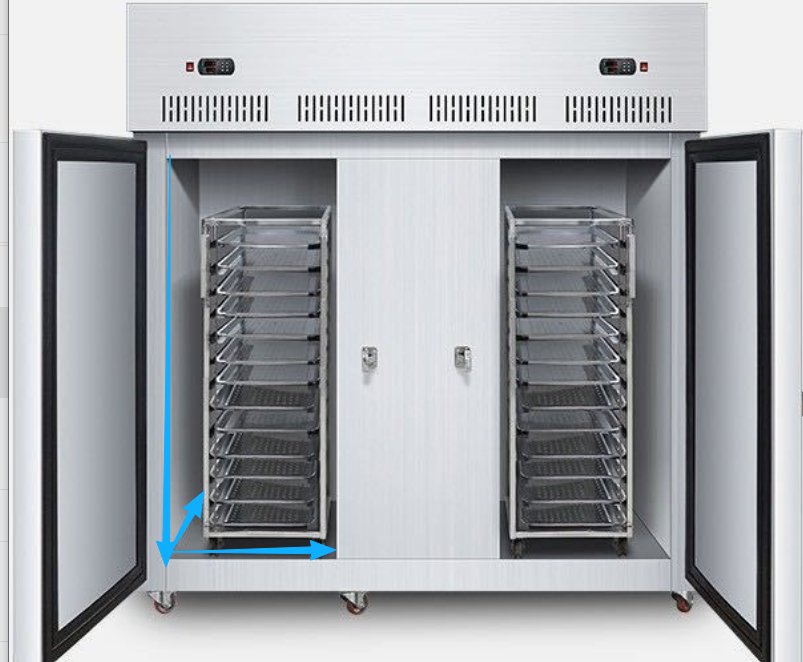
| Internal dimensions | Single cabinet 580 × 720 × 1430 mm; two cabinets total volume approx. 1.2 m³ |
| External dimensions | 1900 × 940 × 2150 mm |
| Minimum cabinet temperature | -45℃ (evaporation temperature -40℃) |
| Compressor | 4.55 kW compressor, selected by model, air-cooled condenser |
| Trays | 30 standard trays per cabinet, 60 for dual cabinets; 3–5 kg load per tray |
| Batch capacity | Approx. 100 kg per cabinet, approx. 200 kg for dual cabinets |
| Cooling time | 1–2 hours per batch (depending on food type and inlet temperature) |
| Temperature range | Inlet 60–90℃ → outlet 3–10℃ (adjustable) |
| Voltage | 220V / 380V optional |
External dimensions are 1900 × 940 × 2150 mm. Floor placement needs to be calculated clearly first: after the machine is positioned in the workshop, the front must have space for opening doors and pulling/pushing trays, the sides must not be against walls, and the top unit must have heat dissipation clearance. This size is not large for most central kitchen workshops, but it must be drawn into the floor plan from the start — don’t wait until the equipment arrives to discover the passage is blocked by a column.
The dual-cabinet design is one of the more practical aspects of this model. The two cabinets open independently, so one can be running a cooling cycle while the other is being loaded for the next batch, preventing idle time from waiting on a single cabinet. With 30 trays per cabinet at 3–5 kg each, the dual-cabinet total batch capacity of approx. 200 kg offers a better match for pasta and prepared meal scenarios with product rotation and small batch sizes than a continuous line. The overall unit has a 4.55 kW compressor, selected by model, air-cooled condenser, and 220V / 380V optional power — the workshop power supply voltage should be determined at the planning stage, as this affects unit configuration.
IV. Process Key Points
Set tray loading rules first, then talk about batches. Keep each tray at 3–5 kg, arrange in a single layer with air channels, no stacking or piling up. Load one product type per cabinet; do not mix products with significantly different thicknesses. Tray loading is an easily overlooked step in this configuration that directly affects results — only when trays are loaded correctly do the subsequent parameters become meaningful.
Judge completion by core temperature, not by time. Different products have different thicknesses and moisture contents, so the time needed to reach the same outlet temperature varies. Before unloading, use a probe to measure the geometric center or thickest part of the product; only when the reading reaches target is cooling complete. Surface readings cannot be used as the result, otherwise the core may not have come down yet.
Move quickly through the danger zone. From 60–90℃ to below 10℃, the shorter the time, the better. In terms of parameters, first determine the number of trays and layers based on the product loading method, then adjust cooling time, with the goal of getting the core temperature out of the moderate zone as quickly as possible. When this stage is efficient, the burden on subsequent cold storage or freezing is lighter.
Provide a low starting point for the freezing stage. For categories that will be frozen afterward, the outlet temperature is adjustable at 3–10℃, set according to downstream process requirements. When the material enters the freezing stage at a lower starting temperature, the time to pass through the maximum ice crystal formation zone is easier to compress, ice crystals are finer, and drip loss is reduced. It should be noted that this machine handles the cooling stage; whether to enter freezing and whether the core reaches -18℃ is completed by downstream equipment, with specific configuration confirmed per order.
V. Suitable Applications and Selection Advice
This configuration suits scenarios with single-batch loads of 100–200 kg, frequent product switching, and cooling or pre-freezing cooling as the goal: cooked pasta, prepared meals, central kitchen semi-finished products, and other similar cooked food processing.
Cabinet type or tunnel type — three points are enough to decide. For small batch sizes, mixed varieties, and several specification changes per day, the cabinet type allows parameter changes without touching the line, making it more flexible than a tunnel. For continuous orders, batch after batch without stopping, and where the workshop can free up a continuous passage, the tunnel line is more cost-effective in capacity and labor. If the workshop layout cannot accommodate it or power conditions are limited, start with the cabinet type.
Before selection, clarify these items: material form and tray loading method, target outlet temperature, single-batch inlet volume and daily cumulative volume, workshop floor dimensions, and power supply voltage. Operating parameters such as tray layer count and cooling time should be confirmed during commissioning based on actual products. For model parameters, see the Food Blast Chiller DKN-RHC-60D-45 product page. For factors affecting cooling speed, see Factors Affecting Blast Chiller Cooling Rate. On-site practices from similar industries are compiled in Customer Cases. To calculate selection based on your own products, contact us.
FAQ
Is a blast chiller the same as a vacuum pre-cooler?
No. This is an atmospheric forced cold air cooling cabinet with no vacuum pump or vacuum chamber inside; it relies on cold air circulation to bring cooked food from 60–90℃ down to 3–10℃. Vacuum pre-cooling uses low-pressure water evaporation to absorb heat, and is mostly used for fruits and vegetables with high surface moisture. Which to choose depends on product form and target outlet temperature.
How is the 200 kg per batch figure derived?
Each cabinet holds 30 standard trays, dual cabinets hold 60, with 3–5 kg per tray. One cabinet is approx. 100 kg, totaling approx. 200 kg for both. Actual loading capacity varies with product form and tray loading method; refer to process confirmation.
What outlet temperature is appropriate?
Outlet is adjustable at 3–10℃, set according to downstream process. For products going into freezing afterward, bring the core temperature down to target before entering the freezing stage; a lower starting temperature in the front stage makes passage through the maximum ice crystal zone in the freezing stage more efficient. The minimum cabinet temperature can reach -45℃; specific outlet targets are confirmed per order and product process.
How should trays be loaded for even cooling?
Keep each tray at 3–5 kg, arrange in a single layer with air channels, no stacking or piling up. Load different product types in separate cabinets; do not mix, otherwise thin products reach target first while thick ones remain at high temperatures, causing core temperature differences within the same batch.
Customer information has been anonymized; model configurations are selection recommendations for comparable capacity.