
A step that prepared dish workshops often get wrong is putting raw chunk dishes, sauced ready-meal packs and cooked dishes into the same equipment and running them with the same set of parameters. The inlet temperatures of the three material types differ by tens of degrees, and their packaging forms are also different, so the freezing paths must be arranged separately. In practice, first divide materials into three tiers, then determine the ratio of cabinet machines to tunnel lines according to daily output and workshop length, and add a separate rapid cooling stage before cooked dishes.
1. Define the scope first, then equipment matching becomes clear
On March 18, 2024, the State Administration for Market Regulation, the Ministry of Education, the Ministry of Industry and Information Technology, the Ministry of Agriculture and Rural Affairs, the Ministry of Commerce and the National Health Commission jointly issued the Notice on Strengthening Food Safety Supervision of Prepared Dishes and Promoting High-Quality Industrial Development (Guo Shi Jian Shi Sheng Fa [2024] No. 27), which defined prepared dishes at the national level: pre-packaged dishes made from one or more edible agricultural products and their products as raw materials, with or without auxiliary materials such as seasonings, without added preservatives, made through industrial pre-processing, conforming to the storage, transportation and sales conditions indicated on the product label, and edible after heating or cooking (source: Chinese government website and the official website of the State Administration for Market Regulation, published on March 21, 2024).
This notice also drew boundaries: staple food products such as quick-frozen flour and rice foods, convenience foods, boxed meals, steamed buns, pastries and bread are not prepared dishes; net vegetables, semi-finished products and finished dishes made by central kitchens of chain catering enterprises and delivered to their own stores are managed under catering food safety regulations and are not included in the scope of prepared dishes. This boundary directly affects equipment selection — workshops making staple foods and workshops making dishes differ in material moisture content, piece thickness and packaging form, so the line cannot be copied directly.
Without added preservatives, what does product shelf life rely on? The notice’s answers to reporters make this clear: prepared dishes achieve this through storage conditions such as freezing and refrigeration and through sterilization post-treatment processes, and different categories should strictly conform to the corresponding freezing and refrigeration conditions. Translated into actions on the workshop floor, the freezing section must steadily bring the core temperature down to the set value, and records must be available for every batch.
2. Three material types, three freezing paths
Prepared dishes can be roughly divided into three tiers by processing depth, and equipment requirements differ completely.
| Category | Typical products | Inlet state | Main difficulties | Equipment form |
|---|---|---|---|---|
| Raw chunk dishes | Marinated meat chunks, raw diced chicken, battered fish fillets, prepared meat skewers | 0–8°C refrigerated or ambient | Thin pieces, thickness rises after stacking, pieces tend to stick together | Continuous freezing on tunnel line, or batch freezing in cabinet machine |
| Sauced ready-meal packs | Sauce packs, soup base packs, braised pork with sauce, braised dishes | Ambient or refrigerated, mostly bagged | Sauce inside the bag has high thermal resistance, bag corners tend to puncture, freezing time varies with bag type | Freezing after packaging in cabinet machine |
| Cooked dishes | Finished dishes packaged directly after stir-frying, steaming or braising | Core temperature 60–90°C | Must first pass through the danger temperature zone; entering the quick-freezing section directly will raise the cavity temperature | Rapid cooler lowers to 3–10°C before quick freezing |
The meaning of tiering lies in production scheduling. If a workshop makes all three categories, the tunnel line runs the category with large volume, the cabinet machine handles small batches and orders with frequent product changes, and a separate rapid cooler is placed before cooked dishes. If the three categories are run in one piece of equipment, the freezing effect in the first half and the second half will not match, and sampling at discharge cannot identify which tier has deviated.
3. Capacity matching: calculate three numbers first
The number of equipment units is not determined by workshop area, but by three numbers: daily output, piece thickness and available length.
Daily output determines whether to use a tunnel or a cabinet. Piece thickness determines residence time; for blocks thicker than 60 mm, speeding up the mesh belt cannot make up for it — only reducing speed to extend residence time or reducing loading layers works. Available length is often overlooked — a tunnel line is equipment laid out in a straight line, and before entry the door opening, passage and turning radius must be measured; if it does not fit, a shorter model must be chosen or the layout changed.
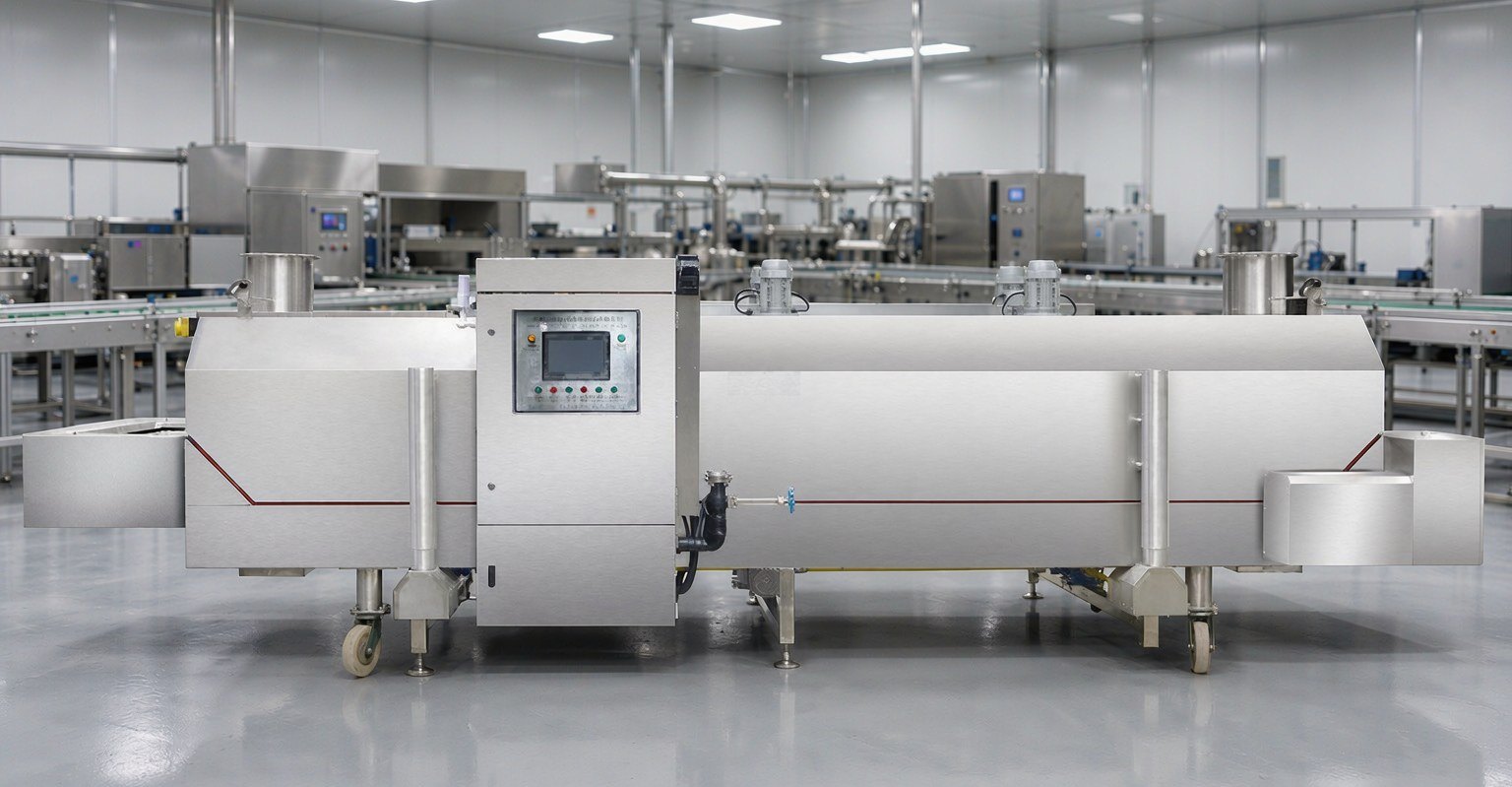
Public parameters of the liquid nitrogen freezing tunnel line:
| Item | DKN-LFT-0908 | DKN-LFT-1212 |
|---|---|---|
| Tunnel mesh belt size | 8000 mm (L) × 900 mm (W) | 12000 mm (L) × 1200 mm (W) |
| External dimensions | 8000 × 1750 × 1670 mm | 12000 × 2250 × 1670 mm |
| Working temperature | -150°C – ambient | -150°C – ambient |
| Temperature control accuracy | ±2°C | ±2°C |
| No-load cooling rate | Up to 10°C per minute, adjustable | Up to 10°C per minute, adjustable |
| Quick-freezing capacity | Calculated by material and packaging | 1 m³/h (depending on material and packaging) |
| Total power | Approx. 15 kW | 18 kW |
| Power supply specification | 380V/50Hz | 380V/50Hz |
| Liquid nitrogen pressure | 5-8 BAR (tank supplied by user) | 5-8 BAR (tank supplied by user) |
The quick-freezing capacity figure must be read clearly: 1 m³/h is volume, and converting it to kilograms requires multiplying by material bulk density and deducting the volume occupied by packaging. The same equipment running bulk chunk materials and bagged ready-meal packs differs noticeably in hourly output; before production, running a full-load test with your own products is more reliable than scheduling by nominal values.
Public parameters of the cabinet machine:
| Item | DKN-LFC-600 | DKN-LFC-1200 (four zones) |
|---|---|---|
| External dimensions | 2900 × 1700 × 2450 mm | 8730 × 2350 × 2170 mm |
| Inner cavity | Not listed in technical data | 2000 × 1500 × 1750 mm × four zones |
| Loading | Confirmed by order | 0–1200 kg per zone, with 10 racks |
| Common working temperature | -150°C – ambient | -150°C – ambient |
| Temperature control accuracy | ±1°C | ±2°C |
| Temperature uniformity | ±3°C | Not listed in technical data |
| No-load cooling rate | Not less than 20°C/min | ≤50°C/min |
| Total power | 5 kW | 12 kW |
| Liquid nitrogen pressure | 5-8 BAR | 6-8 BAR |
The judgment for dividing work between cabinet machines and tunnel lines is actually just one sentence: if the category is stable, daily output is measured in tons, and the workshop can lay out a straight line, use a tunnel; if categories are mixed, single batches are several hundred kilograms, and orders fluctuate greatly, use a cabinet machine. When changing products, the cabinet machine only needs loading and program parameter changes, without moving the line body, which is practical in multi-variety prepared dish workshops.
4. Sauced products: on-site actions for anti-sticking and anti-bag-breaking
Sauced ready-meal packs cause more problems in prepared dishes. The sauce flows inside the bag; when not frozen through, the center is soft and the outer layer is hard, and the bag breaks under compression during transport.
Cool before packaging. Hot material straight from the wok is filled and sealed directly, so the temperature inside the bag is high; after entering the equipment, the early stage of cooling is spent entirely on sensible heat, and the time in the freezing stage is reduced. According to the process specification, cool to a temperature that is not hot to the touch before filling, so the equipment’s cooling capacity is used for phase change.
Lay trays flat in a single layer, do not stack. When trays are stacked, the lower trays are blocked from cold air by those above, and the time to reach temperature at different levels in the same cabinet will spread out. The circulating air field of the cabinet machine is forced convection, and the uniformity of air speed directly determines the temperature difference between trays; loading to “full” and loading to “through” produce visibly different product appearance after discharge.
Unify bag type and leave margin at bag corners. The sauce expands in volume when frozen; if the margin left in the bag is insufficient, the bag corners will be pressed tight after freezing. Using the same bag specification and same fill amount for the same batch allows freezing parameters to be fixed.
After discharge, go directly into an environment below -18°C. The section from the discharge port to the cold store is exposed to the ambient workshop; if the surface warms and then is frozen again, ice crystals will regrow and the texture will scatter.
5. The cooling stage for cooked dishes cannot be omitted
Dishes from stir-frying, steaming or braising have a core temperature of 60–90°C when out of the pot. If this section enters the quick-freezing section directly, the tunnel cavity temperature will be repeatedly raised, and the freezing effect in the first half and second half of the same batch will not match. The correct order is to cool to 3–10°C first, then enter quick freezing.
Parameters of the dual-cabinet rapid cooler DKN-RHC-60D-45:
| Item | Parameter |
|---|---|
| Structure | Dual-cabinet, two cabinets with independent doors |
| Minimum cabinet temperature | -45°C |
| External dimensions | 1900 × 940 × 2150 mm |
| Single cabinet inner dimensions | 580 × 720 × 1430 mm |
| Single cabinet volume | 0.597 m³ (two cabinets total 1.194 m³) |
| Rack size | 460 × 600 × 1370 mm |
| Loading | 30 standard trays per cabinet, 3–5 kg per tray, about 100 kg per cabinet, about 200 kg for two cabinets |
| Inlet temperature | 60–90°C |
| Outlet temperature | 3–10°C (adjustable) |
| Single-batch cooling time | 1–2 hours (depending on food type and inlet temperature) |
| Compressor power | 4.55 kW |
| Power supply | 220V / 380V optional |
| Cooling method | Forced cold air circulation, air-cooled |
The two cabinets are controlled independently, so one cabinet can be cooling while the other is loading or unloading, and the preceding and following processes do not conflict. Cooling time is a range; with high inlet temperature, large piece thickness and densely arranged trays, the time will increase. Before production, test with your own products and write the measured values into the operating procedure — this is more useful than copying data values.
After the cooling stage, the product enters quick freezing, and the equipment’s cooling capacity is spent only on freezing. Whether this connection runs smoothly depends on whether two rhythms match: the single-batch cycle of the rapid cooler and the infeed rhythm of the quick-freezing equipment.
6. Batch consistency relies on records, not experience
Prepared dish factories are in a repeat-purchase business; if the same product tastes different in this batch compared with the previous batch, customers can taste it immediately. What the equipment side can do is three things.
Programs can be stored and adjusted. The control systems of both cabinet machines and tunnel lines use touchscreen input, PLC control and PID automatic adjustment, can run cooling and holding in ten steps, and can store multiple freezing processes for one-key recall. When changing products, adjust the program rather than relying on an experienced operator’s feel.
Temperature can be measured and checked. Temperature measurement uses PT100 platinum resistance, Class A accuracy, with a measurement range of 200°C to -200°C. Discharge judgment takes the core temperature reading, not time as the endpoint. Under the same setting, the cooling process in each run is close, so two batches of data can be compared together.
Do not treat safety items as decoration. The tunnel line is equipped with oxygen concentration detection at the inlet and outlet ends, with a set value of 19.5%–21.5%; the equipment has over-temperature alarms, and emergency stop switches are installed at the infeed position, electrical control cabinet and receiving position. Liquid nitrogen is a cryogenic medium; workshop ventilation and oxygen concentration monitoring should be tested unit by unit during acceptance.
Frequently asked questions
Why do soup-containing ready-meal packs bulge and break after freezing?
Mostly two things: residual air in the bag and overfull filling. If vacuuming or venting before sealing is insufficient, the air inside the bag contracts during freezing and the bag body is pulled out of shape; if the fill amount is too full, the sauce expands during freezing without margin, and the bag corners take stress first. Change the packaging process first, then look at freezing parameters — if the freezing stage is too long, repeated cold air impact on the bag body will also aggravate damage.
Must prepared dishes be cooled to ambient temperature before quick freezing?
Not to ambient temperature, but to the inlet temperature range specified in the process procedure. After discharge, cooked dishes must pass through the danger temperature zone, first lowered to 3–10°C by the rapid cooler, then entering the quick-freezing stage; raw dishes are already at refrigerated temperature and can enter the equipment directly. Hot material entering the tunnel directly will cause cavity temperature fluctuations, and the freezing effect in the front and rear sections of the same batch will be inconsistent.
Can cabinet machines and tunnel lines be placed in the same workshop?
Yes, as long as the division of work is clearly written: the tunnel line performs continuous freezing of main categories, and the cabinet machine handles small batches, new products and rework batches. The tray specifications and transfer containers of the two lines should be unified as much as possible; otherwise an extra tray transfer will be added in between, and materials will be exposed to the ambient area one more time. For the cooked dish line, the rapid cooler should be placed on the infeed side of the quick-freezing equipment, and materials should not be transferred across workshops.
How to choose between liquid nitrogen quick freezing and compressor-refrigerated mesh-belt lines?
Look at liquid nitrogen supply conditions and long-term operation mode. The liquid nitrogen solution cools quickly and occupies little equipment space, and requires on-site tanks and cryogenic piping; the compressor-refrigerated mesh-belt quick freezer does not require a liquid nitrogen tank and can run once powered and with condensation heat dissipation conditions arranged; working temperature, cooling capacity and freezing cycle are configured according to material and capacity, confirmed by order. Both routes can handle prepared dishes; which one to choose depends on the workshop’s energy conditions and product structure, not a one-size-fits-all answer.
Next step
Send us your product category (raw chunks / sauced ready-meal packs / cooked dishes), piece weight and packaging form, daily output and available workshop length, and we will provide a configuration suggestion based on these four items. The message entry is at Contact Us.
Related reading: Core Temperature and Batch Switching in Quick Freezing of Prepared Dish Ready-Meal Packs, Loading and Batch Consistency of Liquid Nitrogen Freezing Tunnel Lines, Liquid Nitrogen Freezing Tunnel Line Product Page, Meat and Poultry Processing Quick-Freezing Solutions.