
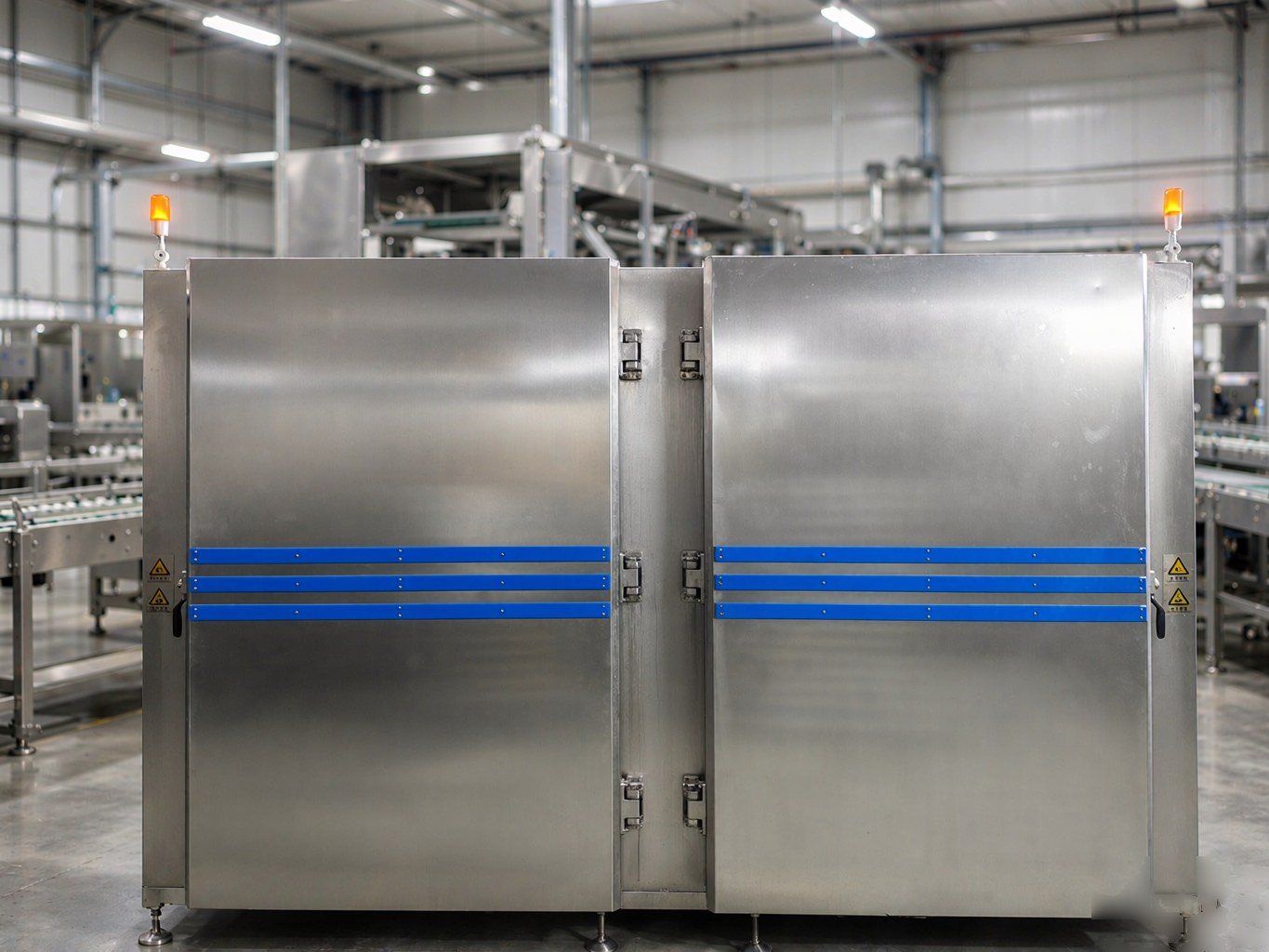
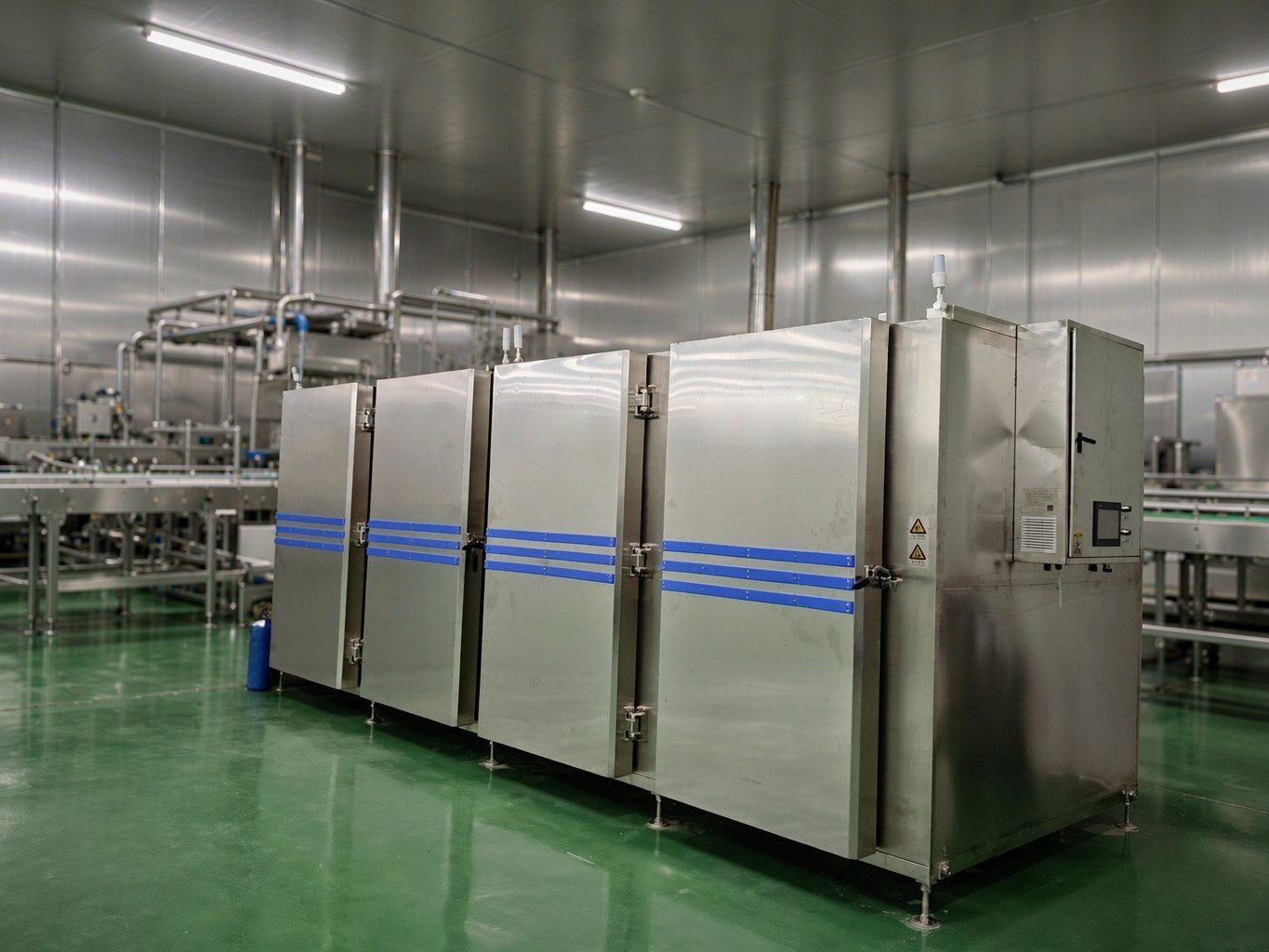
A biopharmaceutical company in East China produces vaccine and biologic materials: many specifications, small individual batches, and every batch must be traceable. Before low-temperature storage, a stable deep-freezing quick-freeze stage is required. The model suited to this capacity is the DKN-LFC-600 liquid nitrogen quick freezer: external dimensions 2900 × 1700 × 2450 mm, working temperature -150℃ ~ ambient, temperature control accuracy ±1℃, temperature uniformity ±3℃, no-load pull-down no less than 20℃/min, capacity 600 kg/h, total power 5 kW. Damage to cell structure is mostly determined in the few minutes of passing through the maximum ice crystal band; what the equipment must do is shorten this time and even out every point inside the cabinet.
1. Application Background
Vaccines and biologics mostly circulate as liquids, semi-finished products, or intermediates before lyophilization. Storage conditions vary by variety, and some require a deep-freezing stage below -80℃; the specific temperature and holding time are confirmed per order.
Such materials have limited loading per batch, frequent specification changeovers, and every batch’s destination must be recorded. The quick-freeze stage sits after filling and before deep-freeze storage; large temperature differences inside the cabinet or equipment waiting for material forces subsequent processes to adjust accordingly. What this stage looks at is not only whether the temperature can be reached, but also whether each load can be reproduced.
2. Process Challenges
Residence time in the ice crystal band determines ice crystal size. As material drops from near 0℃ to around -5℃, this is the range where water nucleates in quantity and ice crystals grow rapidly (-1℃~-5℃, commonly called the maximum ice crystal band). Fast cooling means many fine nuclei, with ice crystals mainly remaining in intercellular spaces; slow cooling means fewer, longer nuclei, and extracellular ice crystals expand and press against the cell membrane, causing intracellular substances to flow out during thawing.
Temperature differences inside the cabinet translate directly into batch differences. Control accuracy and temperature uniformity are two different things: the former is the ability to hold temperature at the set value, the latter is the deviation between different positions at the same moment. If uniformity falls short, the endpoint can only be judged by the slowest position, and the remaining material must wait in the cold air.
Small batches do not fill a cabinet. Batches often do not fill the cabinet; the empty space continuously consumes cooling capacity, and the airflow organization inside the cabinet differs from full load. Consistency when loading volume changes is the real challenge.
3. Solution Configuration
This scenario uses the DKN-LFC-600 liquid nitrogen quick freezer, with parameters quoted from the product technical documents:
| Item | Parameter |
|---|---|
| Name | Liquid nitrogen quick freezer |
| External dimensions | 2900 × 1700 × 2450 mm |
| Working temperature | -150℃ ~ ambient |
| Temperature control accuracy | ±1℃ |
| Temperature uniformity | ±3℃ |
| Pull-down speed | No less than 20℃/min (no load) |
| Capacity | 600 kg/h (varies with product and packaging method) |
| Total power | 5 kW |
| Refrigerant | 5-8 BAR liquid nitrogen |
In terms of configuration logic, liquid nitrogen is dispersed by spraying and circulation fans into low-temperature airflow, forming a large temperature difference with the material surface; the surface quickly crosses the ice crystal band, shortening the residence time of water in the -1℃~-5℃ range. Temperature control accuracy of ±1℃ keeps the set value stable, and temperature uniformity of ±3℃ determines whether different positions in the same cabinet can be discharged within the same time window. Control uses PLC plus touch screen, with a separate program stored for each variety. Power supply, certification, and packaging are confirmed per order.
4. Process Points
Endpoint judgment looks at material core temperature. -150℃ ~ ambient is the equipment working range, not the discharge target. With different loading volumes and packaging thicknesses, the time for the core to reach temperature differs noticeably; measure the geometric center before discharge, and surface readings cannot be taken as the result; measure one point at each layer position inside the cabinet for verification.
No-load figures are not production takt. 20℃/min refers to no-load capability; after material is loaded, speed is affected by loading volume, packaging, and initial temperature. Process parameters must be measured under loaded conditions; do not use no-load data for production scheduling.
Loading leaves airflow channels. Lay trays flat, leave gaps between trays, and do not stack and compress. Run cooling curves for several common loading levels to form traceable records.
Liquid nitrogen safety is managed on site. Liquid nitrogen in relatively enclosed spaces displaces oxygen in the air; cabinet exhaust, oxygen concentration monitoring, and personnel entry and exit require interlocked alarms.
5. Suitable Users and Selection Advice
This configuration suits companies mainly handling vaccines and biopharmaceutical intermediates, with small individual batch loads, frequent specification changeovers, and record requirements for freezing consistency; it also applies to pilot lines.
To judge cabinet versus tunnel: if the product form is single and the batch runs continuously to the point where a line cannot stop, use a tunnel line; if there are many varieties, fragmented batches, and the workshop is arranged by clean zones, a cabinet is more suitable. Before selection, define the single-batch and daily cumulative loading volume, packaging form and individual thickness, target core temperature, on-site power and liquid nitrogen supply, and oxygen concentration monitoring method.
For model parameters, see the DKN-LFC-600 liquid nitrogen quick freezer product page; for explanations of the ice crystal band and freezing curves, see Freezing Curves and the Maximum Ice Crystal Band; for the boundary between cabinet and tunnel types, see Liquid Nitrogen Quick Freezer Selection Points. To check the configuration against your own materials and production schedule, contact us.
FAQ
Why emphasize rapid passage through -1℃~-5℃?
This is the range where water nucleates in quantity and ice crystals grow rapidly, known in the industry as the maximum ice crystal band. The faster the cooling, the more nuclei and the finer the ice crystals, and the less pressure on cell structure; the longer the residence, the larger the ice crystals, and the higher the possibility of intracellular substances flowing out during thawing.
What is the difference between temperature control accuracy ±1℃ and temperature uniformity ±3℃?
Temperature control accuracy is the ability to hold temperature near the set value, reflecting fluctuation over time; temperature uniformity is the deviation between different positions inside the cabinet at the same moment, reflecting spatial distribution. Both must be considered, because endpoint judgment takes the slowest position.
How is 600 kg/h converted to single-batch loading volume?
600 kg/h is the processing capacity under given product and packaging conditions, and varies with different products and packaging methods. Single-batch loading volume must be calculated together with packaging thickness, tray dimensions, and target core temperature; when loading volume varies greatly, measure cooling curves by level.
What to note after discharge?
The key is not to give ice crystals a chance to grow again. Pre-cool downstream containers before discharge and compress transfer time; temperature fluctuations during deep-freeze storage will also let ice crystals continue to grow, so handover and inventory temperature records should be reviewed together with freezing records.