
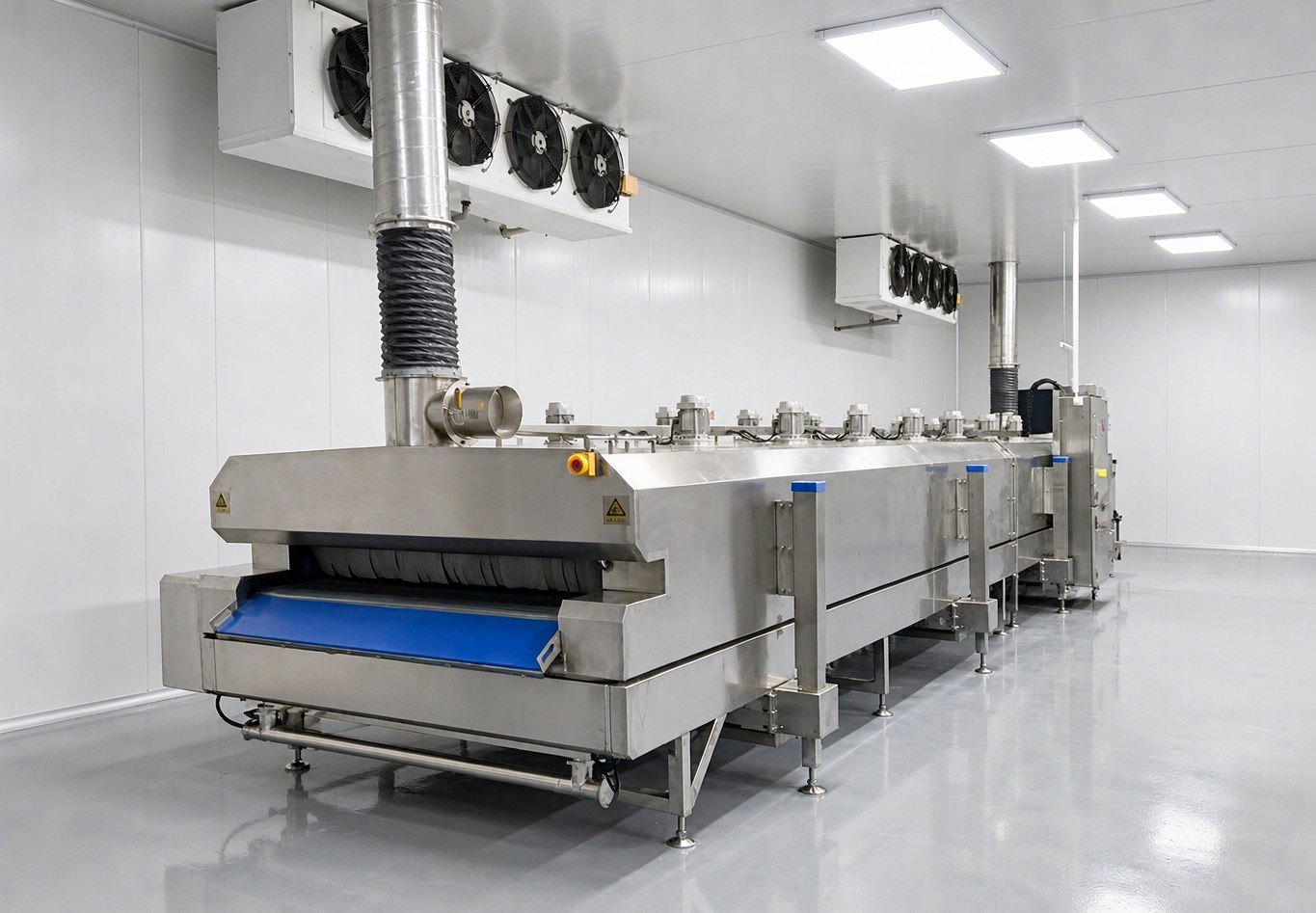
Industry: Poultry processing | Region: Domestic | Equipped model: DKN-LFT-1212 liquid nitrogen freezing tunnel line Customer information has been anonymized; the model configuration is a selection reference for similar capacity.
I. Application Background
The characteristics of poultry cutting processing lie in batch volume and rhythm. A batch of chicken breast, chicken legs, duck wings, and goose parts comes off the cutting line, and the front section barely stops, with types switching constantly, while slicing, trimming, weighing, and tray-loading stations run in parallel. Product forms are mainly cut poultry, duck and goose parts, and prepared poultry meat, mostly individual quick freezing, with core temperature brought below -18℃; some goes to supermarket and prepared dish channels, and some goes to warehouse transfer.
The capacity of a cutting workshop is built by stacking people. Loading, tray arrangement, transfer, and receiving—every step needs people; if the freezing section is a bit slow, the people in the front section just wait there. So for this type of workshop, the evaluation standard for the freezing section is not only “freezes fast enough,” but also “saves labor or not, and whether every batch is the same.”
II. Process Difficulties
First, if the loading and transfer method is not settled, labor cannot be evenly distributed. Trays and racks for poultry cut products are heavy; relying on manual tray handling to feed into the tunnel, workers are exhausted after one shift, and the arrangement of each tray is still inconsistent. The loading method must be determined together with the discharge height of the front cutting line and the size of the carts, otherwise an extra tray-transfer step is added in between, adding labor for nothing.
Second, frequent batch changes make parameters chaotic. The same equipment runs thin chicken breast in the morning and thick duck legs in the afternoon, and both belt speed and loading density need to change. If batch changes rely on verbal instructions and personal experience, core temperatures will vary between batches, and downstream packaging and customer feedback are affected.
Third, the safety design of the liquid nitrogen tunnel must be done upfront. Nitrogen concentration inside the tunnel cavity is high, and opening operations such as loading/unloading ports, inspection ports, and mesh belt cleaning all involve oxygen deficiency risk. Oxygen concentration monitoring is not just adding an alarm; set values, alarm interlocks, and operating procedures must be matched, and operators must know what to do when the alarm sounds.
III. Solution Configuration
This scenario is suited to the DKN-LFT-1212 liquid nitrogen freezing tunnel line, with main parameters as follows (quoted from product technical documents):
| Item | Parameter |
|---|---|
| Tunnel mesh belt | 12000 mm (total length) × 1200 mm (width) |
| External dimensions | 12000 × 2250 × 1670 mm |
| Operating temperature | -150℃ to room temperature |
| Temperature control accuracy | ±2℃ |
| Cooling rate | No-load cooling of 10℃ per minute |
| Freezing capacity | 1 m³/h |
| Total power | 18 kW |
| Refrigerant | 5-8 BAR liquid nitrogen (liquid nitrogen tank self-provided) |
| Oxygen concentration monitoring | Oxygen concentration set value 19.5%-21.5% |
Three main points in configuration.
First, the 12 m tunnel length provides residence time. With the mesh belt 12000 mm (total length) × 1200 mm (width), material travel time in the low-temperature zone is ample, and loading density can be adjusted according to material form without piling trays densely to catch up with rhythm. Temperature control accuracy ±2℃ is directly related to batch consistency; temperature condition fluctuations between batches of the same specification material are small.
Second, mesh belt width determines how loading stations are arranged. At 1200 mm width, whether the front tray-loading positions are set on both sides of the belt or one side is determined by the discharge direction of the cutting line; the cart transfer plan is determined at the same time, including the receiving position at the discharge end and the empty tray return channel, with layout confirmed per order.
Third, cold source and electricity. Total power is 18 kW, the liquid nitrogen tank is self-provided by the user, and the tank position and pipeline routing are incorporated into the workshop layout in advance; the liquid nitrogen replenishment route should not cross the finished product transfer channel.
IV. Process Points
Fix the actions at the loading end first. Make loading density and tray specifications into visual standards, with tiered loading methods by material thickness, so operators follow them without relying on personal judgment. Unify the cart docking height and tray push-in method, which can save the manual tray-transfer step and reduce batch differences caused by inconsistent loading.
Batch changes must be recorded. When the same equipment runs different specifications, record belt speed, residence time, and loading method by specification, and call them up directly at the next batch change. Temperature control accuracy ±2℃ is equipment capability; achieving batch consistency still depends on reusable parameters.
The maximum ice crystal zone must be passed through quickly. From -1℃ to -5℃ is the range where ice crystals form in large amounts; staying too long makes ice crystals coarse, damages cell structure, causes obvious drip loss on thawing, and reduces water-holding capacity and texture. The time material spends in this temperature zone is determined jointly by mesh belt speed and temperature zones; the no-load cooling capability of 10℃ per minute helps with rapid temperature pull-down, and actual parameters are confirmed during debugging according to the product.
Oxygen concentration monitoring is carried out per procedures. The oxygen concentration set value is 19.5%-21.5%; after an alarm, evacuate people first, ventilate and replace until within the set range before entering; loading/unloading, inspection, and mesh belt cleaning—these opening operations all follow the same process and are recorded. This is a safety item and is not skipped for capacity urgency.
V. Applicable Users and Selection Advice
The liquid nitrogen freezing tunnel line is suitable for scenarios with relatively concentrated product types, continuous batches, and the desire to fix loading actions and operating parameters: poultry cut products, aquatic frozen products, prepared dishes, etc. Cutting workshops with large batches and stable rhythm can use the benefits of continuous feeding; with many specifications and small volume per specification, the number of batch changes, mesh belt cleaning, and parameter adjustments increases noticeably, and cabinet-type is more flexible.
To judge whether to use cabinet-type or tunnel-type, look at three things: whether the single-shift batch can run batch after batch with basically no stop in between; whether the two ends of the workshop can have separate inlet and outlet positions so carts travel one way; whether loading can change from manual tray handling to cart docking, turning tray arrangement from physical labor into following standards.
If all three are met, the tunnel line is suitable; if batches are small, varieties are mixed, and space is tight, the DKN-LFC series liquid nitrogen freezing cabinets are configured for this scenario.
For selection, first clarify three things: material form and thickness, target core temperature, and single-shift batch volume; operating parameters such as material layer thickness, belt speed, and nitrogen replenishment rate are confirmed during debugging according to the actual product, and different categories cannot be copied directly.