
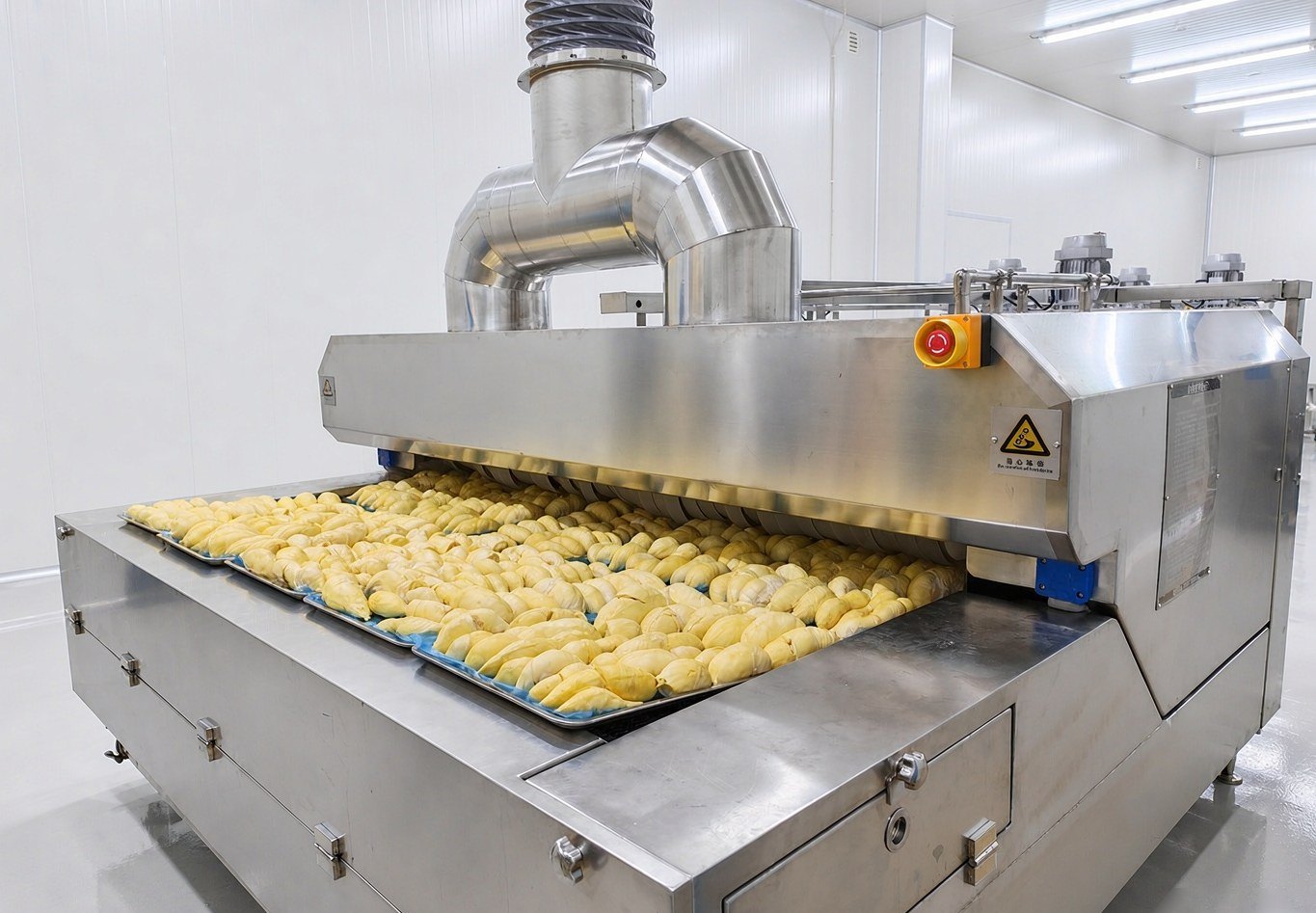
Industry: seafood processing | Region: East China | Equipment: DKN-LFT-1612 liquid nitrogen quick-freezing tunnel line Customer information has been anonymized; the equipment configuration is a selection reference for similar throughput.
1. Application Background
Seafood processing along the East China coast comes down to one word: “value.” Items such as sea fish, abalone, and sea cucumber carry a high unit price, and customers inspect them closely on receipt: after freezing, each piece should be distinct, not pressed into marks by its neighbors; after thawing, it should not collapse or release a pool of water. Sea fish is mostly frozen whole or in sections, with an emphasis on regular frozen blocks and the core temperature reaching target.
Order structures in these workshops tend to be mixed. On busy days, several specifications are run in a single day—a batch of abalone, a batch of sea cucumber, then a batch of fish sections—and individual batch sizes are not large. The processing area often already contains steaming, washing, and packaging steps, leaving little room for the freezing section. Equipment selection is therefore constrained first by workshop space, and only then by throughput.
2. Process Challenges
The first hurdle is placement. A continuous tunnel line is a long, pass-through piece of equipment, and both the infeed end and the outfeed end need room for people to stand and for carts to turn. Many workshops measure out as a perfect fit on paper, but during actual installation the passage turns out to be blocked by wall columns, drainage trenches, or electrical boxes, leaving no operating space at either end—loading and unloading crowd together, and continuity cannot be achieved at all.
The second hurdle is matching throughput. The throughput of a tunnel line is not a fixed value; it equals loading density multiplied by belt speed. On the same line, loading more sparsely and running slower lowers output; loading densely and running faster requires the hands at both the infeed and outfeed ends to keep up. Varieties that bruise easily, such as sea cucumber and abalone, cannot be stacked, so loading density depends on mesh belt width rather than the number of layers—and this directly determines how wide the belt needs to be.
The third hurdle is changing specifications. When several materials run in rotation within a day, each change requires cleaning the mesh belt, re-setting the speed, and re-defining the loading pattern. The longer the line, the more material remains in the passage during a changeover, and the greater the chance of flavor and temperature carryover between consecutive batches.
3. Solution Configuration
This scenario is suited to the DKN-LFT-1612 liquid nitrogen quick-freezing tunnel line, with the main parameters as follows (quoted from the product technical documentation):
| Item | Parameter |
|---|---|
| Name | Liquid nitrogen quick-freezing tunnel line |
| Tunnel mesh belt | 12000 mm (length) × 1600 mm (width), mesh belt effective width 1600 mm |
| External dimensions | 12000 × 2700 × 1950 mm |
| Operating temperature | -150℃ ~ room temperature |
| Temperature control accuracy | ±2℃ |
| Cooling rate | Can drop 10℃ per minute at no load |
| Throughput | About 1000 kg/h (varies with product and packaging method) |
| Total power | 26 kW |
| Refrigerant | 0.5-0.8 MPa liquid nitrogen |
| Oxygen concentration monitoring | Oxygen concentration setpoint 19.5%-21.5% |
Three things need to be checked when placing it in the workshop.
External dimensions of 12000 × 2700 × 1950 mm mean this line occupies a passage 12000 mm long and 2700 mm wide, with operating space still required at both ends. At the planning stage, first mark this passage on the workshop floor plan, avoiding doorways, columns, fire lanes, and drainage trenches; if the workshop is a corner or a narrow, elongated shape, the infeed and outfeed can first be arranged at opposite ends, and other matters can be discussed once the flow path is smooth.
Mesh belt effective width is 1600 mm. This width is practical for seafood: for materials that cannot be stacked, such as sea cucumber, abalone, and whole fish, how many can be placed side by side in one pass is basically determined by the belt surface width. With enough spread, there is clearance between pieces, so they do not stick together into a single mass at discharge. The line body is 12000 mm long, which also separates the infeed, deep-freezing, and outfeed sections, leaving room to adjust belt speed rather than forcing output by driving the whole machine temperature extremely low.
Total power is 26 kW, the cold source is 0.5-0.8 MPa liquid nitrogen, and the liquid nitrogen storage tank is provided by the user. Power supply and tank location need to be decided together during the plant renovation stage; how the piping runs and how far the tank is from the tunnel line both affect how convenient daily refilling will be later.
4. Process Points
Choose the right location for core temperature sampling. Material just out of the tunnel still has residual heat in the core, so the reading should be taken after the temperature has stabilized; for abalone and sea cucumber, sample at the geometric center of the individual piece, and for fish sections, at the thickest part of the flesh. Surface temperature cannot be used as the result, otherwise the core temperature of the whole batch may not actually be on target, and a second freezing in the cold store afterward wastes the quality work already done.
Pass quickly through the zone of maximum ice crystal formation. Most of the water in the material freezes between -1℃ and -5℃; the longer it stays there, the coarser the ice crystals grow, rupturing cell walls and causing water release on thawing. The approach is to first define the loading pattern according to material thickness, then adjust belt speed so that this停留 time is as short as possible while the outfeed core temperature still reaches target. These two goals need trial runs to find a balance; operating parameters are confirmed during commissioning according to the actual product, and cannot be copied from other categories.
Do not press material together just for throughput. Leave spacing at the infeed end, collect material promptly at the outfeed end, and do not let already-frozen individual pieces sit at the end of the mesh belt and soften again from heat. Clean the mesh belt before changing specifications, removing residue from the previous batch before running the next one.
Follow the rules on oxygen concentration. The oxygen concentration inside the liquid nitrogen tunnel is displaced, with a set range of 19.5%-21.5%. After loading/unloading, maintenance, or cleaning the mesh belt, first confirm the concentration has returned to the range before entering; if an alarm sounds, evacuate first—this priority is higher than rushing orders.
5. Suitable Applications and Selection Advice
This line suits seafood processing scenarios where varieties rotate among a few types, orders are continuous, and individual pieces must neither be compressed nor lose their appearance: abalone, sea cucumber, whole or sectioned sea fish, as well as similar frozen shrimp, shellfish, and medium-to-high-value poultry cuts.
Whether to choose a cabinet or a tunnel comes down to three things. Whether single batches can be linked together—running batch after batch without stopping is what gives the tunnel line’s zoned cooling and rapid passage their value; whether the workshop can open up the passage—a 12000 mm line body plus operating space at both ends is a hard requirement, and if it cannot be opened up, choose the DKN-LFC series liquid nitrogen quick-freezing cabinet, which occupies little space and is flexible for changeovers; and how many specifications are run per day—if specifications are mixed, batches are small, and material is changed several times a day, a cabinet is actually less trouble.
Before selection, clarify three things: material form and whether stacking is allowed, target core temperature, and single-batch and daily cumulative volumes. Operating parameters such as loading layers, belt speed, and nitrogen replenishment are confirmed during commissioning according to the actual product.