
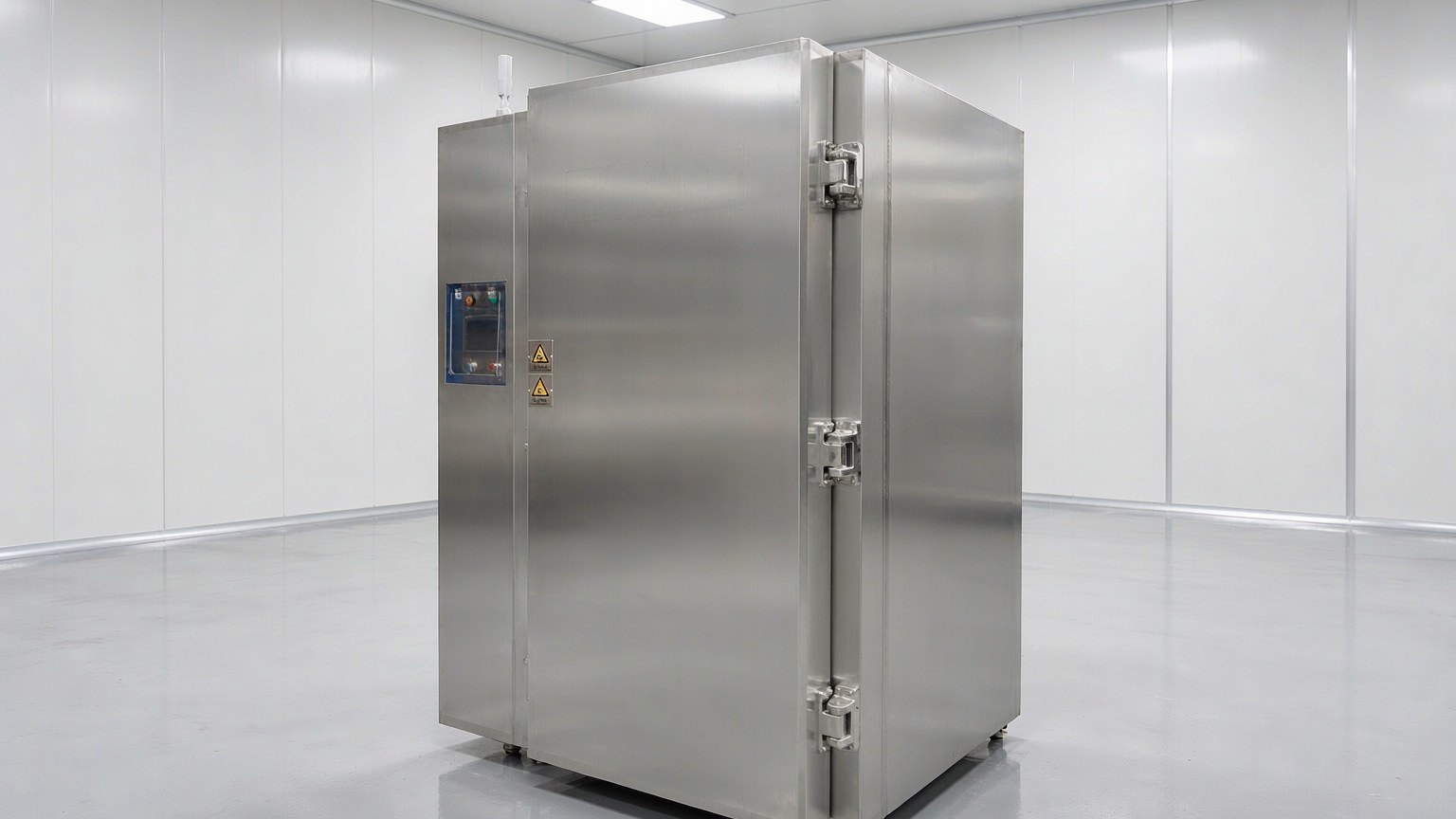
Freezing experiments run by university food research teams are not the same thing as factory production lines. Factories chase capacity and yield; labs chase whether the same batch of experiments can be reproduced: same formulation, same loading temperature, same freezing curve — samples made today and samples made next week must be comparable side by side. The model suited to this scenario is the DKN-LFC-300 liquid nitrogen quick freezer — cavity 900 × 1320 × 1800 mm, working temperature -150℃ to ambient, temperature control accuracy ±1℃, temperature uniformity ±3℃, no-load cooling no less than 20℃/min, capacity 300 kg/h, total power 2.5 kW, rack holds 40 trays at a time.
I. Application Background
A batch of samples is usually a few dozen trays, totaling tens to hundreds of kilograms, with mixed varieties and small batch sizes — what gets frozen differs each time. Large tunnel lines suit continuous throughput of a single variety; changing varieties means cleaning the mesh belt and adjusting parameters, so they don’t fit. Chest freezers and ultra-low temperature freezers rely on natural convection cooling, so the temperature difference between sample surface and center is large and the freezing curve spreads out widely, making conclusions hard to reproduce.
The liquid nitrogen quick freezer has therefore become a routine choice in many labs: the cabinet volume holds a batch of trays, cooling is fast with adjustable magnitude, a batch of samples completes the freezing process in a relatively short time, and the freezing parameters can be fixed and written into the experimental record.
II. Process Challenges
Batch consistency. In comparative experiments, if the cooling rates of two freezing runs differ by a margin, ice crystal sizes differ, and subsequent texture, drip loss, and microscopy results won’t match up. On the equipment side this requires high temperature control accuracy and stable no-load cooling rate; operating practice must also be fixed.
Sample loading, unloading, and transfer. How trays are placed, how many trays go in one cabinet, how the time from loading to unloading is recorded — without fixed stations and fixtures for these actions, different operators produce different freezing times.
Safety in a low-temperature environment. Cabinet temperature can reach -150℃; when the door is opened for loading or unloading, cold air spills out and the oxygen concentration inside is displaced by nitrogen. Labs have many people and frequent shift changes, so oxygen concentration monitoring cannot rely on human vigilance.
III. Solution Configuration
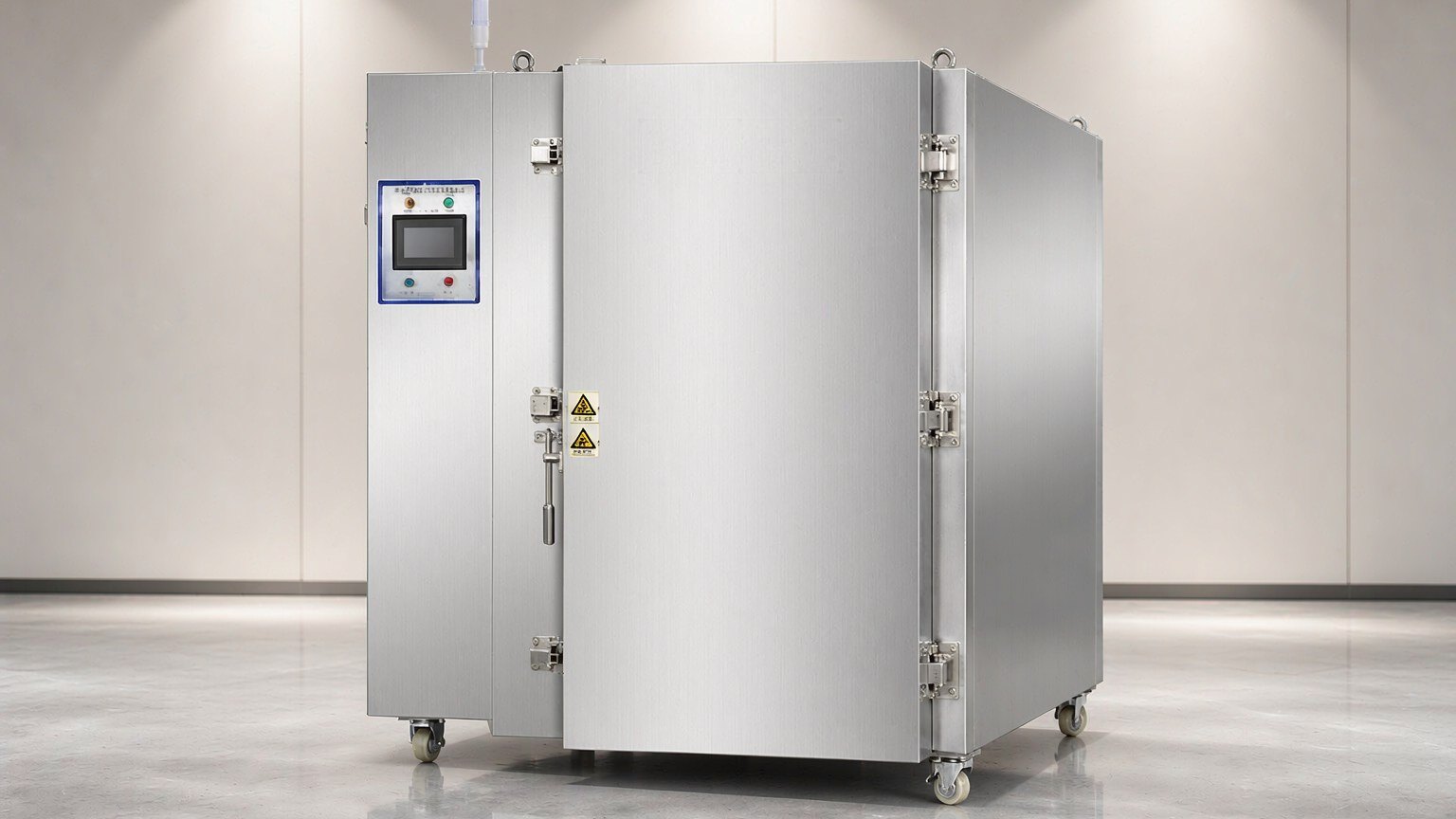
This scenario uses the DKN-LFC-300 liquid nitrogen quick freezer, with parameters quoted from the product technical documentation:
| Item | Parameter |
|---|---|
| Cavity dimensions | 900 × 1320 × 1800 mm (W×D×H) |
| External dimensions | 1740 × 1730 × 2220 mm |
| Working temperature | -150℃ to ambient |
| Temperature control accuracy | ±1℃ |
| Temperature uniformity | ±3℃ |
| Cooling rate | No less than 20℃/min (no load), adjustable to experimental needs |
| Capacity | 300 kg/h (varies with product and packaging method) |
| Total power | 2.5 kW |
| Refrigerant | 5-8 BAR liquid nitrogen |
| Rack and trays | Rack clear height 1600 mm, width 605 mm, depth 807 mm, holds 40 trays at a time; trays 400×600×25 mm stainless steel |
The configuration logic has three points: a cavity clear height of 1600 mm with a 40-tray rack lets a batch of samples enter the cabinet at once, with no need to accumulate batches over time; temperature control accuracy ±1℃ and temperature uniformity ±3℃ place samples at different positions in the cabinet in the same temperature zone, reducing position-induced deviation; liquid nitrogen as the cold source means the cooling rate is adjusted by evaporation rate, giving better comparability across batches under the same setting.
IV. Process Points
Record the initial temperature before samples enter the cabinet; after loading, follow the set curve, with cabinet temperature dropping at no less than 20℃/min under no load. Research scenarios focus more on when the sample center temperature passes through the maximum ice crystal formation zone (about -1℃ to -5℃); the cooling rate through this segment determines ice crystal size and is an item that must be clearly stated in the experimental record.
In operation, three things should be fixed: tray loading per the same standard (same weight per tray for the same variety), fixed rack positions, and recording loading and unloading times for each batch. Cabinet oxygen concentration is monitored against a set value of 19.5%~21.5% (this model’s parameter table lists an oxygen concentration monitoring item; the specific configuration is confirmed per order); after opening the door for loading or unloading, wait until the concentration returns to the safe range before personnel operate inside.
Liquid nitrogen is a self-supplied consumable, supplied at 5-8 BAR; gas consumption is directly related to sample quantity and loading temperature, and calculating consumption per batch is more accurate for labs than calculating per day.
V. Applicable Users and Selection Advice
Cabinet models suit scenarios with batch sizes of tens to hundreds of kilograms, many varieties with frequent changeovers, and the need for a fixed freezing curve for comparative experiments — university and research institute labs, food company R&D centers, and small-batch production of high-value products.
When sample batches rise to the ton level and a single variety requires continuous production, cabinet models give way to tunnel models: the DKN-LFT-1206 with a 6000 × 1200 mm mesh belt, or the 12 m long DKN-LFT-1212, stepping up continuous throughput. Selection starts with three things — single-batch weight, sample form (bulk/tray/packaged), and target center temperature — then whether cabinet or tunnel.
For model parameters see the DKN-LFC-300 liquid nitrogen quick freezer product page; for explanations of the ice crystal band and freezing curves see Freezing Curves and the Maximum Ice Crystal Formation Zone; for how cabinet temperature differences are observed see Liquid Nitrogen Quick Freezer Temperature Uniformity. To check the configuration against your own samples and production schedule, contact us.
FAQ
Why do labs care more about freezing curve repeatability?
Experimental conclusions rely on batch-to-batch comparison. If the cooling rates of two freezing runs differ, ice crystal size and the extent of intracellular substance loss differ, and texture, water loss rate, and microscopy results change accordingly, so the two batches lose comparability. Equipment stability is only a prerequisite; fixed loading and positioning matter equally.
Is 300 kg/h enough for a lab?
300 kg/h is the throughput under given product and packaging conditions; it varies with product and packaging method. Lab batches are mostly tens to hundreds of kilograms, and a cabinet load of 40 trays usually covers one batch of samples; the specific load should be calculated based on sample form, packaging thickness, and target center temperature.
How is cabinet oxygen concentration managed?
Liquid nitrogen evaporation displaces oxygen in the cabinet. This model’s parameter table lists an oxygen concentration monitoring item (set at 19.5%~21.5%; specific configuration confirmed per order); after opening the door for loading or unloading, wait until the concentration returns to the safe range before operating. Labs should also install fixed oxygen concentration alarms and calibrate them regularly.
How long does a batch take from loading to unloading?
It depends on individual sample thickness, loading temperature, and tray load; common samples are on the order of tens of minutes. It is advisable to record the center temperature curve for the first batch, mark the time point at which it passes through the maximum ice crystal formation zone, and reproduce by curve for the same variety thereafter rather than estimating time by experience.