
Temperature Control Accuracy and Temperature Uniformity of Liquid Nitrogen Quick Freezing Cabinets: What ±1℃ and ±3℃ Each Mean
When choosing a liquid nitrogen quick freezing cabinet, there are often two rows of numbers next to each other on the parameter table: temperature control accuracy ±1℃, temperature uniformity ±3℃. Many buyers treat these two rows as one indicator, understanding it as the entire cabinet being controlled within ±1℃. When acceptance is actually carried out based on this understanding, the results often do not match. These two numbers do not measure the same thing, and the directions to adjust are also different.
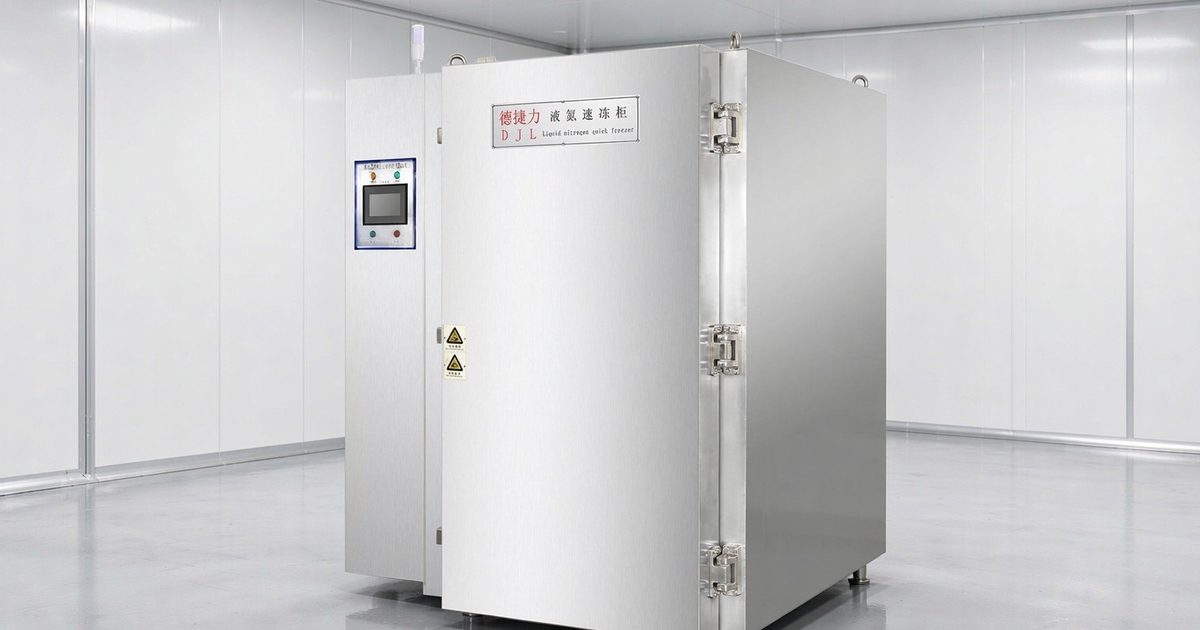
Problem
Looking only at the lower cooling limit does not allow selection of stable equipment
The atmospheric boiling point of liquid nitrogen is -196℃, and the operating temperature range of cabinet-type quick freezing equipment is -150℃ to room temperature. This range is the capability boundary determined by the cold source, indicating that the equipment can cool down, but it does not indicate that every place inside the cabinet is equally cold.
This situation has occurred in actual production: when the same batch of products enters the cabinet, the trays on the fan side freeze through first, while the center temperature on the door side is still a few degrees short; when the whole batch is taken out together, the part that froze first has already stayed in the cabinet for more than ten extra minutes. The problem is not the cold source, but the degree of uniformity of the temperature field.
Temperature control accuracy and temperature uniformity are two indicators
- Temperature control accuracy: refers to ±1℃ or ±2℃, that is, the fluctuation range of the temperature at the location of the measuring point around the set value. It tests the control system, including platinum resistance accuracy, adjustment algorithm, and the response speed of the liquid nitrogen solenoid valve.
- Temperature uniformity: refers to temperature uniformity ±3℃, that is, the temperature difference between different positions inside the cabinet at the same moment. It tests the air duct and flow guide design, loading method, insulation structure, and whether the material itself blocks the cold air circulation.
No matter how well the temperature control accuracy is written, it cannot be inferred that the temperature uniformity is equally good. The reverse is also true. The two rows of data must be viewed separately and verified separately.
Equipment parameters and process standards also cannot be confused
Whether the equipment can cool down quickly is ultimately for the food thermal center to pass through the ice crystal formation zone as quickly as possible. When explaining this concept, Science Popularization China gives: during the process from -1℃ to -5℃ for most foods, about eighty percent of the internal moisture forms ice crystals, and the industry calls this temperature range the ice crystal formation zone; when the time for the food thermal center to pass through this range is less than thirty minutes, it is usually defined as quick freezing.
For quick-frozen prepared dishes, the group standard T/XMSSAL 0058-2023 gives the definition of quick freezing as: using a quick freezing process to rapidly pass pre-treated products through the ice crystal formation zone in an environment as low as minus thirty degrees Celsius, so that the center temperature rapidly drops below minus eighteen degrees Celsius.
Internet sources:
- Science Popularization China https://m.kepuchina.cn/tuwendetail?id=243585
- National Group Standard Information Platform T/XMSSAL 0058-2023 https://www.ttbz.org.cn/upload/file/20230309/6381397871217594528048079.pdf
Principles and key parameters
The working method of the liquid nitrogen quick freezing cabinet is: liquid nitrogen is sent into the cabinet through a low-temperature solenoid valve at a set flow rate, sprayed through a porous disperser, and then the vaporized nitrogen is strongly broken up by a circulating fan and turned into a uniform low-temperature airflow, directly exchanging heat with the food surface. Temperature control is adjusted by the PLC according to PID logic to regulate the solenoid valve opening, and temperature measurement uses a PT100 platinum resistance (Class A, temperature measurement range 200℃ to -200℃). The program can run cooling and holding in ten steps, and after completion automatically alarms and cuts off power.
The public parameters of the three cabinet models are as follows, with temperature control accuracy and temperature uniformity listed in two separate rows:
| Item | LFC-300 | LFC-600 | LFC-1200 |
|---|---|---|---|
| Operating temperature | -150℃ to room temperature | -150℃ to room temperature | -150℃ to room temperature |
| Temperature control accuracy | ±1℃ | ±1℃ | ±2℃ |
| Temperature uniformity | ±3℃ | ±3℃ | Not marked in the technical agreement |
| Cooling speed (no load) | Not lower than 20℃/min | Not lower than 20℃/min | Not marked in the technical agreement |
| Equipment inner cavity dimensions | 900x1320x1800 mm | Not marked in the technical agreement | 2000x1500x1750 mm, four zones |
| Equipment outer dimensions | 1740x1730x2220 mm | 2900x1700x2450 mm | 8730x2350x2170 mm |
| Overall power | 2.5 kW | 5 kW | 12 kW |
| Liquid nitrogen pressure | 5-8 bar | 5-8 bar | 6-8 bar |
| Processing capacity | 300 kg/h | 600 kg/h | 0 to 1200 kg/single zone |
| Oxygen concentration detection | Not equipped | Not equipped | 19.5% to 21.5% |
The parameters in the table above come from the technical agreements and published equipment parameters of Kunning Cryo liquid nitrogen quick freezing cabinets LFC-300, LFC-600, and LFC-1200. The nominal processing capacity varies with product type and packaging method, and the actual capacity must be tested with your own materials.
Several points need to be explained:
- Temperature uniformity ±3℃ refers to the temperature difference between positions inside the cabinet, not fluctuation over time. It answers how large the temperature difference is between different positions inside the cabinet at the same moment.
- Uniformity is greatly affected by loading. The tray specification is 400x600x25 mm stainless steel. The LFC-300 rack has a clear height of 1600 mm, width of 605 mm, and depth of 807 mm, with a standard layer spacing of 75 mm, and can hold 40 trays at one time. If the layer spacing is too dense, the trays exceed the rack, or the products pile above the tray edge, all of these will block the air duct, and the measured uniformity will be worse than with no load.
- When producing multiple varieties at the same time, what matters is the zoning capability. Each zone of the four-zone model is independently controlled, and the single-zone loading capacity is shown in the table above; the single-zone model is more suitable for continuous production of a single variety.
- Oxygen concentration monitoring is a safety configuration. The four-zone model is equipped with an oxygen concentration detector, and the set value is shown in the table above, linked with the exhaust fan and equipment operation.
Cabinet-type and continuous lines can also be compared together: for small batches, multiple varieties, and limited workshop space, the cabinet type is more flexible; if continuous shipment is required within a single time period, see liquid nitrogen quick freezing tunnels.
Selection and configuration points
First determine three numbers: single-batch feed weight, target center temperature, product form and packaging method. The model is determined by these three numbers, and temperature control accuracy and temperature uniformity are the two indicators checked on this basis.
Choose single-zone or four-zone according to the number of items. If only one variety is run in one shift, the single-zone model is sufficient; if multiple specifications need to be switched in one day and the freezing times of each specification differ, four-zone independent temperature control can reduce waiting and flavor mixing.
Choose accuracy according to temperature difference sensitivity. For products with high requirements for center temperature consistency and large differences in single-package weight, give priority to models with temperature control accuracy ±1℃; the ±2℃ of the LFC-1200 is the value corresponding to the large-volume multi-zone structure.
During acceptance, arrange measuring points according to locations, and do not only look at the numbers on the screen. Do one run with no load and one with full load, and the measuring points should at least cover the feed side, cabinet center, fan side, and near the cabinet door; at the same time, use a probe to measure the product center temperature and record it separately from the cabinet space temperature. The ±1℃ in the parameter table refers to the location of the temperature sensor, and the cooling curve of the product center must be measured separately.
Sensors and air ducts are the two anchor points of uniformity. The temperature sensor protection tube is a stainless steel seamless tube, located in the middle of the inner cavity wall; the circulating fan is a low-temperature resistant multi-blade axial flow fan, with a hydrophobic surface that is not prone to frosting, adjustable air speed, and an air field designed through simulation. Only when these structures are written into the configuration list is there a basis for later consistency.
Confirm on-site conditions in advance. Liquid nitrogen pressure is 5-8 bar or 6-8 bar depending on the model, and liquid nitrogen and storage tanks are provided by the buyer; the exhaust hole is located at the rear of the equipment, and the exhaust duct needs to be arranged in advance; the line between the main power supply line and the electrical control cabinet is completed by the buyer, and the power distribution is designed according to 380V.
Door opening frequency will affect the actual temperature difference. For manual door-opening models, the cabinet door is open for a period between batches. The more frequent the door opening, the more obvious the temperature rise inside the cabinet, and the starting conditions of the next batch will be different. For production lines with tight product rhythm and mixed varieties, include this point in capacity accounting.
Application scenarios
| Industry | Typical materials | Model selection approach |
|---|---|---|
| Aquatic product processing | crayfish, fish head, fish fillets, shellfish | Large differences in single-package weight, give priority to models with temperature control accuracy ±1℃, and focus acceptance on measuring uniformity |
| Meat and poultry processing | cut meat, poultry cut products | Single variety in batches, single-zone model with standard rack |
| Prepared dishes | prepared packets, skin-packaged semi-finished products | Frequent variety switching, look at four-zone independent temperature control models |
| Fruits and vegetables | bamboo shoots, fruit and vegetable raw materials | Determine the model according to single-batch feed amount, and pay attention to tray layer spacing and air duct |
| Central kitchen | finished dishes, meal preparation | When connecting with the high-temperature cooked food cooling stage, confirm the interface according to the production line rhythm |
If the product is high-temperature cooked food after coming out of the pot and needs to be cooled from 80 to 90℃ to a temperature range such as 0 to 4℃, that belongs to the applicable scope of rapid cooling cabinets with atmospheric pressure forced cold air circulation, and the processing object is different from liquid nitrogen quick freezing. When selecting a model, first distinguish the process purpose, and you can refer to the applicable scope description of food rapid cooling cabinets.
The two numbers on the parameter table, one says whether the control is stable, and the other says whether the freezing is uniform. When selecting a model, writing the measuring points, loading method, and acceptance method clearly in the technical agreement is more useful than adding one more row of numbers to the parameter table.
To check temperature control and uniformity requirements according to your product, you can explain the material type, single-package weight, single-batch feed amount, and target center temperature, and we will provide a configuration plan according to the actual material: Contact us
Image requirements: photos of the rack and tray loading in the inner cavity of the liquid nitrogen quick freezing cabinet, and a diagram of the cabinet fan and air duct positions.
Frequently asked questions
What is the difference between the temperature control accuracy ±1℃ and temperature uniformity ±3℃ of a liquid nitrogen quick freezing cabinet?
Temperature control accuracy refers to the fluctuation range of the temperature at the location of the measuring point around the set value, and the LFC-300 and LFC-600 are ±1℃; temperature uniformity refers to the temperature difference between different positions inside the cabinet at the same moment, and both models are ±3℃. The former tests the control system and the response of the liquid nitrogen solenoid valve, while the latter tests air duct flow guidance, loading method, and insulation structure. The two must be measured separately and verified separately.
Is the temperature control accuracy of the LFC-1200 the same as that of the LFC-300?
No. The temperature control accuracy of the LFC-300 and LFC-600 is ±1℃, and that of the LFC-1200 is ±2℃. ±2℃ is the value corresponding to the large-volume multi-zone structure. Temperature uniformity is also different: the LFC-300 and LFC-600 are marked ±3℃, while the technical agreement of the LFC-1200 does not mark it.
Where should measuring points be arranged during acceptance of a liquid nitrogen quick freezing cabinet, and how should measurement be done to match the parameter table?
Do one run with no load and one with full load, and the measuring points should cover the feed side, cabinet center, fan side, and near the cabinet door; additionally use a probe to measure the product center temperature and record it separately from the cabinet space temperature. The ±1℃ in the parameter table refers to the location of the temperature sensor, and the cooling curve of the product center must be measured separately. If the layer spacing is too dense or the trays exceed the rack, the air duct will be blocked, and the measured uniformity will be worse than with no load.