
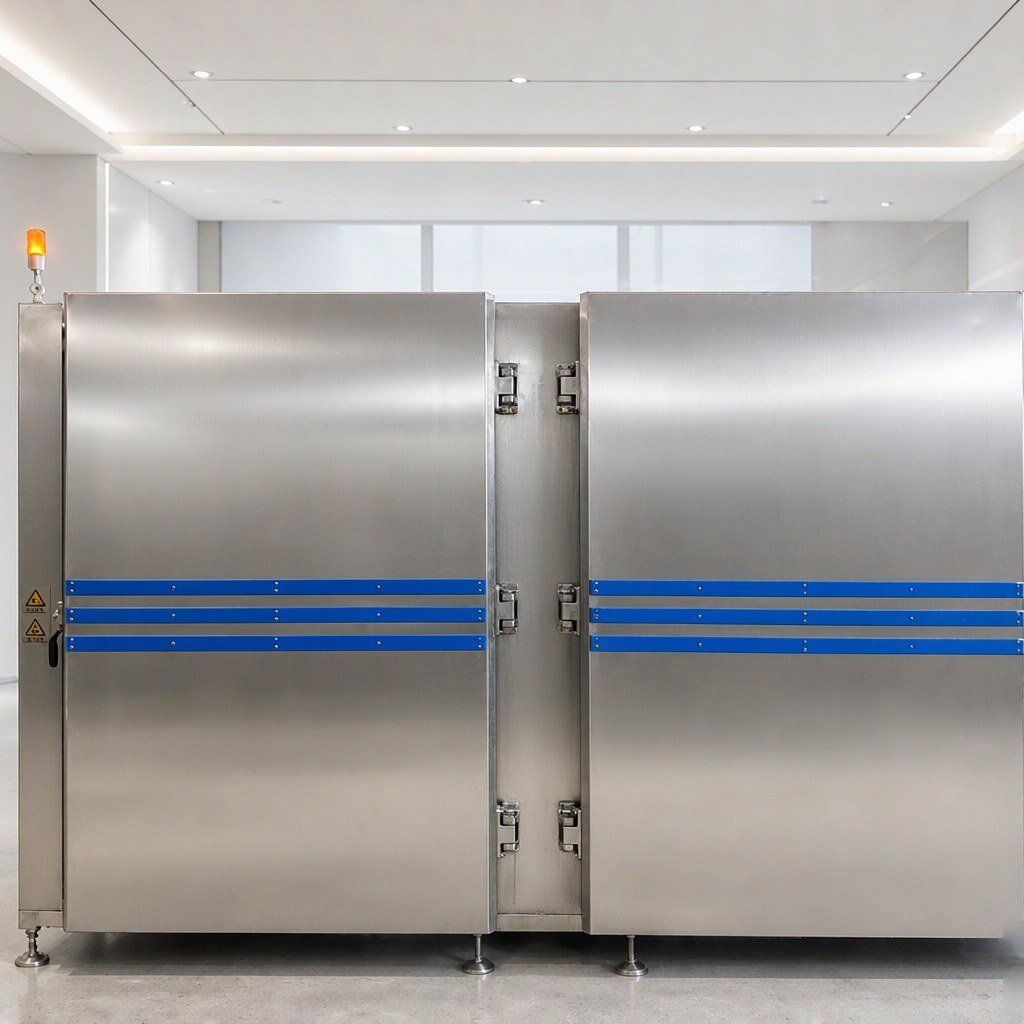
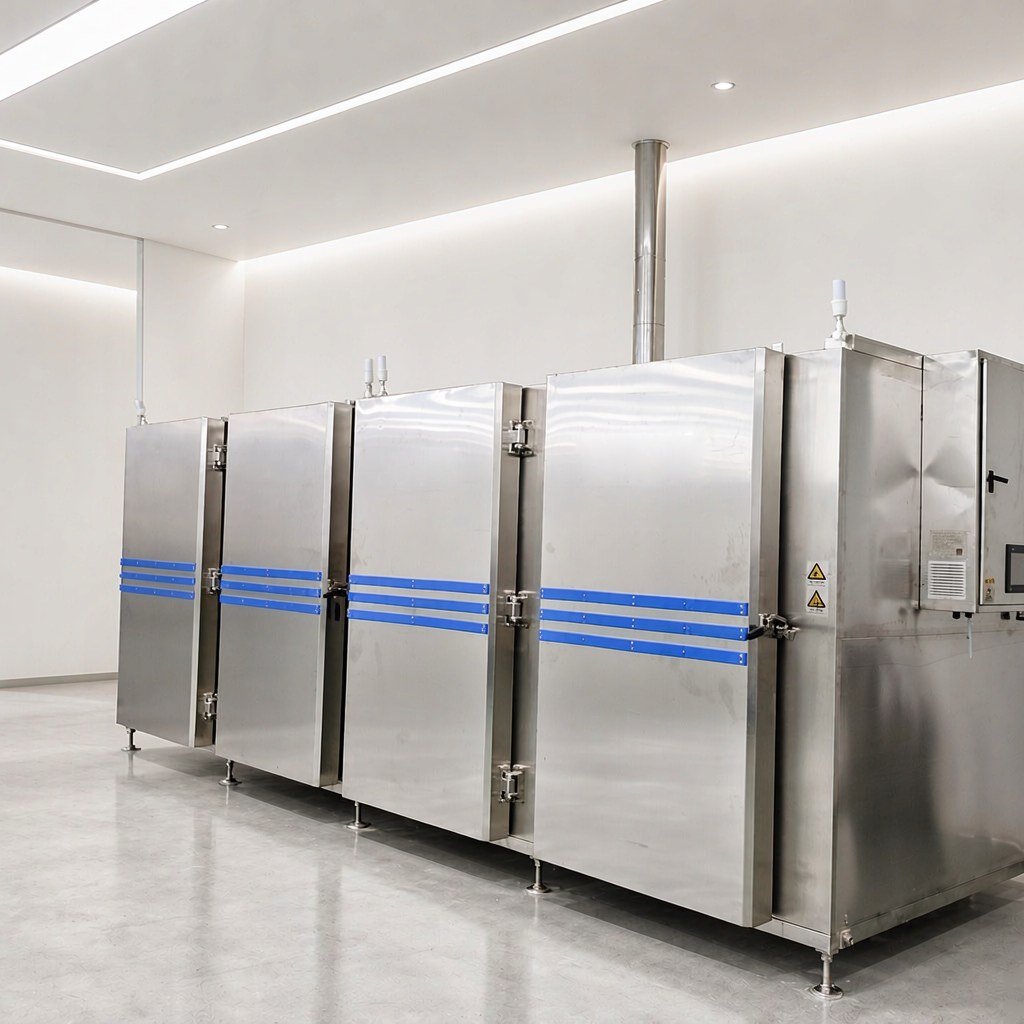
A dairy enterprise in North China mainly produces cheese blocks and dairy intermediates. Its quick freezing stage originally ran on a slow-freezing rhythm, and after each cabinet cycle the weighed output was always a little short, so yield could not be raised. Among the models available at comparable capacity is the DKN-LFC-1200 four-zone liquid nitrogen freezer: 0~1200 kg per zone, working temperature -150℃~room temperature, temperature control accuracy ±2℃, no-load cooling rate ≤50℃/min, total power 12 kW, refrigerant 6-8 BAR liquid nitrogen. Dry loss is not a scale problem; it is a problem of freezing speed and loading method.
一、Application Background
Cheese blocks and dairy intermediates differ considerably in form: formed cheese blocks have a regular shape, while intermediates such as curd and milk protein concentrate tend to be loose and high in moisture. The shared requirements are two — freeze fast, and do not compromise hygiene.
Dairy products are high-moisture, high-protein materials. During freezing, surface moisture is continuously carried away by the cold air, and this portion does not return to the product; it shows up only in the weighed output at discharge. Most of these products go on to subsequent slicing or further processing, and if the surface loses noticeable moisture and hardens, the edges tend to break during slicing. A common situation on the floor is many varieties with small individual batches; if the equipment has only one fixed rhythm, switching varieties means accommodating the one with lower output.
二、Process Challenges
Dry loss accumulates with freezing time. A water vapor pressure difference between the product surface and the cold air persists throughout. The slower the freezing, the longer the exposure to cold air and the more surface moisture is lost. Slow freezing also passes through a zone of slow ice crystal growth, where extracellular ice crystals rupture cell walls, and during thawing or slicing, juice flows out through the ruptures; this loss also counts toward yield.
Loading method determines how evenly the product freezes. In the same cabinet, thin spreading on trays versus tight stacking makes a large difference in whether cold air can reach every layer. The outer product reaches temperature first while the inner product is still at a higher temperature, so the stop point can only be judged by the slower-reaching point, extending overall freezing time and increasing dry loss.
Multi-variety scheduling relies on zoning. When variety switching is frequent, feeding by zone and cooling by zone means the product does not have to sit in the cold air waiting just to fill a cabinet.
On-site safety management of liquid nitrogen. Liquid nitrogen displaces oxygen in the air in enclosed spaces; ventilation, nitrogen usage, and personnel entry and exit should be arranged according to actual site conditions, not estimated by experience.
三、Solution Configuration
This scenario is suited to the DKN-LFC-1200 liquid nitrogen freezer, with parameters taken from the product technical documents:
| Item | Parameter |
|---|---|
| Name | Liquid nitrogen freezer (four-zone) |
| Cavity dimensions | 2000 × 1500 × 1750 mm, four zones |
| Working temperature | -150℃ ~ room temperature |
| Temperature control accuracy | ±2℃ |
| Cooling rate | ≤50℃/min (no load) |
| Load capacity | 0~1200 kg per zone |
| Total power | 12 kW |
| Refrigerant | 6-8 BAR liquid nitrogen |
| Oxygen concentration monitoring | Oxygen concentration setpoint 19.5%-21.5% |
In terms of configuration logic, liquid nitrogen is sprayed in through a porous disperser, and circulation fans break up the cold gas and direct it onto the product. Under the high temperature difference, the product surface crusts over quickly, freezing before moisture can be carried away in large amounts — this is the basic approach to compressing dry loss. The control system uses a PLC plus touchscreen, with stepwise cooling and holding; each variety stores its own program, so switching varieties means changing the program rather than the equipment; oxygen concentration detection is interlocked with the equipment. Power distribution and packaging specifications are confirmed according to the customer’s site conditions.
四、Process Points
Judge the stop point by core temperature. -150℃~room temperature is the equipment’s working range, not the discharge target. Cheese blocks of different thickness and shape cool at different rates at the core; before discharge, measure the geometric center of the product — a surface reading cannot be taken as the result.
Shorten the time spent in the ice crystal zone. Dry loss and juice loss are concentrated in the period from the start of freezing until ice crystals have largely formed, and the loading method determines how long this period is. During commissioning, measure with the actual product; do not take no-load figures as the production rhythm.
Leave air channels on trays. Place cheese blocks in a single layer or two layers, without blocks touching tightly; for loose intermediates, do not pack down when filling trays, and leave air channels between trays; do not mix products of very different thickness in the same load.
Run oxygen concentration at the setpoint. 19.5%-21.5% is the setpoint range of the oxygen concentration detector; manage the site within this range, and do not bypass alarms and interlocks.
五、Applicable Users and Model Selection Advice
This configuration suits enterprises whose products are mainly cheese blocks and dairy intermediates, with batches that are not large but variety switching that is frequent, and that have requirements for freezing dry loss and yield.
To judge between cabinet type and tunnel type, look at two things: whether orders are continuous enough that a line cannot stop, and whether the product form is single — concentrated large batches go to a tunnel line; many varieties, mixed batches, and limited floor space and hygiene zoning — a four-zone cabinet is more suitable. Before selection, it is advisable to define clearly: single-batch input and daily cumulative volume, product block shape and packaging form, target core temperature, and workshop ventilation and liquid nitrogen supply conditions.
For model parameters, see the liquid nitrogen freezer DKN-LFC-1200 product page; for the boundary between cabinet type and tunnel type, see key points for selecting a liquid nitrogen freezer; on-site practices in similar industries are being compiled in customer cases. To check the configuration against your own product and scheduling method, you can contact us.
FAQ
How does freezing dry loss occur?
A water vapor pressure difference exists between the product surface and the cold air. During freezing, surface moisture is continuously carried away, and this portion does not return to the product; it shows up directly in the weighed output at discharge. The longer the freezing time, the more moisture loss accumulates. Shortening the time the product spends passing through the zone of maximum ice crystal formation can reduce this loss.
How does the four-zone structure help yield?
The four zones allow feeding by zone and cooling by zone, so the product does not have to wait in the cold air just to fill a cabinet; waiting time and ineffective exposure time are reduced, and surface moisture loss decreases accordingly. The specific effect should be measured during commissioning according to the actual loading method and target core temperature.
How should the 1200 kg per zone load capacity be understood?
0~1200 kg per zone is the loading range of a single zone of the equipment, with four zones in the whole cabinet. How much is actually loaded depends on product form, tray dimensions, and number of stacking layers; overly dense stacking affects the passage of cold air, and the load should be checked together with freezing time, not scheduled by the weight limit alone.