
With every increase in altitude, atmospheric pressure drops, and the boiling point of liquid nitrogen falls accordingly. The equipment itself has not changed, but the cooling process for the same batch of material on the same machine will differ. For projects above 2000 m altitude (South American plateaus, Yunnan-Guizhou Plateau, parts of Central Asia), the local atmospheric pressure must be used as an input condition during the planning stage, rather than directly applying plains parameters.
Under High-Altitude Conditions, Which Items Actually Change
| Parameter | Direction of Change | Impact on the Quick Freezing Process |
|---|---|---|
| Local atmospheric pressure | Decreases with increasing altitude | All stages measured by pressure require conversion |
| Liquid nitrogen boiling point | Decreases as atmospheric pressure drops | Liquid nitrogen vaporizes more easily; available temperature difference and heat exchange conditions change |
| Air density | Decreases | At the same fan speed, mass air flow decreases |
| Compressor cooling conditions | Thin air, poorer heat dissipation | Air-cooled condensers need to be enlarged or converted to water cooling |
Among these, atmospheric pressure and liquid nitrogen boiling point should be verified first, because they directly determine the actual temperature environment the material sees inside the cabinet or tunnel. At around 2000 m altitude, atmospheric pressure is approximately eighty percent of standard atmospheric pressure, and the liquid nitrogen boiling point drops by a few degrees accordingly; specific values should be based on measured atmospheric pressure at the project site, and cannot be roughly estimated from altitude alone.
Information the customer needs to provide during the planning stage: project location (city), altitude, locally measured or available atmospheric pressure, and on-site ambient temperature range. With these four items, it is possible to determine whether the equipment configuration needs adjustment.
Is a Lower Liquid Nitrogen Boiling Point Good or Bad for Quick Freezing
It cannot be generalized; it must be examined in two parts.
First, the source of cooling capacity. The available cooling capacity of liquid nitrogen consists of two parts: the latent heat of vaporization and the sensible heat from warming low-temperature nitrogen gas. After the boiling point decreases, the sensible heat temperature difference between the boiling point and the target exhaust temperature narrows, so the heat that can be removed per unit mass of liquid nitrogen decreases slightly. Under the premise that batch size, loading method, and target core temperature all remain unchanged, the theoretical lower limit shifts up slightly.
Second, heat exchange conditions. The temperature difference between liquid nitrogen and the material is determined by “liquid nitrogen temperature” to “material temperature.” A lower boiling point means liquid nitrogen is colder, so the temperature difference between the material and the cold source actually increases, raising the heat exchange rate per unit time. These two effects work in opposite directions, and the result depends on material thickness, loading density, and liquid supply method. It can only be calibrated through trial runs, not derived from a single formula.
The conclusion is: for high-altitude projects, directly applying plains parameters to processing capacity and consumption will be inaccurate, and adjustment margin must be reserved in the plan.
Exhaust and Fans: Recalculate by Mass Flow
The exhaust stage is easily overlooked. The volume of nitrogen gas produced after liquid nitrogen vaporizes increases as atmospheric pressure drops for the same mass — that is, at high-altitude sites, the same batch of liquid nitrogen produces a larger gas volume. Exhaust fans are selected by volume flow rate. If plains air volume is copied directly, the site may experience insufficient exhaust capacity.
- Calculate the mass of nitrogen produced from the liquid nitrogen quantity per batch, then convert to volume flow using local atmospheric pressure;
- Select fan air volume with margin based on the converted volume flow;
- After nitrogen density decreases, the air exchange capacity at the same fan pressure decreases, and duct resistance must be recalculated.
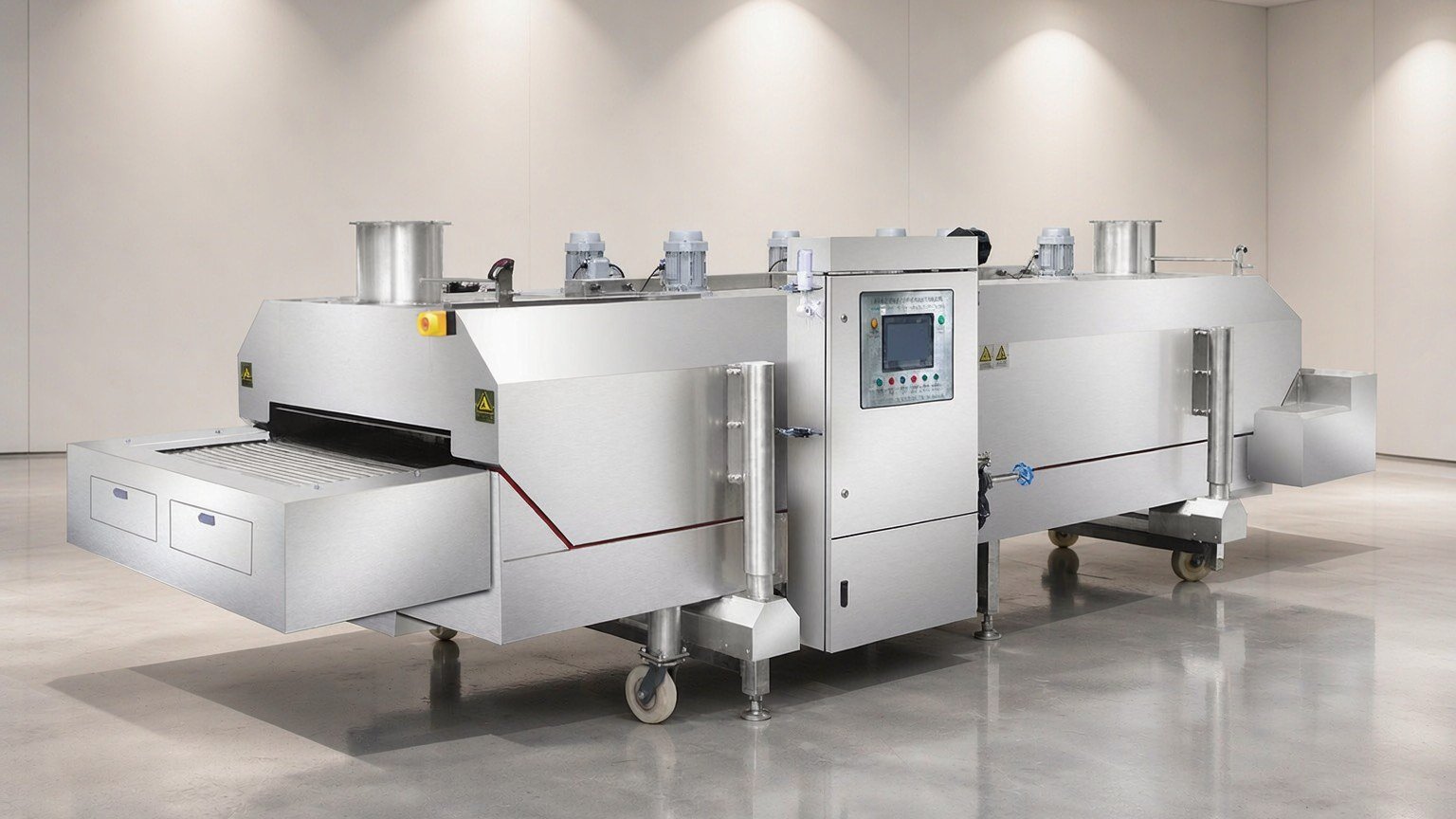
For exhaust and oxygen concentration monitoring practices for liquid nitrogen quick freezing cabinets, see Exhaust and Oxygen Concentration Monitoring for Liquid Nitrogen Quick Freezing Cabinets; tunnel production lines have exhaust extraction ports at the inlet and outlet ends; for structure and air volume parameters, see Liquid Nitrogen Quick Freezing Tunnel.
Refrigeration and Electrical Sections: Determining When to Switch from Air Cooling to Water Cooling
High altitude is usually accompanied by two conditions: low air density and large day-night temperature differences. For liquid nitrogen quick freezing equipment, the refrigeration section is mainly used in auxiliary stages (such as the pre-cooling section or the refrigeration cycle of immersion-type rapid chillers). If this section uses air-cooled condensers, heat dissipation capacity decreases after altitude increases, and it is necessary to evaluate whether to switch to water cooling or evaporative cooling.
The recommended sequence for evaluation is as follows:
- First confirm which stages in the equipment rely on air cooling (air-cooled condensers, electrical cabinet heat dissipation, hydraulic or pneumatic components);
- Recalculate heat dissipation capacity based on local air density;
- For the insufficient portion, switch to liquid cooling or increase heat dissipation area;
- Select electrical components separately based on local voltage and frequency.
For selection points related to voltage and frequency, see Quick Freezing Equipment Selection Under Voltage and Frequency Differences in Export Markets.
On-Site Data Checklist
Breaking this down according to the items above, the on-site data needed during the planning stage for high-altitude projects is:
| Data Item | Purpose |
|---|---|
| Project location and altitude | Preliminary determination of pressure range |
| Local atmospheric pressure | Convert liquid nitrogen boiling point and nitrogen volume |
| Ambient temperature range and humidity | Determine equipment heat dissipation and condensation |
| Power supply voltage, frequency, phases | Electrical component selection |
| Cooling water conditions (water temperature, water volume, water quality) | Determine air-cooled/water-cooled plan |
| Workshop ceiling height and exhaust conditions | Exhaust and piping layout |
Only when the data is complete can the configuration have a basis; filling in missing items by experience increases the probability of error. For the composition of liquid nitrogen consumption and on-site controllable factors, see Liquid Nitrogen Consumption in Liquid Nitrogen Quick Freezing: Which Factors Are Driving It Up and How to Control It On-Site.
Frequently Asked Questions
Can the same model be used in high-altitude areas?
Yes, in most cases the model remains the same; what changes are configuration details: exhaust air volume converted according to local atmospheric pressure, evaluation of whether air-cooled condensers should be converted to water cooling, and electrical components selected according to local voltage and frequency. The specific scope of changes can only be determined after reviewing on-site data.
Above what altitude must conversion be performed?
There is no single unified dividing line. Generally, above 1000 m altitude, exhaust and heat dissipation should begin to be verified; above 2000 m, it is recommended to use atmospheric pressure as a planning input. Plains projects below 1000 m can be handled according to standard atmospheric pressure.
Do liquid nitrogen storage and supply piping need to be modified?
The selection of tanks and piping is verified by the gas supplier according to local conditions; we provide the equipment’s gas consumption and interface requirements. The length and routing of vacuum-insulated piping are confirmed during the layout stage; for related points, see Key Points for Liquid Nitrogen Storage Tank and Cryogenic Piping Design.
Does high altitude affect freezing quality?
Quality depends on the time the material spends passing through the ice crystal formation zone, which is determined by the cooling curve, not directly by altitude. What altitude changes is whether the equipment can operate according to the designed curve; if the parameter conversion is done correctly, the curve can be reproduced.
For quick freezing projects at high altitude or in special environments, you can send the project location, altitude, ambient temperature, power supply conditions, and single-batch product information, and we will provide configuration suggestions based on actual conditions: Contact Kunning Cryo
The physical relationships in this article (atmospheric pressure decreasing with altitude, liquid nitrogen boiling point changing with pressure) are general physical common knowledge; equipment parameters and exhaust practices are cited from Kunning Cryo liquid nitrogen quick freezing cabinet and liquid nitrogen quick freezing tunnel technical documents, and data for each model is subject to the corresponding technical parameters.