In the freezing stage of bakery products, the root of wrong equipment selection is rarely the machine itself, but treating raw blanks and baked goods as the same type of material. Raw blanks must pass through the 0℃ to -5℃ range within tens of minutes; slow down a step, and the gluten network and yeast state cannot recover. Baked bread, mooncakes and egg tarts still have core temperatures above 60℃; sending them directly into freezing means letting the equipment cool them down first. Configure the two paths separately—tunnel lines, cabinet machines and rapid chillers each handle one segment—and the rhythm runs smoothly.
I. First Split into Two Paths: Raw Blanks and Baked Goods
| Category | Typical products | Infeed state | Problem to solve | Equipment form |
|---|---|---|---|---|
| Raw blanks | Frozen dough, croissant and Danish blanks, baguette blanks, pizza bases, tart shell blanks | Room temperature or refrigerated after shaping | Pass quickly through the ice crystal zone, preserve gluten network and yeast activity; no surface moisture loss | Tunnel line continuous freezing, or cabinet machine batch freezing |
| Unbaked pastry | Baozi, dumplings, shumai, tangyuan | Room temperature after shaping | Individual quick freezing, pieces do not stick together, skin does not crack | Tunnel line (mesh belt arrangement) or cabinet machine |
| Baked finished goods | Bread, toast, mooncakes, egg tarts, pastries | Core temperature 60–90℃ | First pass through the danger temperature zone down to packaging temperature, then box | Rapid chiller first, then package and freeze |
The difference among the three categories is not the temperature setting level, but what needs to be prevented: raw blanks prevent ice crystal growth, unbaked pastry prevents sticking and skin breaking, baked goods prevent condensation inside bags and internal cavity temperature fluctuation. Running all three categories mixed in the same freezing stage means outgoing sampling can only show an average—which batch drifted cannot be identified.
II. Frozen Dough: What It Fears Is Not Low Temperature, but Slowness
The process requirements for quick freezing are written into the definition: pass through the maximum ice crystal formation zone within 30 minutes, core temperature from 0℃ down to below -5℃, ice crystal diameter less than 100 μm, core temperature below -18℃ when leaving the equipment. Dough has considerable moisture content; during freezing, water crystallizes between the gluten network. The slower the crystallization, the larger the ice crystals, and the more locations where gluten is compressed and deformed. During thawing and proofing, these locations cannot support themselves, and the baked volume and internal texture differ from unfrozen dough.
Yeast is another line. Low temperature causes some yeast to lose activity; the longer the freezing process, the greater the loss. Increasing yeast in the formula can compensate somewhat for “not rising,” but fermentation products and flavor change accordingly—compensating through formula is not as good as compressing time in the freezing stage.
Thickness is easily overlooked. A large toast blank and a small tart shell blank have freezing times of different orders of magnitude; sharing one mesh belt speed and one program inevitably means one side is overdone while the other is not frozen through. Running different specifications on the same equipment requires programs stored and adjusted separately, and loading methods must change accordingly.
Surface moisture loss is often missed. Bare dough standing long in a strong-air environment dries at the skin first; after freezing a shell forms on the surface, and baking yields thick crust that cracks easily. The liquid nitrogen quick-freezing dry-loss range given in the company’s technical materials is 0.25%–0.5%; longer air-blast time and higher air speed push this number upward.
III. Equipment Configuration: Tunnels for Volume, Cabinets for Variety
The selection judgment is not complicated: single category, stable daily output, workshop able to lay out a straight line—go with a tunnel line; many varieties, several hundred kilograms per batch, specifications changed several times a day—go with a cabinet machine. This statement works better in a pastry workshop than in a seafood workshop, because pastry specification density is inherently high.
Published parameters of the liquid nitrogen tunnel line:
| Item | DKN-LFT-1206 | DKN-LFT-1212 | DKN-LFT-1612 |
|---|---|---|---|
| Tunnel mesh belt size | 6000 mm × 1200 mm | 12000 mm × 1200 mm | 12000 mm × 1600 mm |
| Equipment external dimensions | 6000 × 2200 × 1750 mm | 12000 × 2250 × 1670 mm | 12000 × 2700 × 1950 mm |
| Working temperature | -150℃ ~ room temperature | -150℃ ~ room temperature | -150℃ ~ room temperature |
| Temperature control accuracy | ±2℃ | ±2℃ | ±2℃ |
| No-load cooling rate | 10℃ per minute | 10℃ per minute | 10℃ per minute |
| Infeed/outfeed cycle | 6–30 minutes adjustable | Set by mesh belt speed | 8–40 minutes adjustable |
| Total power | 9 kW | 18 kW | 26 kW |
| Power supply specification | 380V/50Hz | 380V/50Hz | 380V/50Hz |
| Liquid nitrogen pressure | 5-8 BAR | 5-8 BAR | 0.5-0.8 MPa |
The 1206 suits lines with tight workshop length and medium output; the 1212 and 1612 both have 12-meter mesh belts, with a 400 mm width difference that changes how many rows fit side by side—calculate according to your own product arrangement before choosing. The 1612’s freezing capacity is calculated by material and packaging; the technical document gives a figure of approximately 1000 kg/h, which must be measured on your own products.
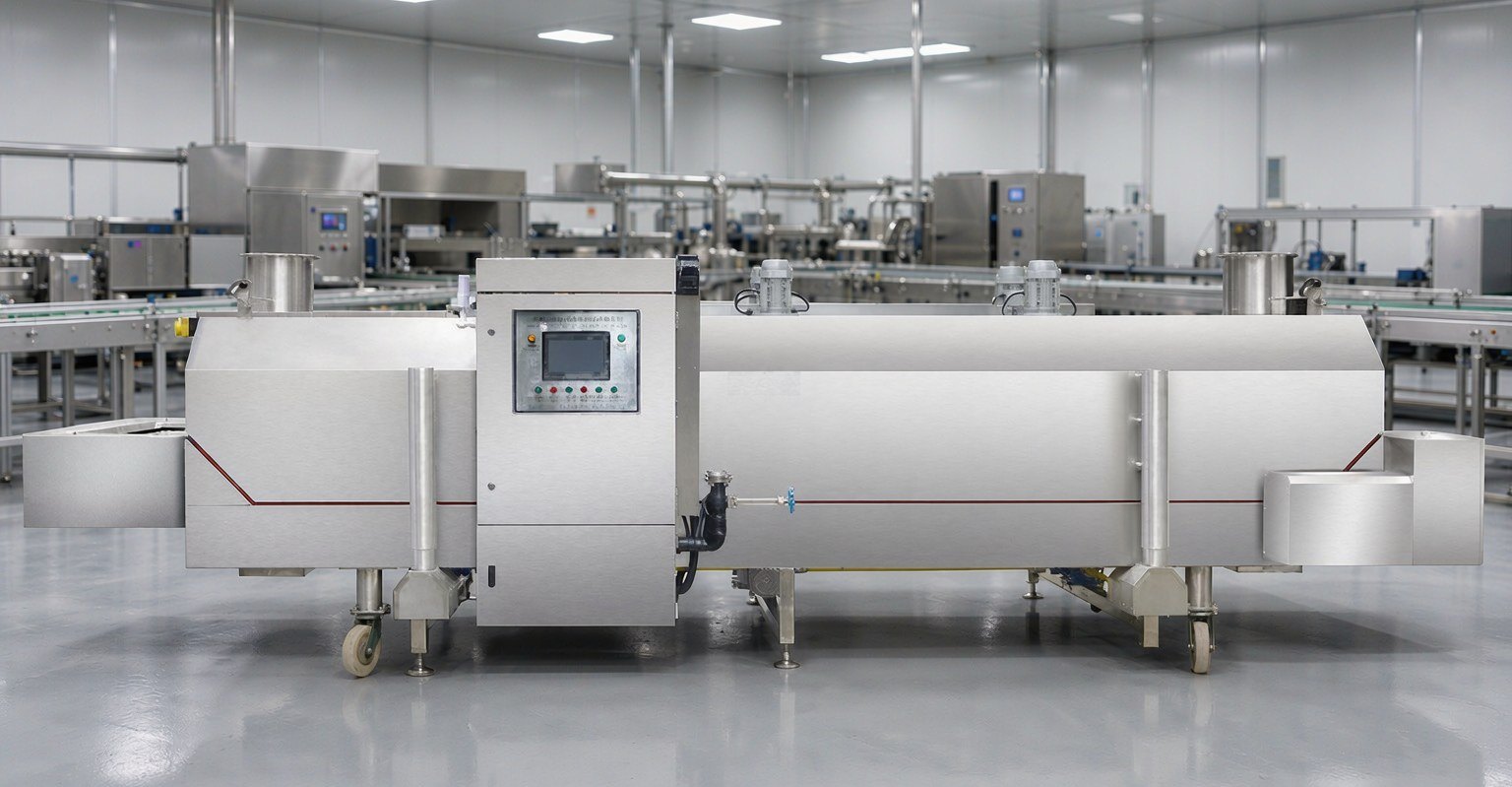
The liquid nitrogen solution requires a storage tank, cryogenic piping and exhaust; if site conditions do not allow, a compressor-refrigerated mesh-belt freezer is another path: 1600 mm wide mesh belt, 12 m long, runs once powered and with condenser heat dissipation conditions configured; working temperature, freezing cycle and total power are configured according to material and capacity. For how to choose between the two cold sources, see Comparison of Liquid Nitrogen Quick Freezing and Mechanical Refrigeration Quick Freezing.
Multi-variety workshops use cabinet machines; parameters of the four-zone DKN-LFC-1200:
| Item | Parameter |
|---|---|
| Inner cavity dimensions | 2000 mm (W) × 1500 mm (D) × 1750 mm (H), four zones |
| Equipment external dimensions | 8730 mm (W) × 2350 mm (D) × 2170 mm (H) |
| Racks | 10, 1300 × 1500 × 1470 mm, upper and lower tiers |
| Working temperature | -150℃ ~ room temperature |
| Temperature control accuracy | ±2℃ |
| No-load cooling rate | ≤ 50℃/minute |
| Load capacity | 0–1200 kg per zone |
| Total power | 12 kW |
| Liquid nitrogen pressure | 6-8 BAR |
The four zones allow zone-by-zone loading and unloading; one zone freezes while the others load and unload, so changing varieties does not require waiting for the whole cabinet to finish. In multi-variety bakery workshops, this is more practical than pure capacity figures.
IV. Baked Goods: First Cool to Packaging Temperature
Bread, toast, mooncakes and pastries come out of the oven at core temperatures of 60–90℃. Packaging at this temperature causes condensation inside the bag, and mold risk rises accordingly; pushing directly into the freezing stage repeatedly pulls up the equipment cavity temperature, so the freezing effect of the first and second halves of the same batch do not match, and later compensating by extending time means the surface has already been over-frozen.
Parameters of the dual-cabinet rapid chiller DKN-RHC-60D-45:
| Item | Parameter |
|---|---|
| Structure | Dual-cabinet, two cabinets with independent doors |
| Cabinet internal temperature | -45℃ |
| Evaporation temperature | -40℃ |
| Cooling method | Forced cold air circulation, atmospheric pressure, no vacuum system |
| Equipment external dimensions | 1900 × 940 × 2150 mm |
| Single cabinet internal dimensions | 580 × 720 × 1430 mm |
| Single cabinet volume | 0.597 m³ (two cabinets total 1.194 m³) |
| Loading | 30 standard trays per cabinet, 3–5 kg per tray, about 100 kg per cabinet, about 200 kg for two cabinets |
| Infeed temperature | 60–90℃ |
| Outfeed temperature | 3–10℃ (adjustable) |
| Single-batch cooling time | 1–2 hours (depending on food type and infeed temperature) |
| Total power | 4.55 kW |
| Power supply | 220V / 380V optional |
Packaging temperature is set by the product process specification; different categories have different requirements, and no single unified number is applied. Judgment uses a probe thermometer inserted into the center; an infrared thermometer reads surface temperature and cannot substitute. The two cabinets are independently controlled—one cooling while the other loads and unloads—so upstream and downstream processes do not wait on each other.
V. Individual Quick Freezing: Sticking and Deformation Mostly Come from Arrangement
Single-layer arrangement, leave spacing. Stacking layers on the mesh belt means lower blanks exchange heat through the layer above, spreading the time-to-temperature of each layer within the same batch. The same applies to trays entering cabinet machines—arranged to “full” versus arranged to “through” produces visibly different outgoing quality.
Surface treatment per product process. Dough blanks are dusted with flour or brushed with oil; tangyuan and dumpling surfaces stay dry. Do not leave them on room-temperature tables for long before infeed—surface moisture returns and they stick together as one piece upon entering the equipment.
Outfeed goes directly into below -18℃ environment. The segment from outfeed to cold storage is exposed to the room-temperature workshop; if the surface warms before re-freezing, ice crystals regrow, and the effort spent increasing freezing speed is wasted.
Clean the machine when changing varieties. The tunnel line has an integral lift-type body, 304 stainless steel cavity, shallow V bottom with drain port; when changing varieties, lift the body to clean the mesh belt and cavity, drain residue and standing water before running the next batch. Sloppy cleaning means the next batch’s appearance problems show up first on edge pieces.
VI. Batch Consistency Relys on Programs and Records
For controls, tunnel lines and cabinet machines share one logic: touchscreen input, PLC control, PID automatic adjustment, multiple freezing processes stored for one-key recall—changing products means adjusting programs, not relying on operator feel; cabinet machine programs can also run cooling and holding in ten steps, with automatic alarm and power-off after the program ends. Temperature measurement uses PT100 platinum resistance, Class A accuracy, range 200℃~-200℃, one master and one monitor; outfeed judgment takes the core temperature reading, not time as the endpoint.
Safety items must be tested unit by unit at acceptance: oxygen concentration detection setpoint 19.5%–21.5%, over-temperature alarm, emergency stop switch, grounding and phase sequence protection. Liquid nitrogen is a cryogenic medium; ventilation and oxygen concentration—these two items—acceptance records must be kept.
The compliance line must also be aligned in advance. GB 19295-2021 “National Food Safety Standard Quick-Frozen Flour and Rice Products and Prepared Foods” was issued on September 7, 2021 and implemented on March 7, 2022; the standard requires product storage and sales temperature controlled at -18℃ or below, with temperature fluctuation controlled within 2℃; labels must indicate quick-frozen, raw or cooked, ready-to-eat or non-ready-to-eat, and cooking method (source: National Center for Food Safety Risk Assessment standard interpretation material, September 7, 2021, https://sppt.cfsa.net.cn:8086/staticPages/1A0E2FC1-1B11-4A3C-A17E-8BB22A441A2A.html). What the equipment side can do is record outfeed core temperature and post-freezing transfer time into batch records, so labels and cold chain have a basis.
FAQ
How long must frozen dough be frozen to count as frozen through?
Look at individual thickness, infeed temperature and loading method, not the clock. The endpoint is core temperature below -18℃; the process requirement is to pass through the maximum ice crystal formation zone from 0℃ to -5℃ within 30 minutes, with ice crystal diameter less than 100 μm. What is adjustable on the equipment side is mesh belt speed and liquid nitrogen flow; before production, run a full load with your own dough, record time, core temperature and loading layers, and write them into the work procedure.
Bread blanks turn white on the surface after freezing and crack after baking—is the temperature not low enough?
Mostly it is surface moisture loss, not temperature. Bare dough standing long in strong air dries at the skin first; after freezing a shell forms, and during baking the shell sets first while the interior is still expanding, so it cracks. In practice, compress surface exposure time: no long standing before infeed, single-layer arrangement, dusting per process; package and freeze as soon as possible after outfeed.
Can cabinet machines and tunnel lines be placed in the same workshop?
Yes, and it is common. The tunnel line runs main single products; the cabinet machine handles new products, small batches and rework batches. Tray and transfer cart specifications should be unified as much as possible, reducing one tray transfer in between and one more exposure of material in the room-temperature area. Place the rapid chiller on the infeed side of the freezing equipment so baked goods do not need cross-workshop transfer.
Can freshly baked bread go directly into the freezer cabinet?
Not recommended. Products with core temperature 60–90℃ entering the freezing stage directly repeatedly pull up the equipment cavity temperature, freezing is inconsistent between the front and back of the same batch, and condensation easily forms inside bags after packaging. First pass through the rapid chiller down to the packaging temperature range specified by the process, then package and freeze. The DKN-RHC-60D-45 outfeed temperature is adjustable from 3–10℃, with single-batch cooling of 1–2 hours.
Next Step
Send over these four items—product category (raw blanks / unbaked pastry / baked goods), individual weight and arrangement method, daily output, and available workshop length—and a configuration suggestion will be provided based on these four items. The message entry is at Contact Us.
Related reading: Liquid Nitrogen Quick-Freezing Tunnel Line, Liquid Nitrogen Quick-Freezing Cabinet, Production Scheduling and Material Flow for the Pastry Food Freezing Stage