
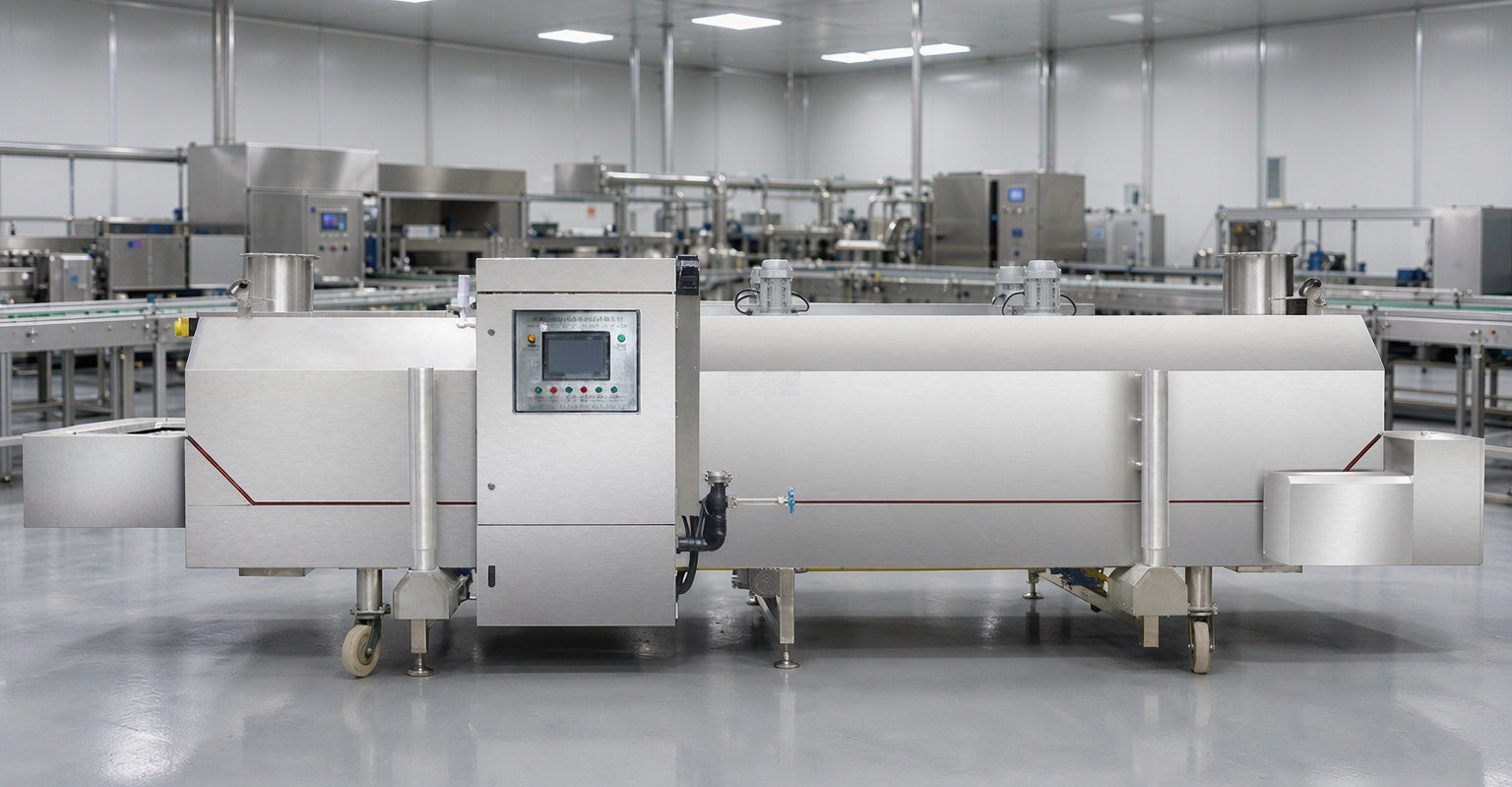
Industry: fish head processing | Region: Northwest | Equipped model: DKN-LFT-1206 liquid nitrogen quick-freezing tunnel line Customer information has been anonymized; the model configuration is a selection recommendation for similar capacity.
I. Application Background
The raw material for fish head products comes from bulk freshwater fish, with a strong catching season, arrivals concentrated in a few months, and large day-to-day differences in intake volume. The product forms are split fish heads and fish head chunks, sold through restaurant, hot pot and prepared dish channels, mostly individually frozen, with core temperature brought below -18℃.
Fish heads are irregular in shape, with exposed surface meat at the gill cover and eye socket areas; frozen in a pile they deform under pressure, and the appearance drops a grade after thawing. Trays must be spaced apart and must not be pressed in a single line, which directly determines the loading method and mesh belt width.
II. Process Challenges
First, capacity must be configured by peak. During the catching season arrivals are concentrated and upstream output is large; if quick freezing cannot keep up, product piles up; in the off-season the equipment is underused. Calculating only by average output will cause blockage in peak season, while calculating only by peak gives a high investment.
Second, space in an old workshop is fixed. Clear height, door width and aisle width are all set. Whether the equipment can get in is one thing, and how much front-end operating space remains after it is in is another. Fish head processing is labor-intensive work; if the equipment footprint is large, operating positions get squeezed out and the front end actually becomes slower.
Third, in-feed and out-feed flows easily cross. If both ends of the equipment are loaded and unloaded on the same side, material carts must turn back and share the same aisle section with loading workers. Once the aisle is narrow, labor is all spent waiting for carts.
III. Solution Configuration
This scenario is suited to the DKN-LFT-1206 liquid nitrogen quick-freezing tunnel line, with main parameters as follows (quoted from product technical documents):
| Item | Parameter |
|---|---|
| Tunnel mesh belt | 6000 mm (length) × 1200 mm (width) |
| External dimensions | 6000 × 2200 × 1750 mm |
| Working temperature | -150℃ to room temperature |
| Temperature control accuracy | ±2℃ |
| Cooling rate | 10℃ per minute at no load |
| Total power | 9 kW |
| Refrigerant | 5-8 BAR liquid nitrogen (liquid nitrogen tank self-provided) |
| Oxygen concentration monitoring | Oxygen concentration setpoint 19.5%-21.5% |
The configuration logic comes down to three points.
First, the footprint of the unit itself. The external dimension figures are only the outline of the tunnel line itself; the loading position, unloading position and maintenance aisle at both ends are not included, and must be calculated separately according to the actual workshop layout; the layout is confirmed per order.
Second, mesh belt width. 1200 mm determines how many trays or racks can be placed side by side in one row. Fish heads must be spread individually with spacing; when loading density cannot be increased, widening the mesh belt is more reliable than speeding up the belt: freezing time is preserved, and the surface will not be under-frozen. In-feed and out-feed are set at opposite ends, and material carts travel one way.
Third, cold source and electricity. Total power is shown in the table above; the liquid nitrogen tank is self-provided by the user; changes mainly involve the tank placement position and piping route, which must be decided together with the workshop layout in advance.
IV. Process Points
Decide the loading method first, then discuss belt speed. Fish head chunks are thin and whole fish heads are thick; at the same belt speed the thicker batch may not reach the target core temperature. In practice, run by specification in batches: run thin material first, confirm the core temperature is reached, then adjust for thick material; parameters are confirmed per order.
The maximum ice crystal zone must be passed quickly. From -1℃ to -5℃ is the range where ice crystals form in large amounts; a long dwell makes crystals coarse, cells are ruptured, and drip loss on thawing is obvious, with a dry, tough surface. The tunnel line runs material continuously, and the time material spends in this temperature zone is determined jointly by mesh belt speed and temperature zones.
Individual freezing, core temperature and oxygen concentration are handled by the rules. Space trays at the in-feed end and collect product promptly at the out-feed end; if frozen together, breaking them apart later damages the shape; for core temperature sampling, choose the thicker part; just out of the tunnel the core still carries residual heat, so read after the temperature stabilizes; after loading and unloading, maintenance and mesh belt cleaning, first confirm the oxygen concentration has returned to the set range before entering, and evacuate people first on alarm.
V. Suitable Users and Selection Advice
The tunnel line suits scenarios with a relatively single product type, continuous batches, and a wish to fix the loading motion: aquatic frozen products such as fish heads, fillets and peeled shrimp, as well as poultry cuts and prepared dishes with stable batches.
To judge between cabinet and tunnel types, ask three questions: whether the per-shift batch is continuous enough that material runs batch after batch without stopping in between, which is when a tunnel line pays off; how many specifications there are in a day; with many specifications and small volumes, changing material requires cleaning the mesh belt and adjusting parameters, so a cabinet is more flexible; whether the workshop has the conditions to set in-feed and out-feed positions at opposite ends; if the flow cannot be separated, the continuity of the tunnel cannot be brought into play.
If all three hold, the tunnel line is suitable; for small batches, mixed varieties and cramped sites, the DKN-LFC series liquid nitrogen quick-freezing cabinet is configured for exactly this scenario.
For selection, first define three things clearly: material form, target core temperature, per-shift batch; operating parameters such as material layer thickness, belt speed and nitrogen make-up rate are ultimately confirmed during commissioning according to the actual product, and cannot be copied from other categories.