Industry: Crayfish processing | Region: Domestic | Equipped model: DKN-LFT-1206 liquid nitrogen quick-freezing tunnel line Customer information has been anonymized; the model configuration is a selection recommendation for similar capacity.
I. Application Background
The seasonality of crayfish processing is a curve that is almost a straight line. The peak season is concentrated in one period, and the workshop staffs up according to peak levels; when orders drop in the off-season, equipment sits idle and workers disperse. Product forms fall roughly into three categories: cooked crayfish in shell, peeled shrimp meat, and frozen blocks sorted by specification. Both IQF and block freezing methods are used, and the core temperature is required to reach below -18℃.
This order structure determines that equipment cannot be calculated on capacity alone; labor must also be factored in. Temporary workers hired during peak season are unfamiliar with the equipment, and loading speed depends entirely on feel; when a shift changes, freezing parameters drift along with it. The processing side actually has only two requirements for the freezing stage: the core temperature must be reached, and the discharged product form must not break or stick together.
II. Process Challenges
Loading and transfer account for the bulk of manual labor. A common practice is to mix three loading methods: trays, racks, and carts. The front section is manually tray-loaded, the middle relies on cart transfer, and finally the product is dumped onto the mesh belt. Throughout the process, the tunnel belt speed is constant, but the manual loading speed fluctuates. When the two do not match, either the mesh belt runs short of material or the infeed end piles up, and freezing time varies accordingly.
Batch consistency cannot be maintained by relying on people. Across different shifts on the same day, if the material layer thickness, when nitrogen supplementation starts, and when discharge stops are all based on experience, the surface condition and core temperature of the frozen product will differ by a noticeable margin. The customer’s quality control can spot the difference with a single sampling inspection.
Operational safety in a liquid nitrogen environment. Cold air spills from the tunnel inlet and outlet, and nitrogen displaces local oxygen. The loading end and discharge end are precisely where operators spend longer periods of time. Actions such as loading and unloading, maintenance, and cleaning the mesh belt must all be completed beside the equipment, and oxygen concentration monitoring cannot rely on people watching it.
III. Solution Configuration
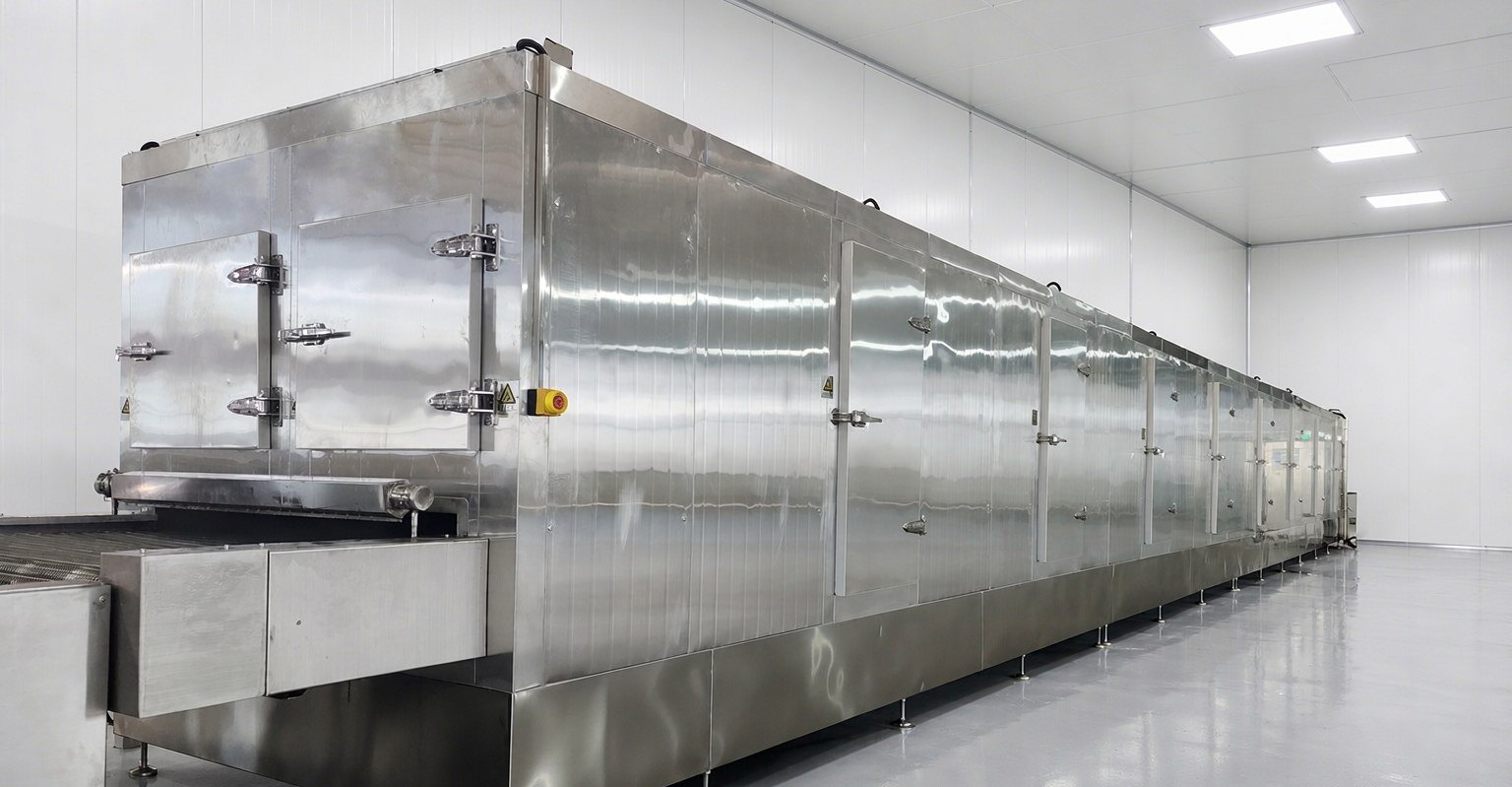
This scenario is suited to the DKN-LFT-1206 liquid nitrogen quick-freezing tunnel line. Main parameters are as follows (quoted from product technical documents):
| Item | Parameter |
|---|---|
| Tunnel mesh belt | 6000 mm (length) × 1200 mm (width) |
| External dimensions | 6000 × 2200 × 1750 mm |
| Operating temperature | -150℃ to room temperature |
| Temperature control accuracy | ±2℃ |
| Cooling rate | Can drop 10℃ per minute at no load |
| Total machine power | 9 kW |
| Refrigerant | 5-8 BAR liquid nitrogen (liquid nitrogen storage tank self-provided) |
| Oxygen concentration monitoring | Oxygen concentration setpoint 19.5%-21.5% |
The configuration logic mainly depends on three points. First, the 1200 mm mesh belt width corresponds to an arrangement where racks or trays are placed side by side, with infeed and discharge on the same axis, leaving one workstation each at the loading end and discharge end, which can reduce the number of transfers (actual arrangement to be confirmed according to the order). Second, the temperature control accuracy of ±2℃, combined with the no-load cooling rate of 10℃ per minute, keeps different shifts comparable under the same setting; once parameters are set, fewer operating actions mean greater stability. Third, oxygen concentration monitoring is configured with a setpoint of 19.5%-21.5%, with an alarm when exceeded. This is a mandatory safety design for liquid nitrogen equipment and is also the prerequisite for operators to stand at the loading end for extended periods. The total machine power is 9 kW, and cooling relies on 5-8 BAR liquid nitrogen (storage tank self-provided), so the workshop’s electrical load pressure is not high.
IV. Process Points
Belt speed and material layer thickness must be matched. If the material layer is spread thick, the surface freezes first and the core can only be compensated by time. In actual use, it is common to start with a thin material layer on a trial run, confirm the core temperature is reached, and then adjust gradually. The specific thickness and belt speed are to be confirmed according to the order.
Discharge based on core temperature sampling. The goal is to bring the core temperature below -18℃. When the product has just exited the tunnel, the core still carries residual heat. When sampling to measure core temperature, representative positions must be selected; the sampling points for IQF and block freezing are different.
The speed of passing through the maximum ice crystal formation zone determines quality. Shrimp meat has a high water content. Moving faster through the -1℃ to -5℃ range produces smaller ice crystals, resulting in less drip loss after thawing; moving slowly through this range makes the meat fibrous and causes noticeable weight loss. The tunnel line runs material continuously, and the time material spends in the temperature zones is determined jointly by mesh belt speed and temperature zoning.
Read oxygen concentration from the meter, not by feel. Before and after opening doors for loading and unloading, and after maintenance and mesh belt cleaning, first confirm that the oxygen concentration has returned to the 19.5%-21.5% range before entering to operate. Once an alarm is triggered, evacuate personnel first, then investigate the cause.
Fix the loading method first. The three methods—trays, racks, and carts—differ greatly in their dependence on manual labor: manual tray loading requires low investment, but speed is tied to manpower; using standardized fixtures for loading gives a stable cycle and lower training costs. When there are many temporary workers in peak season, fixing actions through fixtures is more reliable than relying on training.
V. Applicable Users and Selection Recommendations
This type of tunnel line is suitable for processing scenarios with relatively few product varieties and a need for continuous material flow: aquatic frozen products such as crayfish, peeled shrimp, shellfish, and fish fillets, as well as prepared dishes with stable batch volumes. To judge whether a tunnel is needed, first check three points: a single variety, continuous batch volume, and a desire to standardize operating actions. If all three apply, a tunnel line is suitable.
If batch volumes are small, varieties are mixed, and several types of goods must be changed in a day, a cabinet-type model is more cost-effective. Changing varieties only requires rearranging the trays once, without cleaning the mesh belt or adjusting parameters. The DKN-LFC series liquid nitrogen quick-freezing cabinets are configured for this scenario.
When selecting a model, first clarify three things: material form (bulk material, tray, or packaged), target core temperature, and single-shift batch volume. Operating parameters such as material layer thickness, belt speed, and nitrogen supplementation rate must ultimately be confirmed during commissioning according to the actual product, and cannot be copied from other categories.