
Workshops in Southeast Asia, South Asia and the coastal Middle East see year-round ambient temperatures of 30~40℃ and relative humidity of 70~90%. Under these conditions, liquid nitrogen freezing equipment still runs at its design parameters, but several issues appear around the equipment: condensation on cabinet surfaces, elevated temperatures inside control cabinets, water clinging to the outer walls of low-temperature piping, and slippery floors. These are all manageable on site, provided that the layout stage is planned around hot and humid operating conditions.
Five points to handle in hot and humid sites
| Point | Phenomenon | Direction of handling |
|---|---|---|
| Condensation on cabinet outer surface | Surface temperature below ambient dew point, water clinging and dripping | Insulation in place, avoid exposed metal, add anti-condensation measures where necessary |
| Control cabinet heat dissipation | Cabinet internal temperature above component allowance | Independent heat dissipation or air-conditioning cooling, air inlet away from humid zones |
| Low-temperature piping outer wall | Frost and dripping at damaged insulation | Full coverage with vacuum-insulated piping, seams sealed |
| Workshop exhaust | Nitrogen and moisture not discharged smoothly, stuffy | Match air volume to nitrogen generation, form a flow direction between inlet and exhaust |
| Floor and walkways | Condensate accumulation, slippery | Drainage slope and collection points, anti-slip walkways |
How condensation forms and how to handle it
The criterion for condensation is the comparison between surface temperature and dew point temperature. At a workshop temperature of 35℃ and relative humidity of 80%, the dew point is around 31℃; as long as the cabinet outer surface is below this temperature, water vapor in the air will condense on the surface. When a liquid nitrogen freezing cabinet operates, the interior is at a low temperature of -80℃ to -120℃ or similar, separated from inside and outside by insulation, so the surface temperature depends on how well the insulation is done, not on how cold the interior is.
Specific practices:
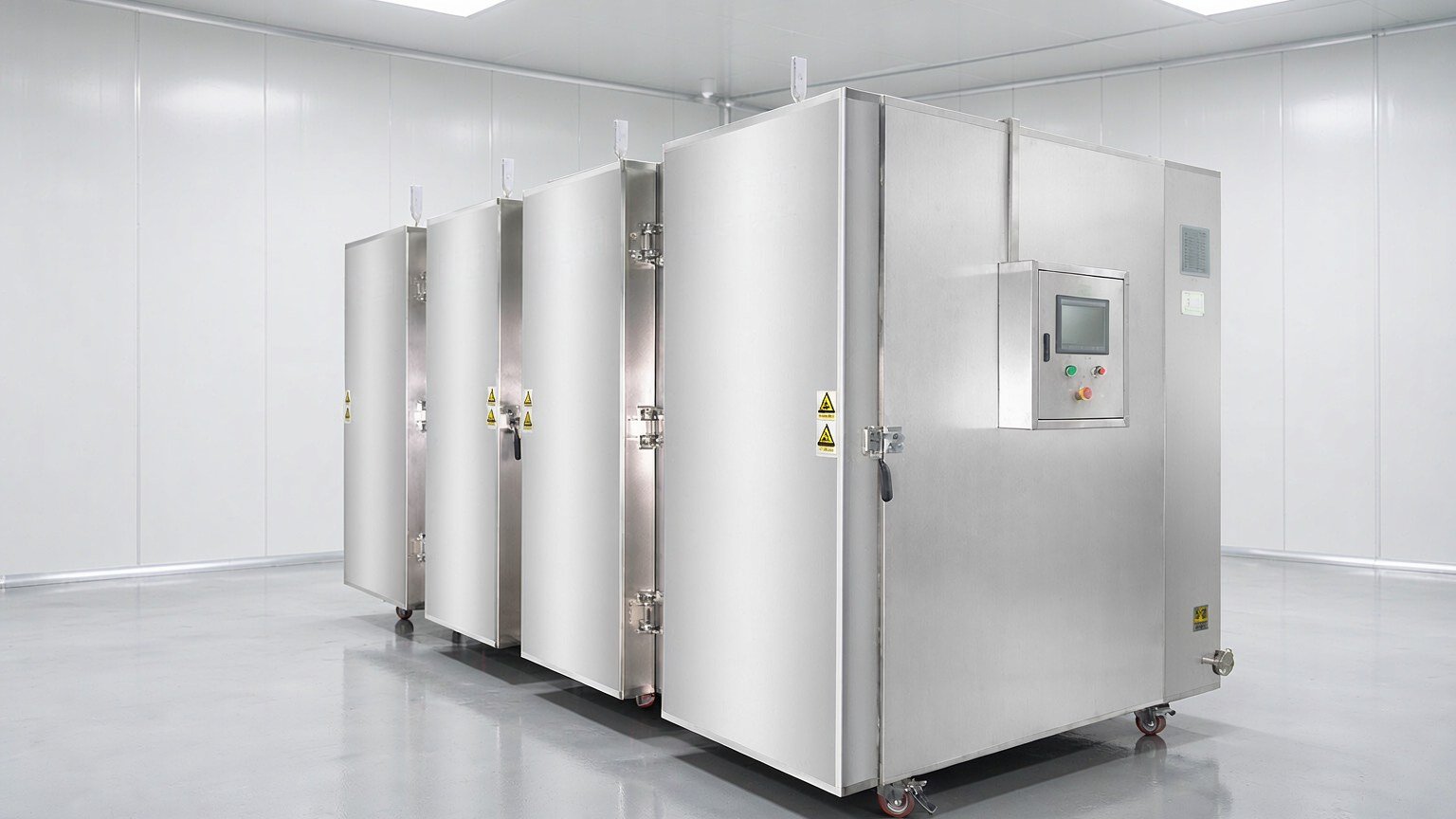
- Complete insulation: Cabinet insulation is installed at the design thickness, with seams not misaligned; check for thermal bridges after installation.
- Reduce exposed metal: Door frames, hinges and handles — metal parts directly connected to the internal structure — are high-incidence points for condensation; apply thermal isolation treatment.
- Door seals and sealing: Ultra-low-temperature sealing rings maintain flexibility at low temperatures, reducing cold air spillage from door gaps; spilled cold air directly forms local frost.
- Local air supply: Areas with severe condensation can have local air supply added to raise the surface temperature above the dew point.
For the cabinet insulation structure and door seal practices, see the liquid nitrogen freezing cabinet series.
Control cabinet heat dissipation: the weak point in high-temperature environments
Control cabinets contain components such as inverters, contactors and controllers, whose allowable ambient temperature usually has an upper limit. When the workshop itself is at 38℃, the cabinet internal temperature will be higher; long-term operation shortens component life and may trigger over-temperature protection.
Order of handling:
- First confirm the actual cabinet internal temperature (not the workshop temperature), measured during full-load operating periods;
- Choose the heat dissipation method: increase heat dissipation area, add independent fans, or use cabinet air conditioning;
- Keep air inlets away from areas with concentrated steam, wash water and dust;
- Clean dust regularly; blocked air ducts directly make heat dissipation ineffective.
For the long-term effect of ambient temperature on electrical components, see this together with voltage and frequency selection issues: Freezing equipment selection under voltage and frequency differences in export markets.
Exhaust and workshop airflow
Hot and humid workshops are stuffy by themselves, and with the low-temperature nitrogen produced during freezing, it will accumulate in the work area if not discharged. Exhaust air volume should be matched to the nitrogen generation calculated from the liquid nitrogen amount per batch, not by blindly selecting fans based on workshop volume.
- Set air inlets on the low-temperature side of the workshop, and exhaust outlets near above the equipment and nitrogen accumulation zones;
- For tunnel production lines, set tail gas extraction ports at the infeed and outfeed ends to reduce cold air escaping from both ends;
- Design exhaust and overall workshop ventilation separately to avoid competing for air volume.
For nitrogen concentration monitoring and interlock practices, see Exhaust and oxygen concentration monitoring for liquid nitrogen freezing cabinets.
On-site layout and scheduling
Two more easily overlooked points in hot and humid environments:
- Temporary storage and installation: If the equipment is stored in the open after arrival, moisture absorption by cabinet insulation materials will affect subsequent performance; after arrival, move it into a warehouse or provide rain protection as much as possible.
- Commissioning time slot: Schedule commissioning during periods when the workshop temperature is relatively low (early morning or night shift) as much as possible, to facilitate observation of condensation and heat dissipation, and the readings are more representative.
For the process from factory shipment to the site and pre-installation preparation, see Sea freight packing and site installation preparation for freezing equipment.
FAQ
Will liquid nitrogen consumption increase noticeably in high-temperature environments?
Yes. High workshop temperatures increase heat leakage from the cabinet and piping, and the hot humid air entering when doors open also brings in more heat; this part must be offset by additional liquid nitrogen. How much it increases depends on insulation quality, door opening frequency and weight per batch; the baseline for your plant can only be calibrated through trial runs, and no uniform coefficient can be given.
Will condensation damage the equipment?
Condensation itself does not directly damage the equipment, but long-term water clinging will cause metal parts to rust, control cabinets to become damp, and floors to become slippery. With the practices above, condensation can be kept within an acceptable range under normal operating conditions.
The workshop humidity is high — can the equipment be washed directly with water?
Food workshops commonly use high-pressure water washing, but freezing equipment is electrically live and has insulation and low-temperature piping; before washing, power off and avoid control cabinets, air ducts and insulation seams. Specific washable parts should follow the equipment instructions and on-site hygiene regulations.
What is the exhaust air volume calculated from?
From the nitrogen generation converted from the liquid nitrogen amount per batch, combined with air change rate for margin. In hot and humid environments, it is advisable to leave a larger margin on this basis, because lower air density reduces air change efficiency.
If your project is in a hot and humid region, send us the location, workshop temperature and humidity range, product per batch and batch size, and we will give configuration and layout suggestions based on site conditions: Contact Kunning Cryo
The relationship between condensation and dew point in this article is general physical common knowledge, and the workshop temperature and humidity ranges are descriptions of common regional operating conditions; equipment insulation, door seal and exhaust practices are cited from Kunning Cryo liquid nitrogen freezing cabinet technical documents, and data for each model is subject to the corresponding technical parameters.