Temperature Fluctuations and Ice Crystal Recrystallization During Frozen Storage: Quality Keeps Changing After Freezing Is Complete
The quick-freezing stage determines the starting point of ice crystals: the faster the material passes through the -1℃ to -5℃ range, the finer and more uniformly distributed the ice crystals. The frozen storage stage determines the endpoint — after freezing is complete, crystals continue to grow. During storage, as temperature rises and falls, small ice crystals melt and water refreezes on the surface of larger crystals, and structural damage is slowly accumulated in the cold store. Goods quick-frozen by two identical pieces of equipment, entering cold stores with different temperature management levels, can show a noticeable difference in performance after thawing.
I. Freezing Completion Is Only the Starting Point; Ice Crystals Continue to Grow During Frozen Storage
According to the technical framework in Kunning Cryo’s “Fundamentals of Liquid Nitrogen Quick-Freezing Technology,” quick freezing means passing food through the maximum ice crystal formation zone (-1℃ to -5℃) within 30 minutes, with the core temperature dropping from 0℃ to below -5℃, forming ice crystals with a diameter of less than 100μm, and after freezing is complete, the core temperature reaching below -18℃. This describes the state at the moment of exiting the equipment.
Once ice crystals form, the system is not stable: ice crystal surfaces have high energy, small crystals tend to melt, and water migrates to the surface of larger crystals to refreeze. This process is called ice recrystallization. A review published online in January 2026 in Food Reviews International (Boumaiza et al., DOI: 10.1080/87559129.2026.2617954) lists recrystallization as a key mechanism affecting the long-term quality of frozen foods, noting that it brings structural damage, texture deterioration, and declines in sensory and nutritional properties. The freezing process determines how fine the ice crystals are; frozen storage conditions determine how long this “fineness” can be maintained.
II. How the -18℃ Line Came About
Science Popularization China, in introducing the concept of quick freezing, states: quick freezing requires passing through the maximum ice crystal formation zone within 30 minutes and rapidly dropping to below -18℃ for storage — this is the standard of the International Institute of Refrigeration. In other words, -18℃ is not an arbitrary number but a storage baseline matched to the quick-freezing process; freezing and frozen storage are a set of coordinated actions.
The common cold chain temperature zones in the industry are roughly as follows:
| Stage | Temperature Setting | Purpose |
|---|---|---|
| Chilled meat storage and transport | 0℃ to 4℃ | Unfrozen fresh products |
| Finished product freezer | Below -18℃ | Long-term storage of already frozen goods |
| Quick-freezing store (for processing) | Generally -30℃ to -40℃ | Freezing during processing |
A distinction must be made between “freezing to what temperature” and “storing at what temperature”: quick freezing pulls the core temperature through the ice crystal formation zone in an environment below -30℃, while frozen storage holds already-frozen products stable below -18℃. Using the same store for both tasks brings fluctuations.
III. What Happens Inside the Material During Temperature Fluctuations
A study by Yangzhou University quantified this. The study used -3℃ as the target temperature for superchilled storage, setting three conditions — constant, -3±2℃, and -3±4℃ — to store pork and measure quality changes. The results showed that temperature fluctuations led to a decrease in immobile water content and an increase in free water content, worsening water-holding capacity; as fluctuation amplitude increased, meat color further deteriorated, pH value and shear force rose noticeably, total sulfhydryl content decreased, and thiobarbituric acid reactive substances value increased (“Study on the Mechanism of Temperature Fluctuations on Pork Quality During Superchilled Storage,” Science and Technology of Food Industry, 2025, Issue 19, pp. 230—237).
The mechanism chain is not complicated: temperature rises, small ice crystals melt; temperature drops again, this water no longer nucleates uniformly but freezes on the surface of existing large ice crystals; ice crystals continue to grow, squeezing the surrounding cell structure. With each cycle, water-holding capacity drops a little more. Repeated freeze-thaw also brings food safety implications — repeated formation and fracturing of ice crystals punctures cell structures and causes exudate loss; the exuded liquid is rich in protein and water and becomes a substrate for microbial growth, with risk accumulating with the number of cycles.
IV. The Foundation Left by the Freezing Stage Determines the Margin for Frozen Storage
The finer and more uniformly distributed the ice crystals, the relatively smaller the driving force for recrystallization, because the system lacks sufficiently large crystals to serve as cores for continued growth. Therefore, the heat exchange conditions in the freezing stage not only affect quality at the point of exiting the equipment but also affect how long this batch of goods can hold up in the cold store. The heat exchange methods and cycle parameters of Kunning Cryo’s three categories of equipment determine how fine the ice crystals can be made in the freezing stage:
| Model Series | Heat Exchange Method | Key Freezing Stage Parameters (from corresponding model technical documents) |
|---|---|---|
| Liquid nitrogen quick-freezing cabinet DKN-LFC-300 / 600 | Liquid nitrogen vaporization heat absorption plus forced air circulation | No-load cooling rate not less than 20℃/min; temperature control accuracy ±1℃; temperature uniformity ±3℃ |
| Liquid nitrogen quick-freezing cabinet DKN-LFC-1200 (four-zone) | Four-zone independent temperature control, independent loading | No-load cooling rate ≤ 50℃/min (adjustable per actual conditions); temperature control accuracy ±2℃; loading capacity 0~1200 kg/single zone |
| Liquid nitrogen quick-freezing tunnel line DKN-LFT-1206 / 1612 | Mesh belt conveying, liquid nitrogen injection plus air field | No-load cooling 10℃ per minute; temperature control accuracy ±2℃ |
| Immersion-type quick cooler DKN-RHV-2000L | Food-grade refrigerant liquid direct contact, mesh belt conveying | Working temperature ≤ -35℃, refrigerant liquid temperature can be as low as -50℃; temperature control accuracy ±2℃; quick-freezing liquid temperature uniformity ±3℃ |
Parameters in the table are taken from the corresponding model technical documents; items not recorded are confirmed per order. For differences in heat exchange methods, see the Liquid Nitrogen Quick-Freezing Cabinet and Immersion-Type Quick Cooler product pages.
V. What Can Be Controlled in the Frozen Storage Stage
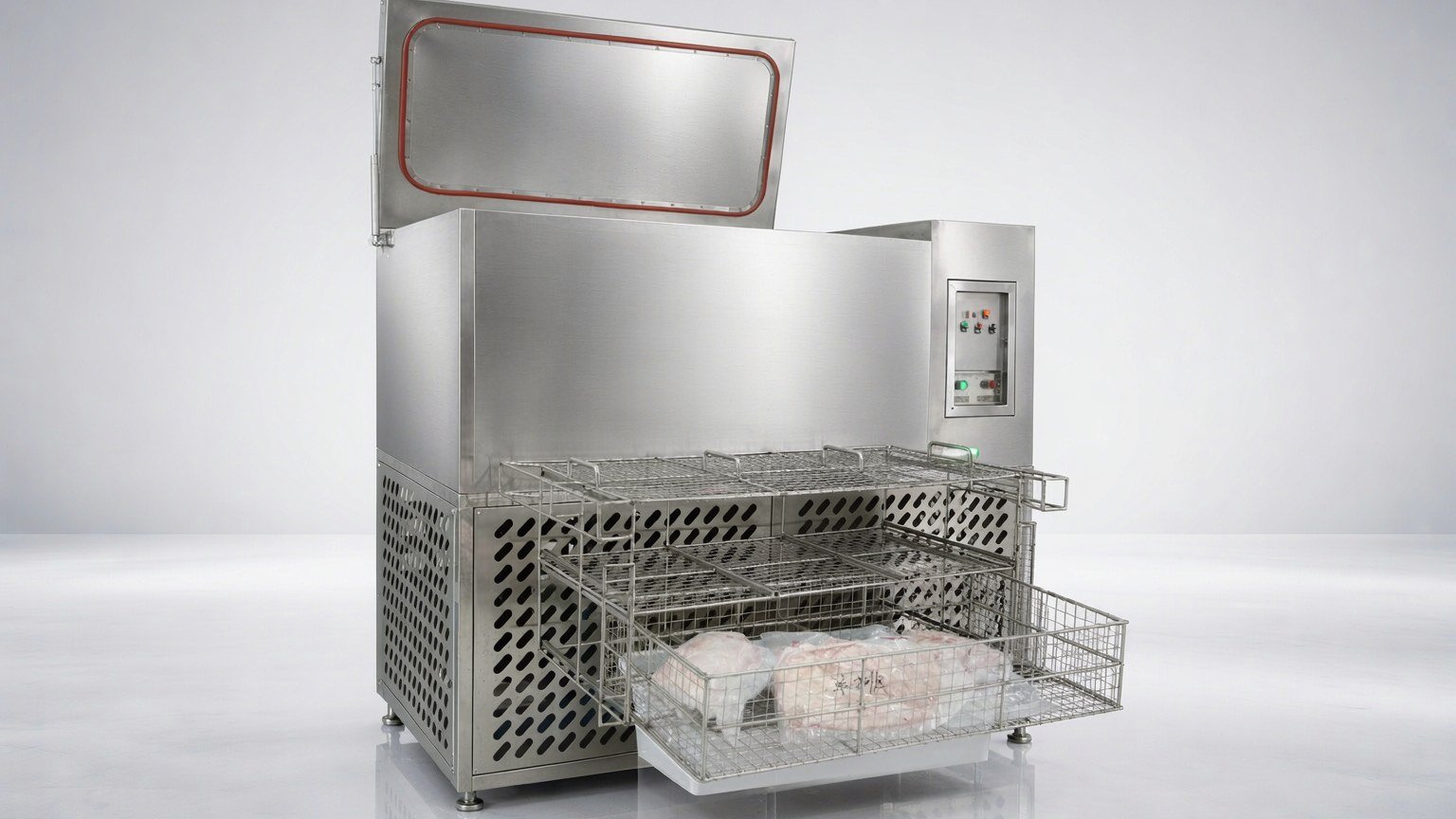
After the equipment freezes goods to below -18℃, the subsequent stage depends on the cold store and operating practices. The following actions are not costly to change in a project:
- Zoned temperature separation: Finished product frozen storage maintains below -18℃, processing quick-freezing stores are set at -30℃ to -40℃, and the two do not share one store.
- Quick loading and unloading, reducing door opening frequency: The shorter the door opening time, the smaller the temperature rise in the store; a single fluctuation may not be large, but accumulated frequency still adds up.
- Single-portion packaging, one-time thawing: Package according to single-use quantities to avoid returning leftovers to the store for refreezing after taking out a whole block.
- Thawing method: Prioritize low-temperature thawing in a refrigerator or cold water indirect thawing; avoid prolonged standing at room temperature.
- Temperature recording and alarms: Kunning Cryo models’ control systems use touchscreen plus PLC, with PID automatic adjustment and PT100 platinum resistance temperature measurement (measurement range 200℃ to -200℃), capable of remote monitoring. Such records are equally useful in the frozen storage stage, showing from which time point fluctuations arise.
VI. Equipment-Side Responsibility Boundaries
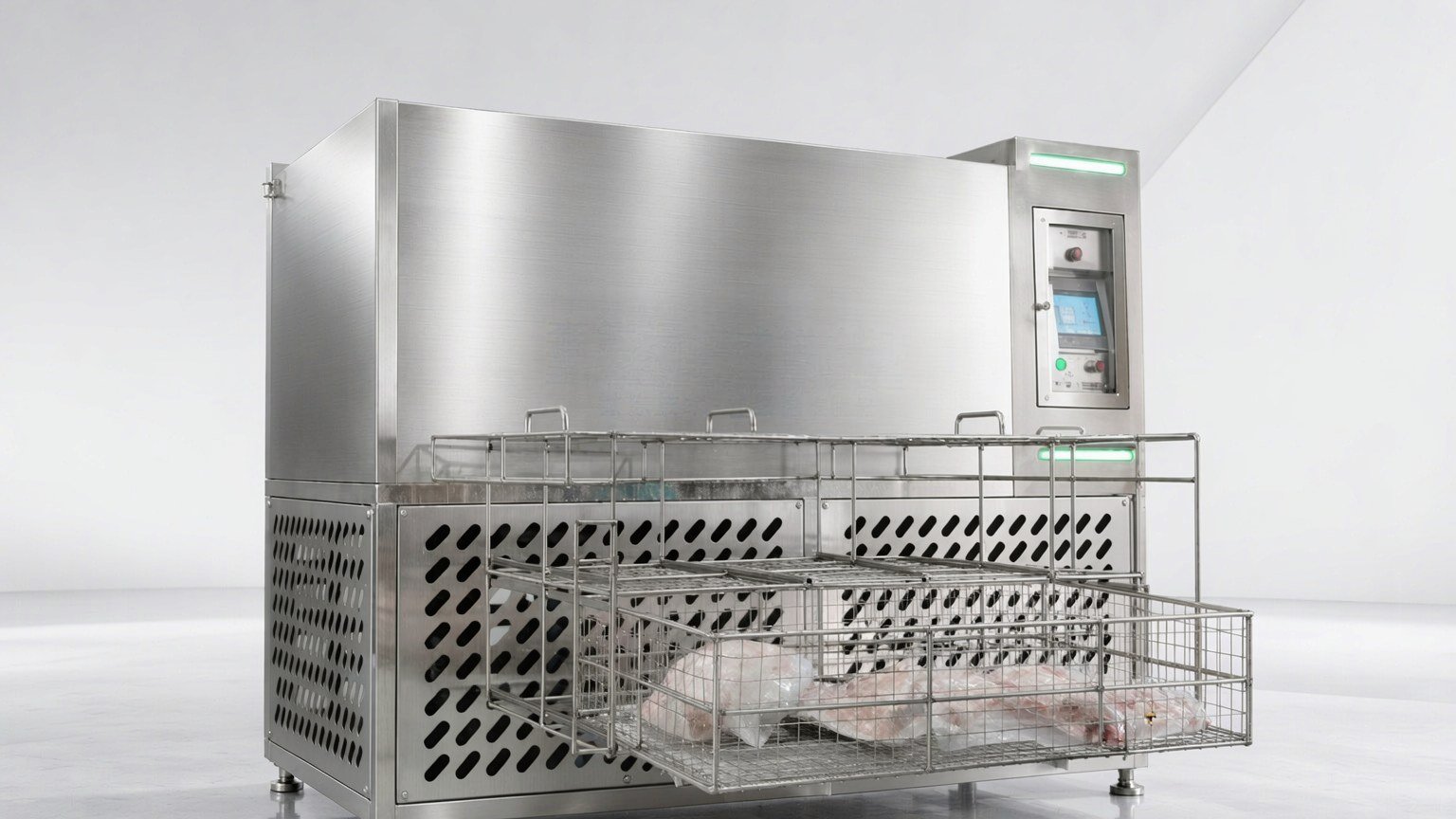
In the numbering rules, the function position F refers to quick freezing (food core temperature to below -18℃), and H refers to quick cooling (temperature reduction without freezing). When selecting models, first distinguish whether the customer wants freezing or only temperature reduction. Liquid nitrogen quick-freezing cabinets and liquid nitrogen quick-freezing tunnel lines are responsible for bringing product core temperature to below -18℃, after which they enter the frozen storage store; the immersion-type quick cooler DKN-RHV-2000L and quick cooling cabinets belong to the temperature reduction stage equipment, rapidly pulling materials through the high-temperature range or providing a low starting point for subsequent freezing, with whether freezing occurs completed by subsequent equipment, confirmed per order.
Temperature control of frozen storage stores and loading/unloading areas belongs to facility-side configuration. During the model selection stage, the store temperature setting, daily throughput, and loading/unloading method must all be provided to judge whether the discharge cycle of the freezing stage matches the subsequent stage. For how ice crystals form in the freezing stage, see Freezing Curve and Maximum Ice Crystal Formation Zone.
Frequently Asked Questions
Is the quality of frozen food determined at the moment of freezing?
The freezing stage determines the starting point, not the endpoint. The faster the passage through -1℃ to -5℃, the finer the ice crystals — this is the foundation; temperature fluctuations during frozen storage cause ice crystal recrystallization and continued growth, with structural damage accumulating continuously during storage. Final quality is jointly determined by the freezing process and frozen storage management.
Why does meat frozen in a home refrigerator release more water after thawing?
The cooling rate of home freezing is much slower than industrial quick freezing; ingredients stay in the maximum ice crystal formation zone for a long time, forming coarse ice crystals that puncture cell structures and release water upon thawing. Industrial quick freezing crosses this zone in ten-plus minutes or even a few minutes, with fine and uniform ice crystals, making it easier for water to be reabsorbed by cells.
What level of frozen storage temperature fluctuation is appropriate to control?
The Yangzhou University experiment used -3±2℃ and -3±4℃ as controls, concluding that the smaller the fluctuation, the better the water-holding capacity and color retention. For a specific project, the set value should be determined by combining product type, packaging method, cold store equipment, and daily throughput frequency, without applying a single number.
Can quick cooling equipment be used as quick freezing equipment?
It depends on the function position in the numbering. F category (liquid nitrogen quick-freezing cabinets, liquid nitrogen quick-freezing tunnel lines) targets core temperature below -18℃; H category (immersion-type quick coolers, quick cooling cabinets) performs temperature reduction without freezing. If subsequent freezing is still needed, the value of the quick cooling stage is to lower the freezing entry point, making the time through the ice crystal formation zone easier to compress.
Can products that have been frozen and thawed several times continue to be frozen?
From a food safety perspective, it is not recommended. Repeated formation and fracturing of ice crystals punctures cell structures and causes exudate loss; the exuded liquid becomes a substrate for microbial growth, with risk accumulating with the number of cycles. This is also why portioning and one-time thawing are more important than convenience.
Confirm the connection method between the freezing stage and frozen storage stage according to product type, daily throughput, store temperature setting, and loading/unloading conditions. Send over the material form, core temperature requirements, existing cold store conditions, and site dimensions, and we will provide a configuration based on actual conditions: Contact Kunning Cryo
Sources: Kunning Cryo “Fundamentals of Liquid Nitrogen Quick-Freezing Technology,” “Equipment Numbering Rules,” and DKN-LFC-300 / 600 / 1200, DKN-LFT-1206 / 1612, DKN-RHV-2000L technical documents (heat exchange method, cooling rate, temperature control accuracy, temperature uniformity, temperature measurement range). External sources: Science Popularization China (quick freezing definition and International Institute of Refrigeration -18℃ storage standard); Food Reviews International (Boumaiza et al., published online January 2026, https://doi.org/10.1080/87559129.2026.2617954 ); Science and Technology of Food Industry, 2025, Issue 19 (Yangzhou University, Mechanism of Temperature Fluctuations on Pork Quality During Superchilled Storage, pp. 230—237).