
When problems arise in a quick-freezing workshop, it is usually not that nobody measured the temperature, but that it is unclear which program that batch ran, whether the core temperature reached -18℃, and how many times the alarm sounded. The equipment side can provide probe readings and program traces; the product-side data can only be recorded by people. If the two sides do not match, traceability fails. This article sorts it out according to “what equipment records, what people record, and how to reconcile the two records.”
I. Why a single probe is not enough
In the control description of liquid nitrogen quick-freezing equipment there is a sentence that is often overlooked: equipped with main-control and monitoring temperature sensors and a feedback system. It is not just one probe working inside the cabinet.
The main-control probe provides the basis for temperature control to the control system, and the PID adjusts the opening of the liquid nitrogen proportional valve according to its reading; the monitoring probe is an independent feedback channel, and its reading also enters the system. The two are installed in the same cavity, and under normal conditions their readings should be close. Once the two readings continuously deviate, suspect the probe itself first—loose wiring, water ingress in the protective tube, frost buildup, and long-term drift all fall into this category. In a single-probe system encountering this situation, the control loop will treat the erroneous reading as the true value and keep adjusting, and neither over-freezing nor under-freezing of the product can be detected.
Under liquid nitrogen spraying, the temperature inside the cabinet changes very quickly, and if the probe response cannot keep up, the phenomenon of a set point of -80℃ with actual overshoot will occur. Dual probes at least give the site a means of cross-checking: if the readings diverge, stop the line and check the probe first; do not keep running.
II. Where the probe is installed and whose temperature it measures
The probe installation position determines the meaning of the reading, and this must be clearly stated in the records.
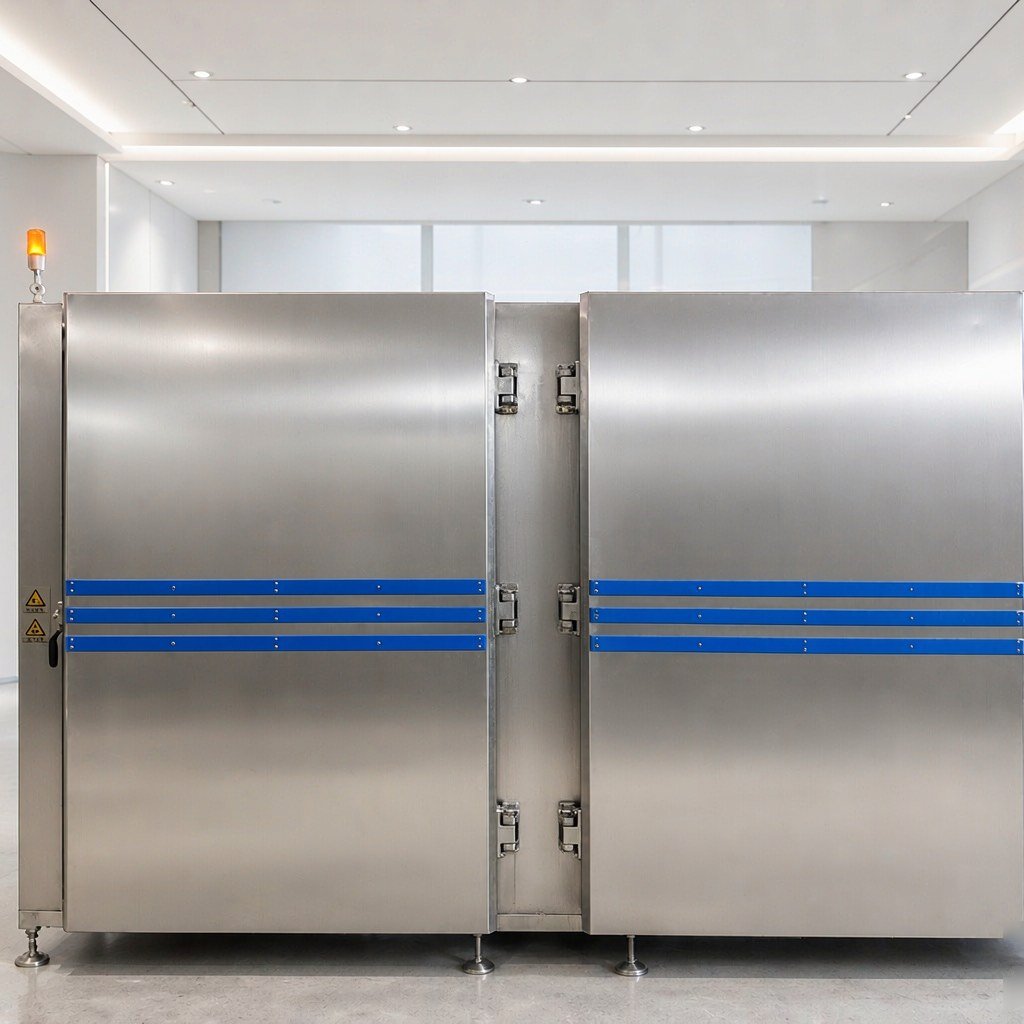
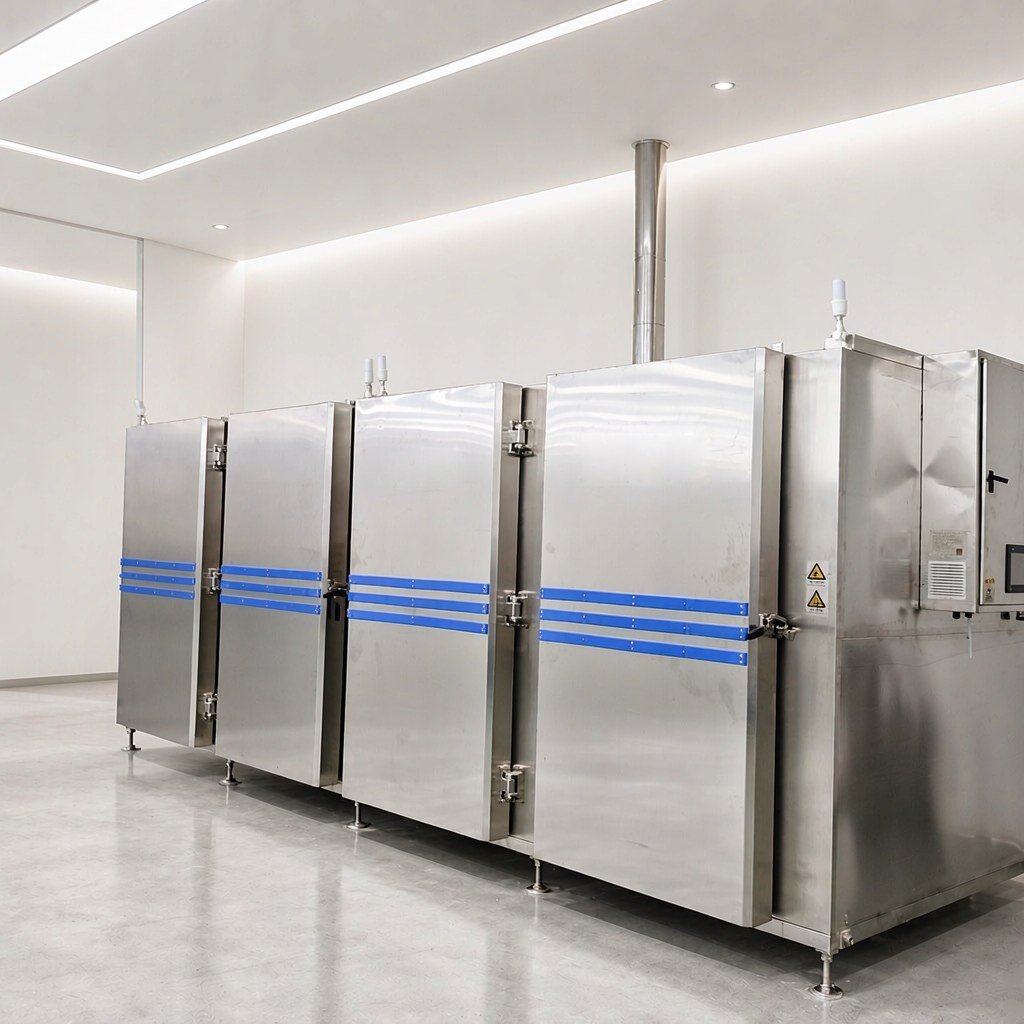
Taking the DKN-LFC series cabinet machines as an example, the temperature sensor protective tube uses SUS304 seamless tube, positioned in the middle of the inner cavity wall of the cabinet, avoiding the area directly blown by liquid nitrogen spray, reflecting the cavity circulation temperature. The tunnel line is equipped with oxygen content measuring instruments at both the feed end and the discharge end; for temperature, it follows a main-control plus monitoring layout, with platinum resistance accuracy Class A, and the temperature measurement range covers 200℃ to -200℃.
Two things need to be distinguished here:
- Equipment temperature is the temperature of the air or circulating airflow in the cavity, measured by fixed probes, used for temperature control and alarms.
- Product core temperature is the temperature at the geometric center of the material, which can only be measured by inserting a portable probe; fixed probes cannot measure it.
If these two numbers are mixed into one column in the records, traceability fails. A cavity at -40℃ does not mean the center of an 80 mm thick piece of meat has reached -18℃; these are two different physical processes.
III. The program number itself is a record
Cabinet machines use PLC plus touchscreen control, can perform ten-step cooling and holding, can store multiple process sets for one-key recall, and automatically alarm and cut power after the program ends. The tunnel line uses PLC control and automatic PID adjustment, with variable-frequency adjustable mesh belt speed, and the running cycle from feed end to discharge end is set according to the model (DKN-LFT-1206 is 6–30 minutes).
The value of this system is not only ease of operation; it solidifies the process into a referenceable number. Writing “Program No. 3” in the record is equivalent to clearly stating how fast the temperature-rise stage is, how long the constant-temperature stage lasts, and whether the final stage leaves time for temperature equalization. Across shift changes, personnel changes, or rechecks three months later, as long as the program number is the same, the process is the same. Conversely, if parameters are adjusted by feel each time and programs are not saved, a batch that goes well cannot be reproduced in the next batch, and when problems occur there is no reference for comparison.
Immersion-type models have a different recording basis. The DKN-RHV-2000L follows a constant liquid temperature route, with working temperature ≤-35℃, freezing liquid temperature up to -50℃, temperature control accuracy ±2℃, liquid temperature uniformity ±3℃, adjustable circulation time of 20–100 minutes, and a control cabinet with remote monitoring. The recording focus for this type of equipment is three items: liquid temperature, circulation time, and freezing liquid concentration.
IV. A usable batch record should have these fields
| Group | Field | Why record it |
|---|---|---|
| Batch | Batch number, date, shift, operator | Problems can be traced to the person and time period |
| Material | Variety, individual piece size and weight, feed temperature | The two main variables of freezing time |
| Loading | Number of pieces loaded, number of layers or spreading thickness, rack number | If loading changes, the process changes |
| Process | Program number and step length, start and end readings of liquid nitrogen or liquid temperature | The main basis for reproducing the process |
| Result | Discharge core temperature, deviation-point temperature, discharge time | The core evidence for conformity judgment |
| Abnormality | Alarm content and occurrence time, handling action, reset person | An alarm not reset in the record is equivalent to not having occurred |
Among the six groups, the loading and abnormality groups are often omitted. Loading is padded by “it fits,” and then tray spacing, layer height, and spreading thickness all go out of control; when the alarm sounds, it is pressed away and running continues, and afterward the record is clean—such records do not hold up in audits. For the impact of tray loading and loading density on freezing time, refer to the comparison table in How to determine tray loading and loading density.
V. How to measure on the result side to make it count
Discharge judgment only looks at whether the core temperature is below -18℃; it does not look at the surface, does not look at frost, and does not look at the timetable. Three practices:
- Insert the probe to the geometric center. The surface of large pieces reaches temperature much faster than the center; if inserted shallowly, the reading is the shell-layer temperature.
- Add a deviation point. Temperature differences are larger near the door side, lower layers, and near the return air inlet. Only when this point is qualified can the whole batch be judged qualified. The temperature uniformity of cabinet-type equipment is on the order of ±3℃; tunnel and immersion types have separate bases of ±2℃ temperature control and ±3℃ liquid temperature uniformity, and judgment should leave this margin.
- Spot-check no fewer than three pieces per batch, and clearly write the reading and insertion depth, so there is a basis when another person rechecks. Infrared temperature guns can only measure the surface and cannot be used for discharge judgment.
There is one more point that is easily overlooked: the probe itself must be calibrated. Set the cycle according to on-site instrument management procedures, and record the calibration date and deviation value; after a probe is replaced, dropped, or exposed to water, it must be recalibrated before use. If the calibration status cannot be seen in the records, the weight of all the preceding data must be discounted.
VI. How to combine the two records
Equipment-side data is continuous and automatic; product-side data is discrete and manual. The method for combining them into a traceable chain is not complicated:
- At the start of each batch, enter the program number and loading quantity into the batch record;
- Before discharge, measure the core temperature and enter it, binding it to the program number on the same line;
- Write the time point when an alarm occurs into the abnormality column, and compare it with the equipment alarm record;
- At the end of each shift, check whether the number of batch numbers for the shift matches the number of equipment operation records.
This reconciliation action at the end is quite useful. If the quantities do not match, it means some batches were missed in the record or some runs were not registered, and it can be found the same day, without waiting until customer complaints or before an audit to dig through the books.
FAQ
The equipment has two temperature probes. Is this a redundant configuration, and does one failing not affect production?
It is not simple redundancy. The main-control probe provides the basis for temperature control, and the monitoring probe provides independent feedback. Long-term divergence between the two indicates that one of them may be inaccurate; if running continues at this point, temperature control is proceeding according to an erroneous reading. When the two readings diverge, stopping the line to check probe status is more cost-effective than continuing production.
The screen shows a cavity temperature of -40℃. Can this be taken as the product already being frozen?
No. The cavity temperature is the circulating airflow temperature; whether the product is frozen depends on the geometric center temperature. For thick materials, heat conduction from surface to center is a process; the surface layer reaches temperature early, while the center may still be more than ten degrees short. Before discharge, use a probe to measure the center; this is a separate step.
Is it enough to record the program number on paper? Why also store it in the equipment?
The program number on paper can only indicate which set was intended to be used; the program record in the equipment indicates how it actually ran. When operators change, when rechecking after several months, or when batch disputes arise, what is needed is the continuous trace on the equipment side. Keep both sides so they corroborate each other.
The alarm sounded and was then reset. Should it be written in the record?
Yes. An alarm is direct evidence that the process deviated. Only by clearly writing the alarm content, occurrence time, handling action, and reset person can it be judged whether the batch was affected. Recording only results and not alarms leaves the traceability chain broken.
Is the recording focus of immersion-type rapid chillers the same as that of liquid nitrogen equipment?
No. Liquid nitrogen equipment records program step length and spraying trace; immersion type records liquid temperature, circulation time, and freezing liquid concentration. Liquid temperature is controlled in the ≤-35℃ range, circulation time is adjusted at 20–100 minutes, and concentration is replenished according to online detection results. If any of these three items changes, the freezing effect changes, and the records follow these three items.
Send us the variety, individual piece size, hourly output, and target core temperature, and we will provide a set of production line and program arrangement suggestions according to loading and takt time, and list the fields that need to be recorded on site. For details, contact us. Related models can be seen in liquid nitrogen quick-freezing cabinet, liquid nitrogen quick-freezing tunnel line, and immersion-type rapid chiller.