
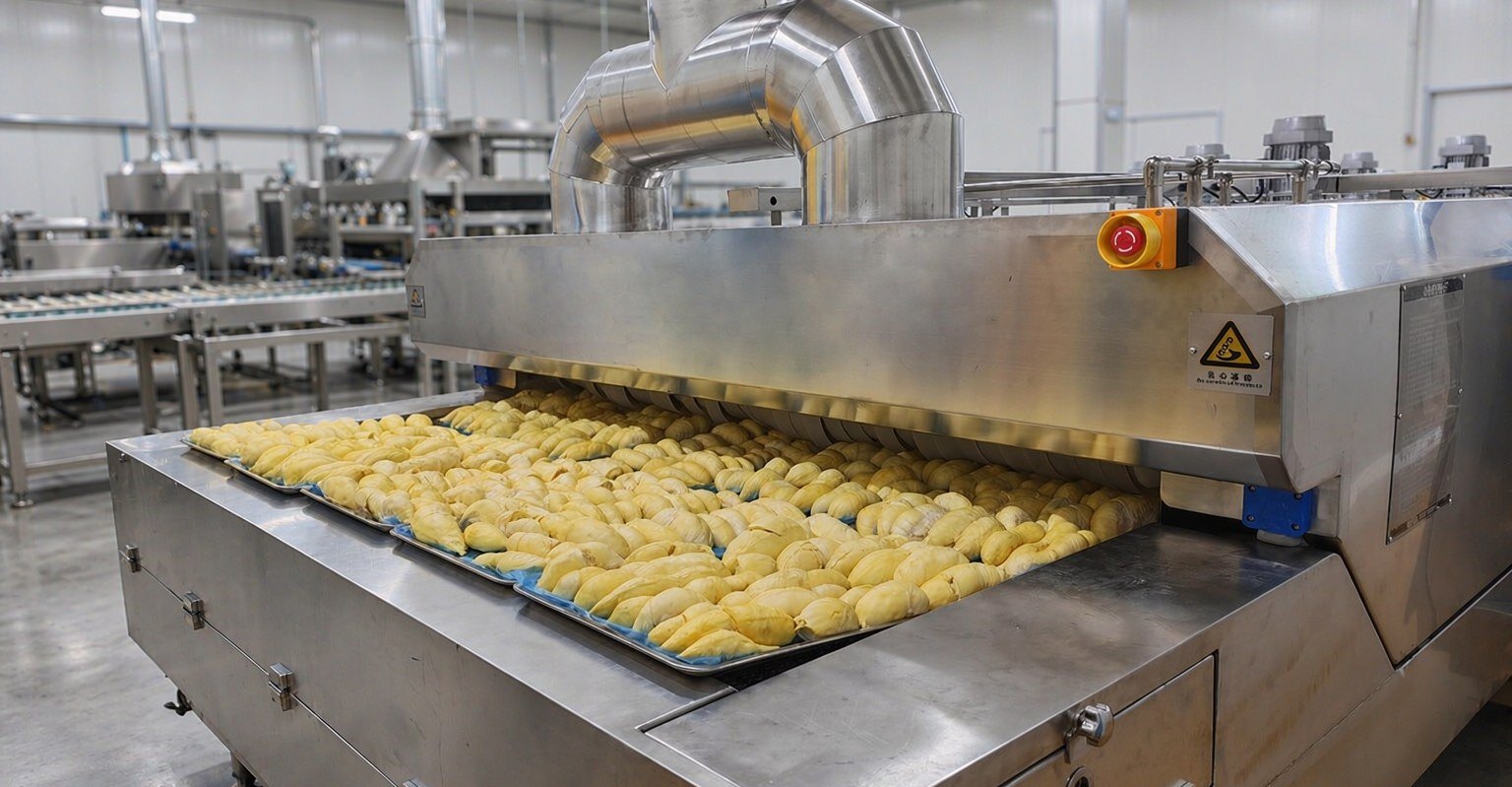
Industry: Aquatic processing | Region: South China | Supporting model: DKN-LFT-1212 liquid nitrogen quick-freezing tunnel line Customer information has been anonymized; the model configuration is a selection reference for similar capacity.
I. Application Background
Most aquatic processing plants in South China take orders from two ends: one is domestic food service distribution and prepared dishes, the other is export — shrimp, fish fillets, shellfish and the like. Export orders inspect frozen products more closely. Juice loss after thawing, whether the muscle turns fibrous, and whether individual pieces stick together into a clump — the customer sees it all when the box is opened for inspection.
Product forms are mainly IQF (fish fillets and shrimp with IQF effect) and block frozen. The former requires distinct individual pieces, the latter requires regular frozen blocks with the core temperature in place. These two things place somewhat different demands on the quick-freezing tunnel: distinct pieces rely on the surface setting quickly and separating from each other, while block freezing relies on internal cooling keeping pace.
II. Process Difficulties
First, damage to cell structure occurs within a very narrow temperature zone. From -1℃ to -5℃ is the range where most of the water in the material freezes, known in the industry as the zone of maximum ice crystal formation. If the material stays in this range for long, ice crystals grow coarse, rupture the cell walls, and intracellular juice flows out during thawing — shrimp turn dry and fibrous, fish fillets release water, and both yield and texture drop. To preserve structure, the material must pass quickly through this range rather than freeze through slowly.
Second, individual separation relies on the surface freezing first. If the surface of shrimp or fish fillets has not yet set before they touch each other, the discharge is one solid block. Spacing must be left during loading, and the belt speed must hold up; once material piles up at the feed end, all subsequent steps are wasted.
Third, the cooling rate of a continuous line must be stable. Export orders are continuous batches; once a line starts, it runs for hours or even all day. No-load cooling and cooling with material are two different things. If the equipment’s own refrigeration capacity has no margin, the temperature cannot recover after running for a while, the time to pass through the zone of maximum ice crystal formation is stretched, and the structural protection mentioned above amounts to nothing.
III. Solution Configuration
This scenario is suited to the DKN-LFT-1212 liquid nitrogen quick-freezing tunnel line, with the following main parameters (quoted from product technical documents):
| Item | Parameter |
|---|---|
| Tunnel mesh belt | 12000 mm (total length) × 1200 mm (width) |
| External dimensions | 12000 × 2250 × 1670 mm |
| Operating temperature | -150℃ ~ room temperature |
| Temperature control accuracy | ±2℃ |
| Cooling rate | No-load cooling of 10℃ per minute |
| Quick-freezing capacity | 1 m³/h |
| Total unit power | 18 kW |
| Refrigerant | 5-8 BAR liquid nitrogen (liquid nitrogen tank self-provided) |
| Oxygen concentration monitoring | Oxygen concentration setpoint 19.5%-21.5% |
Three points to look at in the configuration.
The mesh belt is 12000 mm long and 1200 mm wide. The length provides zoning space: the feed section, deep-freeze section, and discharge section can be spread out, and the residence time of the material in the deep-freeze temperature zone is controlled by belt speed rather than by forcing the whole unit to an extremely low temperature. The width determines how many trays can be placed side by side in one pass. Thin materials such as shrimp and fish fillets need to be spread out and separated; if density cannot be raised, widening the mesh belt is more stable than simply speeding up the belt.
The operating temperature range reaches -150℃ with a temperature control accuracy of ±2℃, giving sufficient margin for deep-freeze low temperatures, so the temperature is not easily dragged up during continuous material flow. The quick-freezing capacity is 1 m³/h; this figure is converted according to the material’s boxed form, and how many kilograms it amounts to depends on loading density, to be confirmed per order.
The cold source is 5-8 BAR liquid nitrogen, with the tank self-provided by the user. The main work lies in planning the tank location and piping route, to be determined together with the workshop layout. The total unit power is 18 kW.
IV. Process Points
The time to pass through the zone of maximum ice crystal formation is the parameter this line must watch. The approach is not to push the belt speed to its upper limit, but first to set the number of loading layers according to material thickness, then set the belt speed, so that the time the material stays in the -1℃ to -5℃ range is as short as possible while the core temperature at discharge meets the target. These two goals are balanced through trial runs, and the final parameters are confirmed per order.
The surface freezes first, so the pieces can separate. Leave spacing when loading trays at the feed end; do not compress material for output. Collect material promptly at the discharge end; pieces that have already frozen should not be left piled at the end of the mesh belt to soften again from heat.
Take core temperature samples from the thicker part. Material just out of the tunnel still has residual heat in the core; wait for the temperature to stabilize before reading. Choose the sampling point at the thicker part of a fish fillet or the geometric center of a block freeze; do not take the surface temperature as the result.
Follow the rules for oxygen concentration. The oxygen concentration inside the liquid nitrogen tunnel is displaced, with a setpoint range of 19.5%-21.5%. After loading and unloading, maintenance, or cleaning the mesh belt, first confirm the oxygen concentration has returned to the range before entering. If an alarm sounds, withdraw personnel first; this takes priority over rushing orders.
V. Applicable Users and Selection Advice
This line suits aquatic processing scenarios with a relatively concentrated variety and continuous orders: export shrimp, fish fillets, and shellfish IQF; portioned aquatic products for domestic food service distribution; and poultry cuts and prepared dishes with stable batch sizes.
To judge whether to choose a tunnel line or a cabinet, ask three things. Is the single-shift batch continuous enough — one batch after another without stopping the material flow — so that the tunnel line’s deep-freeze zoning and rapid passage make sense? How many specifications per day — if specifications are mixed and single batches are small, changing material requires cleaning the mesh belt and adjusting parameters, and the DKN-LFC series liquid nitrogen quick-freezing cabinets are more flexible. Can the two ends of the workshop be set up separately for infeed and outfeed positions — if the flow path cannot be spread out, continuity cannot be brought into play.
For selection, first clarify three things: material form (thin material or block freeze), target core temperature, and single-shift batch size. Operating parameters such as the number of loading layers, belt speed, and nitrogen replenishment must be confirmed during the commissioning stage according to the actual product; other categories cannot be copied directly.