
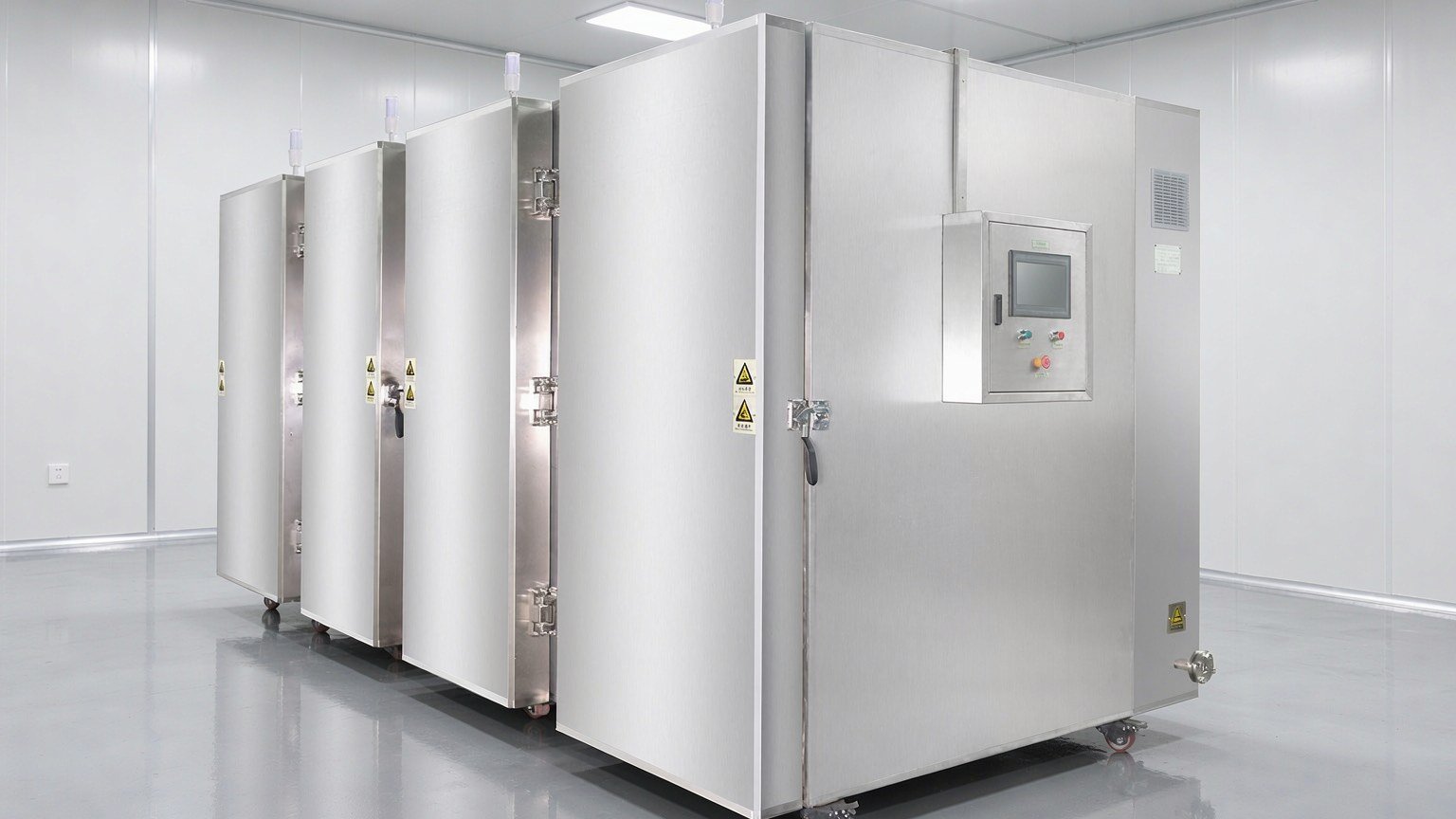
Industry: Meat processing | Region: East China | Equipment: DKN-LFC-600 liquid nitrogen freezer cabinet Customer information has been anonymized; the equipment configuration is a selection reference for similar capacity.
I. Application Background
Meat processing plants in East China often run more than one product line. Prepared meat, meatballs, minced meat, and formed meat products are produced simultaneously, with specifications following orders, and several product changes within a single shift. The characteristic of such workshops is small batch size, dense batches, and fast changeovers. The freezing stage sits between forming and packaging; if freezing is slow, the entire line waits.
Product forms are also varied. Meatballs and formed meat pieces require individual quick freezing so they can be separated after freezing without sticking together. Minced meat and prepared meat mostly run on trays and only need to be frozen through, but performance after thawing differs considerably: whether slices fall apart, whether water is lost during pan-frying—these directly affect downstream processes. Meat products have high moisture and fat content, making them more sensitive to the freezing process than aquatic products.
II. Process Challenges
First, many product types—one set of freezing conditions cannot cover everything. The thickness of meatballs and formed meat pieces differs greatly. Running thin pieces in the morning and thick blocks in the afternoon on the same equipment makes it difficult to balance fixed airflow and time: thin pieces become over-frozen with surface cracking, while thick pieces cannot bring the core temperature down.
Second, the maximum ice crystal zone has a major impact on cell structure. Water in meat exists in two states: free water and bound water. In the range from -1℃ to -5℃, water freezes in large amounts; this temperature zone is called the maximum ice crystal zone. The longer the residence time, the coarser the ice crystals grow, muscle fibers are pushed apart, cell membranes are damaged, and cell fluid flows out during thawing—that is, drip loss. In the product, this shows as darkened color, dry texture, and water seepage when sliced.
Third, small batches with many product types make batch consistency difficult to maintain. A batch ranges from tens of kilograms to two or three hundred kilograms. Relying on operators to track time and follow procedures leads to variation between batches. The same specification frozen twice can yield different results, and downstream packaging and customer feedback must be adjusted accordingly.
III. Solution Configuration
This scenario is suited to the DKN-LFC-600 liquid nitrogen freezer cabinet. Main parameters are as follows (from product technical documents):
| Item | Parameter |
|---|---|
| Name | Liquid nitrogen freezer cabinet |
| External dimensions | 2900 × 1700 × 2450 mm |
| Operating temperature | -150℃ ~ room temperature |
| Temperature control accuracy | ±1℃ |
| Temperature uniformity | ±3℃ |
| Cooling rate | Not less than 20℃/min (no load) |
| Capacity | 600 kg/h (varies with different products and packaging methods) |
| Total power | 5 kW |
| Refrigerant | 5-8 BAR liquid nitrogen |
The configuration logic follows three points.
First, cooling capacity. Cabinet temperature is pulled down quickly, and the surface temperature of materials drops quickly after loading.
Second, temperature uniformity and control accuracy. These two govern whether freezing conditions at various points and across batches inside the cabinet are close. In mixed-production workshops, airflow field uniformity is more practical than the low temperature value itself.
Third, scale matches. The capacity in the table above, applied to many product types in small batches, fits exactly one batch per cabinet, running several cabinets in succession. The liquid nitrogen storage tank is provided by the user; its location and piping route should be incorporated into the workshop layout in advance.
IV. Process Points
Define the loading method first, then discuss the program. Spread materials out and leave air channels so cold air can flow around them. Stacking and pressing may look like more product fits, but in practice the difference between surface and core is large.
Turn experience into parameters. The cabinet uses programmable temperature control. Cooling and holding stages for commonly used specifications are stored as fixed programs, called up directly when changing product types, without relying on verbal handover.
Choose the right location to judge whether freezing is complete. When sampling, pick the thicker position; thin pieces harden quickly at low temperatures, while thick pieces need longer residence, and mixed loading can lead to misjudgment.
Follow procedures for opening and closing the cabinet door. Nitrogen concentration inside the cabinet is high; loading, unloading, maintenance, and cleaning—these door-opening operations follow the same set of procedures.
V. Suitable Applications and Selection Advice
Liquid nitrogen freezer cabinets suit scenarios with single batches of a few hundred kilograms, frequent product changes, and requirements for thawing quality: prepared meat, meatballs, minced meat, and formed meat products all fall within this range, and they are also common for small-batch frozen aquatic products and single pastry items. For R&D sampling and small-batch trial production—where batch sizes are unstable but freezing speed is required—cabinets are easier to arrange than continuous lines.
To judge between a cabinet and a tunnel line, look at three points. Whether single-batch size and batch density are sufficient for continuous operation—one batch after another without stopping—only then is a tunnel line cost-effective; whether there are many specifications—changing materials requires cleaning the mesh belt and adjusting parameters, and cabinets are more flexible; whether both ends of the workshop can have separate loading and unloading positions—if the flow path cannot be separated, continuity cannot be realized.
For mixed product types, small batches, and limited space, cabinets are suitable. For concentrated specifications and continuous material flow, consider the DKN-LFT series liquid nitrogen freezing tunnel line.
For selection, first clarify three things: material form and thickness, target core temperature, and single-shift batch size. Operating parameters are confirmed during commissioning according to the actual product; other categories cannot be copied directly.