
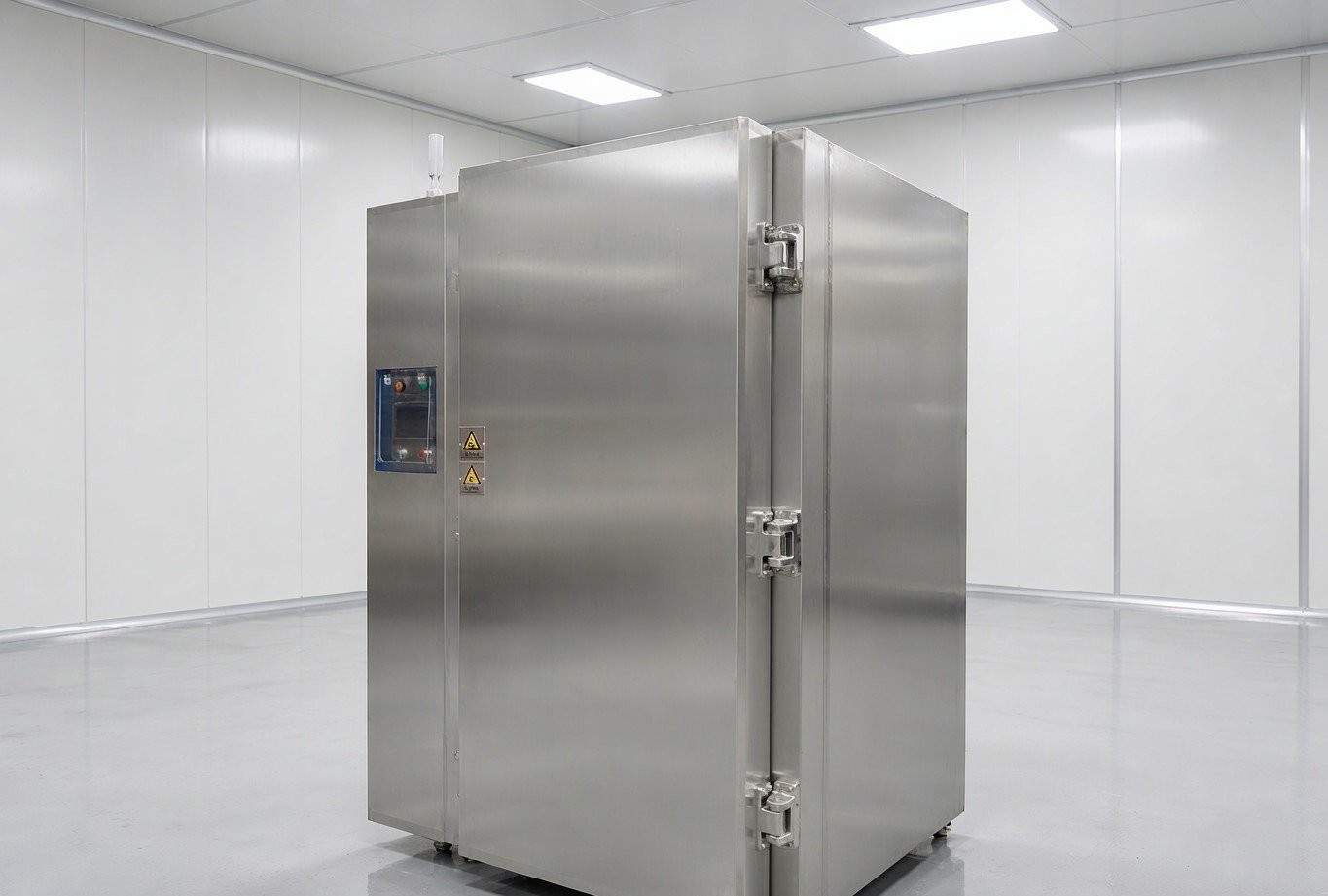
A university food research team in East China handles sample freezing in batches of tens to hundreds of kilograms, with frequent product changes, test records that must be reproducible, and available space limited to a small cold room next to the laboratory. The matching solution for this scenario is the DKN-LFC-300 liquid nitrogen freezer cabinet: external dimensions 1740 × 1730 × 2220 mm, inner chamber 900 × 1320 × 1800 mm, capacity 300 kg/h (varies with different products and packaging methods), total power 2.5 kW, working temperature -150℃ to room temperature. Fitting into the space and moving materials in and out without modifying the workshop are the first issues to solve in this scenario.
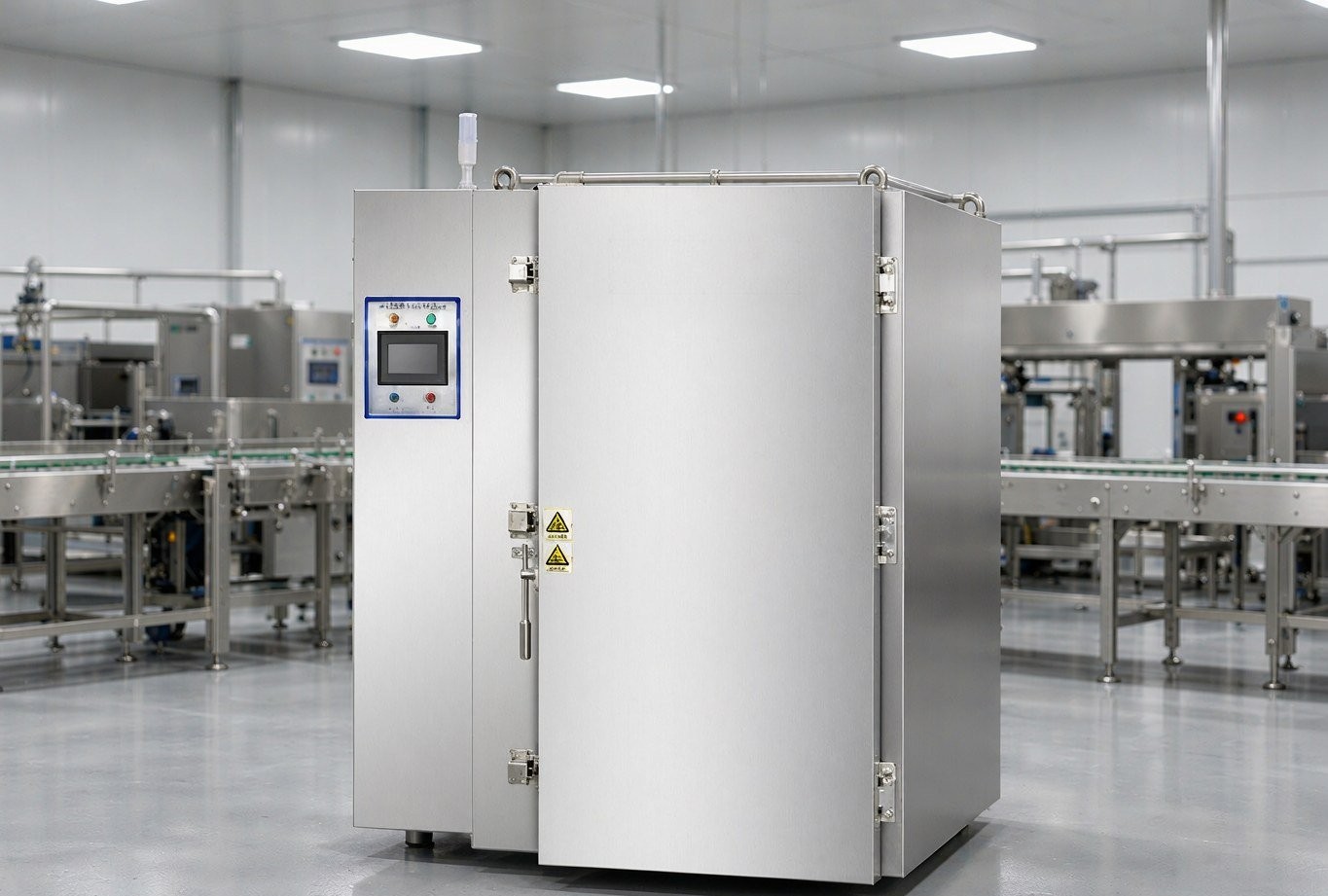
I. Application Background
Food and biological samples at research institutes commonly come in pre-portioned small bags, petri dishes, sample boxes or pilot-scale small batches. Batch loads are modest, materials and parameters differ between batches, and a complete cooling record must be kept after each batch. The freezing stage follows portioning and pretreatment and precedes cryogenic storage or testing, and neither end can afford long waits.
Space is usually tight: a test room of ten to several tens of square meters must accommodate the equipment, workbenches and personnel movement. Buying too large wastes floor space; buying too small leaves batches queued. Selection starts with calculating space and cycle time.
II. Process Challenges
Batch weight and hourly capacity are not the same thing. The rated 300 kg/h is the throughput under given product and packaging conditions, while test scenarios care more about “how much goes into this batch and how soon it can be taken out.” The rack has a clear height of 1600 mm, width 605 mm and depth 807 mm, holds 40 trays at a time, with trays of 400 × 600 × 25 mm stainless steel; the batch load is these 40 trays multiplied by the per-tray load, and as packaging thickness changes, the load for the same tray count differs considerably.
Footprint must be calculated by external dimensions plus operating clearance. The external dimensions 1740 × 1730 × 2220 mm are the cabinet itself; the cabinet structure opens front and back, so door-opening and tray-pushing space must be reserved in front, and heat dissipation and service access on the sides. Marking out floor space at only 1.7 m square means doors cannot open fully and trays cannot be pulled out in practice.
The loading/unloading workflow determines labor. Test scenarios have no conveyor line and rely on racks and carts. Having the cabinet door face the workbench saves effort; if the door faces a corridor or personnel passage, cold air spillage and floor condensation become daily problems.
III. Solution Configuration
This scenario uses the DKN-LFC-300 liquid nitrogen freezer cabinet, with parameters taken from the product technical documentation:
| Item | Parameter |
|---|---|
| Name | Liquid nitrogen freezer cabinet |
| Inner chamber dimensions | 900 × 1320 × 1800 mm (W×D×H) |
| External dimensions | 1740 × 1730 × 2220 mm |
| Working temperature | -150℃ to room temperature |
| Temperature control accuracy | ±1℃ |
| Temperature uniformity | ±3℃ |
| Cooling rate | Not less than 20℃/min (no load) |
| Capacity | 300 kg/h (varies with different products and packaging methods) |
| Total power | 2.5 kW |
| Refrigerant | 5-8 BAR liquid nitrogen |
| Rack/trays | Rack clear height 1600 mm, width 605 mm, depth 807 mm, holds 40 trays at a time; trays 400×600×25 mm stainless steel |
The configuration approach directly addresses space and cycle time: the vertical cabinet gains capacity through height, with an inner chamber 1800 mm tall and a footprint kept at the order of 1.7 m square external dimensions; the 40-tray rack moves in and out as a whole, loading and unloading are done outside the cabinet, door opening time is short, and both cooling loss and frost formation are reduced. Total power is 2.5 kW, within the reach of standard laboratory power distribution. Liquid nitrogen is fed from an external tank through piping, with consumption adjusted according to the process curve; one set of parameters is stored per product type and recalled for repeat tests.
IV. Process Points
Build curves by load tier. The air flow state inside the cabinet differs between a full rack of 40 trays and half-rack operation, and cold air short-circuiting is more pronounced at lower loads. It is advisable to run one loaded cooling record for each commonly used load tier to form a comparison table, then apply the same tier directly thereafter.
Judge completion by core temperature, not surface. -150℃ to room temperature is the equipment working range, not the unloading target; temperature control accuracy of ±1℃ keeps the setpoint stable, and temperature uniformity of ±3℃ determines whether different positions in the cabinet can be unloaded within the same time window. Before unloading, measure the geometric center of the sample, taking one point each from the upper and lower layers for verification.
No-load rate cannot be used for scheduling. Not less than 20℃/min is a no-load figure; after loading, it is affected by load, packaging thickness and initial temperature, so the actual cycle time must be measured under loaded conditions.
Reserve space in three places. Leave door-opening and tray-pushing space in front, a service opening at the side, and exhaust and piping space above the cabinet; slope the floor for drainage to avoid defrost water and condensation pooling.
V. Suitable Users and Selection Advice
This configuration suits laboratories and pilot lines with batch loads of tens to hundreds of kilograms, frequent product changes, limited space and a need for batch records. Deciding between cabinet and tunnel comes down to two points: whether the product form is uniform enough to run continuously through a line, and whether the site can provide a straight loading/unloading workflow. With fragmented product types, small batches and only one room, a cabinet is more suitable; only when product types are fixed, daily volumes are large and continuous, and upstream and downstream are themselves assembly lines does the tunnel type come into play.
More detailed model parameters are on the liquid nitrogen freezer cabinet DKN-LFC-300 product page, the boundary between cabinet and tunnel types is discussed in Cabinet or Tunnel: Freezing Equipment Selection Judgement, and scheduling and unit count calculation in Freezing Capacity Planning and Equipment Count Calculation. To check the configuration against your own sample forms and site, you can contact us.
FAQ
How is 300 kg/h converted to batch load?
300 kg/h is the throughput under given product and packaging conditions. Batch load is calculated from 40 trays per rack load multiplied by the actual per-tray load; the thicker the packaging, the less each tray holds, and the longer the same batch takes to process. When load varies widely, measure cooling curves by tier rather than extrapolating from no-load data.
How much space does this cabinet actually take up?
The cabinet external dimensions are 1740 × 1730 × 2220 mm. When marking out the site, beyond this outline you must also reserve the operating clearance for door opening and tray pushing, side service access and overhead piping space, so the actual occupied area is larger than the cabinet itself.
What safety points matter when placing liquid nitrogen equipment in a laboratory?
The key points are ventilation and oxygen concentration. Liquid nitrogen expands in volume after vaporization and displaces oxygen in a closed room; the room needs mechanical exhaust, the personnel activity area needs oxygen concentration monitoring with alarms, and equipment exhaust must not be directed at personnel operating positions. Protect against frostbite near the cabinet, and wear cryogenic gloves and a face shield during operation.