
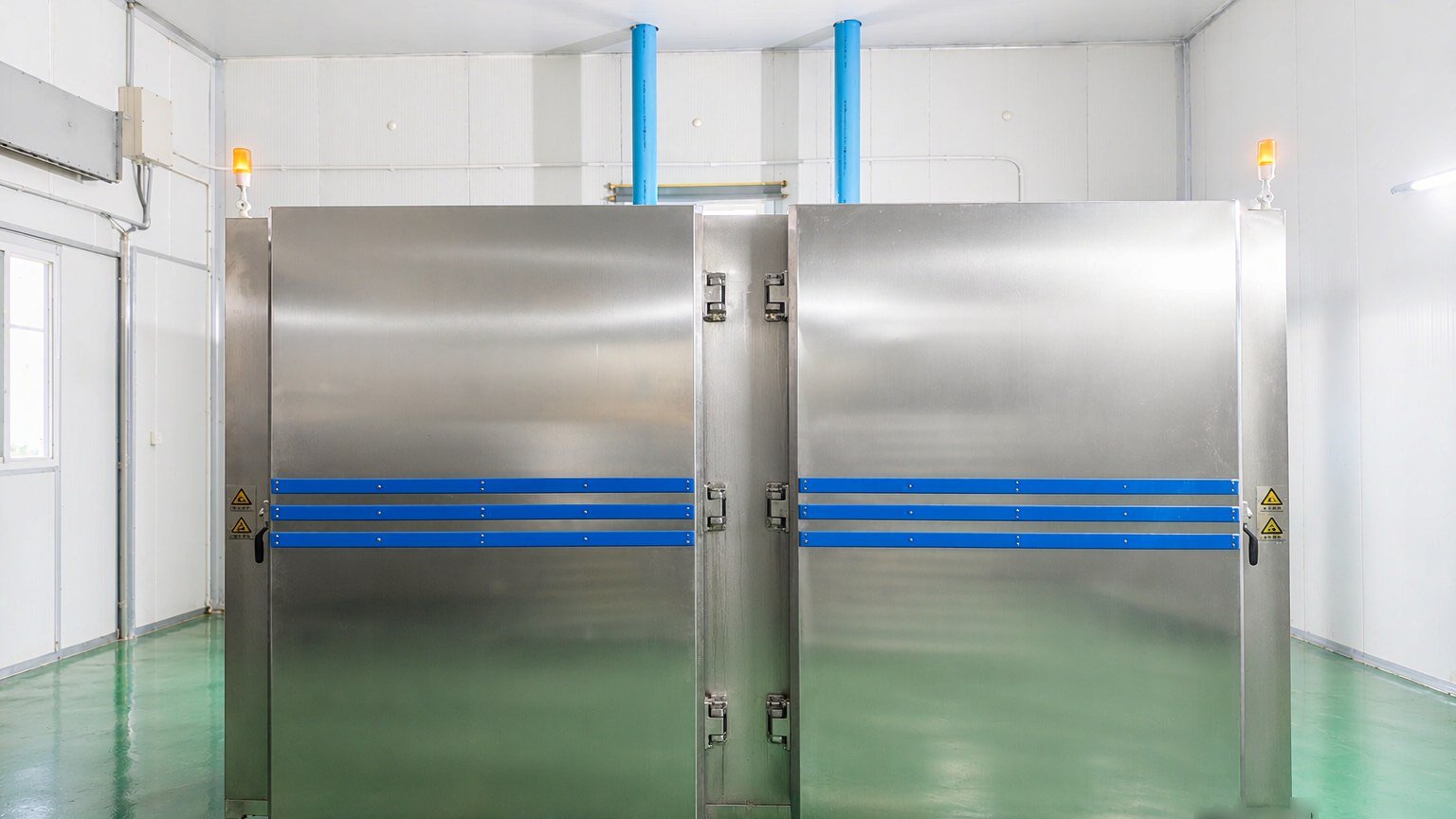
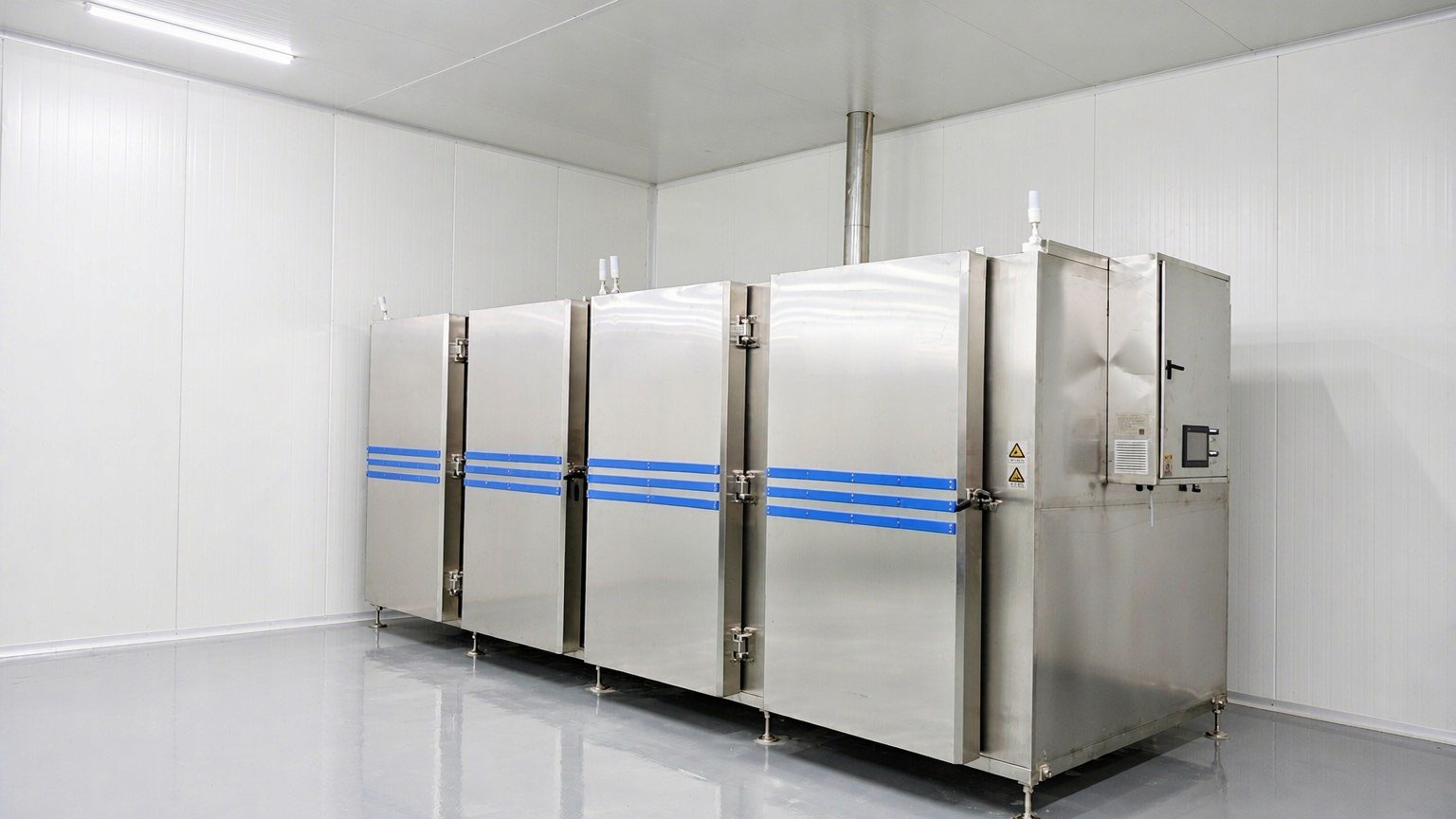
A fish head products processing enterprise in Central China produces split fish heads and fish head pieces, requiring individual quick freezing, no sticking after freezing, and no deformation from stacking. These products have irregular shapes and large contact surfaces between pieces; when frozen in stacks, the cross-section collapses after thawing. Comparable capacity is matched by the DKN-LFC-1200 liquid nitrogen freezing cabinet, whose inner cavity is divided into four zones, each with a loading capacity of 0–1200 kg, loaded and unloaded in whole batches via carts or racks. The four zones are used in rotation, so loading, freezing, and discharging do not interrupt one another.
I. Application Background
The upstream stages of fish head processing are slaughtering, gill removal, washing, and splitting; the downstream stages are freezing, packaging, and frozen storage. Products fall into three categories: whole split fish heads, spec-cut fish head pieces, and seasoned semi-finished fish heads. The first two require individual quick freezing; the latter is frozen in whole trays or boxes.
A fish head has one bony side and one meaty side; if the meaty side faces down it gets compressed and collapses, and stacking more than two layers causes the contact surfaces to stick. Workshops usually arrange one round of tray loading after washing and splitting and before freezing, spread in a single layer with the bony side down. The loading pace is constrained by the equipment’s loading and unloading method: whether a cart can be pushed in and how much one cart holds both affect scheduling.
II. Process Challenges
Irregular shapes deform under stacking. The meaty side collapses under pressure, and freezing fixes the shape so it cannot recover after thawing. Tray loading must be single-layer with gaps, controlled manually rather than by loading more to chase output.
Large single batches make batch mixing easy. A cabinet holds several hundred kilograms; if all zones load and unload together, the next batch cannot enter until the previous one is out, and the upstream stage must stop and wait. Once batches are mixed up, which cabinet, what time in and out, and what core temperature cannot be traced afterward.
Many transfer steps. From the loading table to the cabinet door, product passes via carts or racks. Long transfer times let surfaces warm up and release water, causing frost inside the cabinet and raising the probability of sticking at discharge.
Safety in a liquid nitrogen environment. When the cabinet door opens, nitrogen spills out and oxygen concentration at the operator position drops; opening the door, loading, and unloading are exactly when personnel are close to the cabinet interior.
III. Solution Configuration
This scenario is matched by the DKN-LFC-1200 liquid nitrogen freezing cabinet (four zones), with parameters as follows (from the product technical file):
| Item | Parameter |
|---|---|
| Inner cavity dimensions | 2000 × 1500 × 1750 mm, four zones |
| Working temperature | -150℃ ~ ambient |
| Temperature control accuracy | ±2℃ |
| Cooling rate | ≤50℃/min (no load) |
| Loading capacity | 0~1200 kg/single zone |
| Total power | 12 kW |
| Refrigerant | 6-8 BAR liquid nitrogen |
| Oxygen concentration monitoring | Oxygen concentration setpoint 19.5%-21.5% |
The configuration logic rests on zoning. The 2000 × 1500 × 1750 mm inner cavity is divided into four zones, each with independent loading, unloading, and temperature control. During scheduling, one zone is freezing while the others can be loading or unloading, so loading need not wait for the whole cabinet to empty. The ±2℃ control accuracy keeps set conditions stable across different time periods in the same zone, making data comparable when switching batches. Total power is 12 kW; the electrical portion covers fans, control system, and cabinet auxiliary components, while cooling capacity is supplied by liquid nitrogen. Power distribution is checked against site conditions and subject to order confirmation.
IV. Process Points
Spread loading in a single layer, bony side down. Fish heads and fish head pieces are placed by spec in separate zones with gaps between pieces. Trays or racks are configured to zone dimensions and pushed in fully loaded, reducing handling at the cabinet door.
Carts and racks must match the cabinet door. Cabinet-type units load and unload in whole batches via carts or racks; rack height matches the internal clear height so pushing in and out is done in one motion, without setting down or tipping trays midway. Keep the transfer route from loading table to cabinet door as short as possible; for layout arrangements see Loading, Unloading and Transfer Methods for Freezing Lines.
Calculate loading by zone, not by stacking higher. 0~1200 kg/single zone is the loading range; actual load depends on product spec, layer thickness, and inlet temperature. The more loaded, the longer the core comes to temperature, and the greater the variation between positions in the same cabinet.
Check oxygen concentration before and after opening the door. The oxygen concentration setpoint is 19.5%-21.5%, with monitoring points covering the cabinet door operator position. Confirm readings are normal before opening, close the door promptly after unloading, and ventilate before maintenance or extended shutdown; details in Liquid Nitrogen and Nitrogen Ventilation Safety.
Record batches by zone. Record inlet time, loading, spec, outlet time, and measured core temperature separately for each zone; one cabinet with four zones means four data sets. Before changing specs, run a loaded trial and record the time for core temperature to reach -18℃ as the basis for scheduling.
Send discharge directly to frozen storage. Transfer from the cabinet straight to frozen storage below -18℃ or to the packaging station, avoiding surface warming and secondary crystallization.
V. Applicable Users and Selection Advice
This configuration suits fish head and aquatic product processors with single batches from several hundred kilograms to the one-ton level, many specs, and frequent changeovers. The cabinet’s zoning is flexible, takes relatively little floor space, and allows staggered loading and unloading; the limitation is batch-type production, relying on manual tray loading and cart transfer, so output per unit time is lower than continuous systems.
To judge cabinet versus tunnel, look at two points: whether continuous hours of uninterrupted discharge are needed, and whether the workshop can provide a straight-line loading and unloading route. For scattered output, many varieties, and manual tray loading, a cabinet is more convenient; for continuous high-volume production of a single spec with upstream and downstream lines, only a tunnel line runs well. For differences see How to Choose Between Cabinet and Tunnel Freezing Equipment.
For full DKN-LFC-1200 parameters see the Liquid Nitrogen Freezing Cabinet DKN-LFC-1200 product page. To check the configuration against your own product specs, batch weight, and workshop layout, contact us.
FAQ
Why is single-layer tray loading emphasized for fish heads?
A fish head has one bony side and one meaty side; the meaty side collapses under pressure, and freezing fixes the shape so it cannot recover after thawing. Stacking more than two layers also causes contact surfaces to stick, requiring manual separation at discharge and easily damaging the cross-section.
Do the four zones freeze simultaneously or in rotation?
In rotation. While one zone freezes, the others can load or unload, so loading need not wait for the whole cabinet to empty, and the upstream tray-loading pace can be staggered. Loading per zone is controlled at 0~1200 kg/single zone, with in and out times recorded separately.
Can the 50℃ per minute no-load cooling rate be used directly to calculate freezing time?
No. This is the no-load cooling capability; with product loaded, it will be lower than the no-load value depending on spec, layer thickness, and inlet temperature. Schedule based on loaded trials, recording the time for core temperature to reach -18℃.
What should be noted when the cabinet door is opened?
Confirm the oxygen concentration reading is normal before opening. Vaporizing liquid nitrogen displaces oxygen in the cabinet and at the operator position; the setpoint is 19.5%-21.5%. Close the door promptly after unloading, and ventilate before maintenance.