
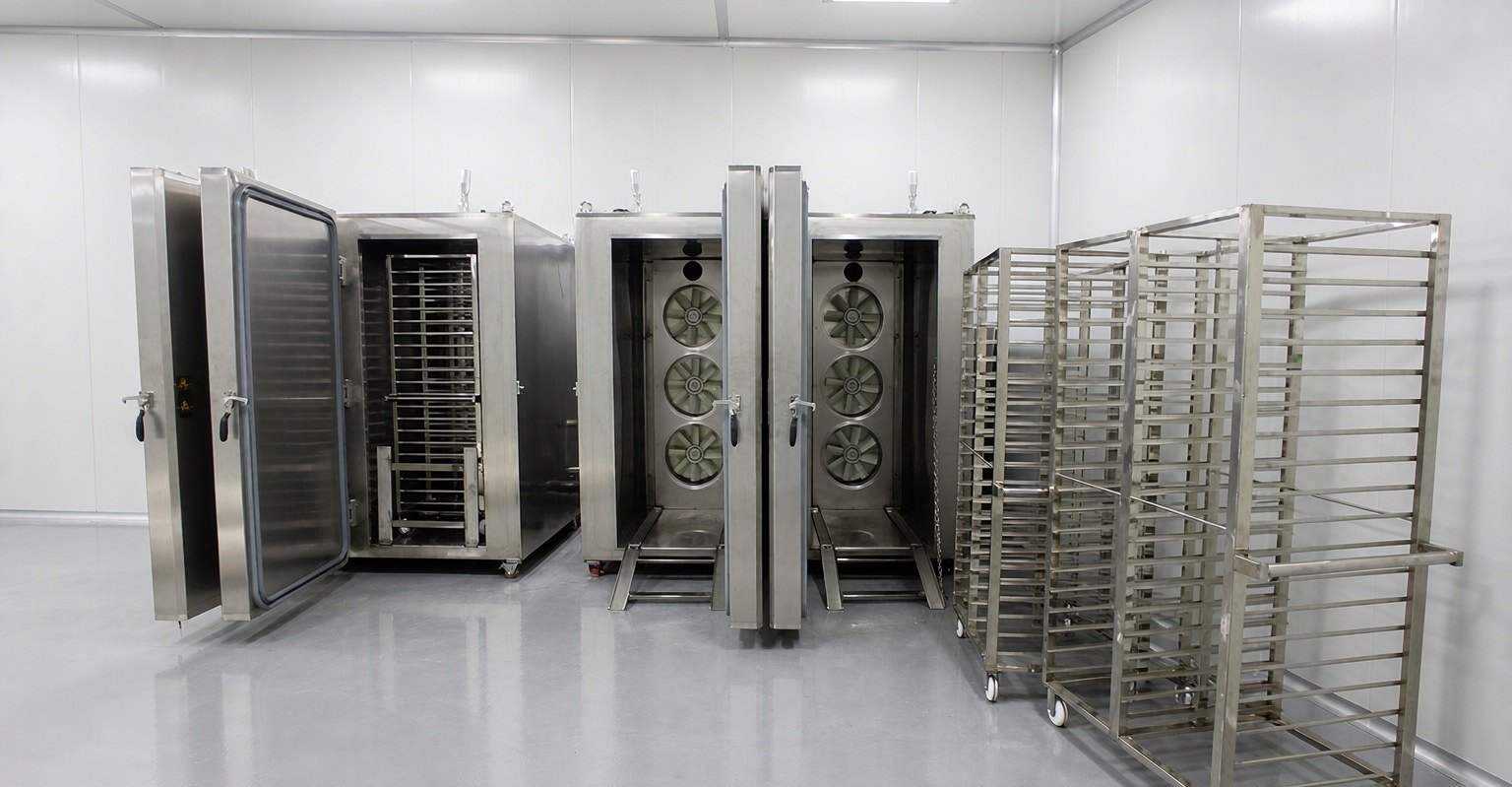
Freezing samples in research institutions often hinges not on “temperature not low enough,” but on inconsistent cooling at different positions in the cabinet for the same batch, or a freezing process that cannot be matched from one run to the next. The approach breaks into three steps: group samples by form, fix loading and placement, and save the cooling process as a reusable program. Choose cabinet-type liquid nitrogen freezers rather than tunnel lines.
Why labs focus on “consistency” rather than “throughput”
Factories count kilograms per hour; labs count whether two batches of data can be plotted on the same chart. Temperature differences between samples and cooling differences between runs ultimately show up in test results. Corning’s product description for sample cooling systems states plainly: temperature inconsistency between samples may lead to misleading analytical results and further affect research outcomes (Corning official website, sample cooling and heating systems page, accessed 2026-11).
This places two requirements on equipment. Temperatures at different positions in the cabinet must fall within the same narrow range—temperature uniformity; and the cooling process under the same settings must be close each time—temperature control accuracy and program repeatability. Ultra-low temperature freezers rely on natural convection; opening the door to load or retrieve samples raises the temperature, and temperature differences between shelves are large, introducing too many variables for comparative experiments. Liquid nitrogen cabinets use forced circulation plus spray vaporization; cooling is controlled by evaporation rate, and a batch of samples completes the freezing process within a short time window.
Four sample types, different loading and placement
What labs send into the cabinet varies widely in form. The four categories below are common groupings; loading must be determined by actual container dimensions—there is no universal number.
| Sample form | Handling before loading | Placement and loading | What to watch during freezing |
|---|---|---|---|
| Tissue blocks, organs, muscle samples | Trim, aliquot, label, wipe surface moisture dry | Single layer flat on 400×600 mm trays, leave gaps between blocks | Rate at which core temperature passes through -1℃~-5℃; block size must be consistent |
| Homogenates, extracts, culture media | Load into centrifuge tubes or cryoboxes, cap and seal | Cryoboxes upright, same-spec boxes on the same layer | Consistent fill volume; avoid frost adhesion on tube walls |
| Cell and strain suspensions | Add cryoprotectant per respective protocols, aliquot into cryovials | Cryovials upright in racks, not in direct contact with trays | These follow programmed cooling and LN2 cryopreservation protocols; the cabinet only handles the initial rapid cooling stage |
| Food R&D samples (dough, fruit pulp, minced meat, compound fillings) | Aliquot by formula, weigh and record | Same-weight samples on the same tray and layer | Corresponding records of formula batch and freezing batch |
One point must be clear: cryovials for cells and strains typically require a programmable rate freezer at one to two degrees per minute; cabinet LN2 freezers cool much faster and cannot replace programmed cooling. Their role is the initial stage—bringing temperature down quickly after collection to suppress enzyme activity and microbial activity, after which samples follow their respective preservation protocols.
Choosing a cabinet: parameters of three models
Research batches generally range from tens to hundreds of kilograms; cabinet freezers suffice. The published parameters of three Kunning Cryo cabinet LN2 freezers are as follows:
| Item | DKN-LFC-300 | DKN-LFC-600 | DKN-LFC-1500 |
|---|---|---|---|
| Internal cavity dimensions | 900×1320×1800 mm | Not listed in technical data | 1300×1700×1800 mm × 2 zones |
| External dimensions | 1740×1730×2220 mm | 2900×1700×2450 mm | 3800×2500×2300 mm |
| Working temperature | -150℃~room temp | -150℃~room temp | -150℃~room temp |
| Temperature control accuracy | ±1℃ | ±1℃ | ±2℃ |
| Temperature uniformity | ±3℃ | ±3℃ | Not listed in technical data |
| No-load cooling rate | Not less than 20℃/min, adjustable | Not less than 20℃/min, adjustable | Technical data notes 50℃/min order of magnitude, adjustable |
| Total power | 2.5 kW | 5 kW | 5 kW |
| LN2 pressure | 5-8 bar | 5-8 bar | 6-8 bar |
| Throughput | 300 kg/h | 600 kg/h | 1500 kg/batch |
| Racks and trays | Rack 1600×605×807 mm, 40 trays per run; tray 400×600×25 mm | Confirmed per order | Two zones independently loaded |
| Oxygen concentration detection | Per configuration | Per configuration | Setpoint 19.5%~21.5% |
The trade-offs are clear. For groups with batches of tens of kilograms, many sample types, and frequent changeovers, the DKN-LFC-300 occupies 1740×1730 mm, holds 40 trays on one rack, and takes a batch in one load without splitting to fill time. For mid-scale central labs or pilot lines, the 600 kg/h tier fits better; the cabinet lengthens to 2900 mm and holds more trays per run. For batch pallet loading and unloading, consider the DKN-LFC-1500 with two independently loaded zones, 1500 kg/batch, and a cabinet width of 3800 mm—measure door openings and passages before delivery.
Throughput figures vary with sample moisture content, piece weight, and packaging; the technical data itself notes “differences with different products and packaging methods.” A full-load test with your own samples before commissioning, recording the actual cooling curve, is more useful than nominal values.
How to arrange the freezing program
The control systems of the three cabinets share the same logic: touchscreen input, PLC control, PID auto-tuning, ten-step cooling and holding, automatic alarm and power-off after program completion; 7-inch color screen, manual operation, and storage of multiple freezing processes for one-key runs. Temperature measurement uses PT100 platinum resistance sensors, Class A accuracy, range 200℃~-200℃.
How to use the ten steps depends on the samples. A practical arrangement:
- The first two steps run rapid cooling, pulling cabinet temperature and sample surface temperature down together so samples enter the below -18℃ range as quickly as possible.
- Middle steps slow down according to sample thickness and loading; thick blocks dwell longer here to avoid a hard surface with a soft core.
- The last two or three steps hold, letting sample core temperature catch up to cabinet temperature so the outer layer does not soften on removal.
- Record each step’s temperature and duration in the lab notebook and recall it for the next batch—this is the prerequisite for batch-to-batch comparability.
Do not set the cooling rate in the program higher than equipment capability. No-load 20℃/min is the nominal value for the LFC-300 and 600; full load will be slower—setting parameters from the measured full-load curve is more stable.
Loading, records, and batch-to-batch comparability
Cabinet circulation uses three low-temperature motors mounted externally, transmitting power into the chamber via extended stainless steel shafts, with guide plates and multi-blade axial fans, adjustable frequency, airflow field designed by simulation, uniform air speed 10 m/s. Airflow is forced, so placement strongly affects results—trays blocking the duct and trays at the edges cool differently.
Fix three things and data becomes comparable: first, loading per tray follows the same standard, same variety and same weight; second, rack placement is fixed, with what goes on which layer written into the work card; third, each batch records loading temperature, removal time, cabinet temperature curve, and sample core temperature. Sample labels must correspond to tray positions; after removal, samples go directly to cryostorage or testing without intermediate transfers.
The cabinet structure uses SUS304 stainless steel sheet, cut, folded, and welded for inner and outer chambers, 150 mm insulation, integrated embedded electrical cabinet, exhaust vents at the rear to keep condensate from dripping onto trays. For labs, this means the interior can be wiped clean per cleanliness requirements, with no residual liquid pooling at the bottom.
Site conditions: power, LN2, exhaust
Power. The three cabinets are wired for 380V/50Hz, total power 2.5 kW to 5 kW—one tier lower than compressor refrigeration equipment of the same capacity, generally connectable to lab power. For overseas institutions or partner sites with 60Hz, motors and electrical components must be checked separately; do not ship the domestic configuration directly.
LN2. The equipment does not include an LN2 source; liquid is supplied from the user’s LN2 tank via cryogenic piping, inlet pressure 5-8 bar (6-8 bar for the LFC-1500). Calculating consumption per batch is more accurate than per day, since usage relates directly to sample quantity, loading temperature, and loading volume.
Exhaust and oxygen concentration. Vaporized LN2 is nitrogen gas, which displaces air in enclosed rooms. The DKN-LFC-1500 technical data specifies an oxygen concentration detector with setpoint 19.5%~21.5%, interlocked with the equipment; monitoring configuration for smaller cabinets is determined by site conditions and order. Do not place exhaust vents above operator positions; after opening the door for loading or retrieval, wait until concentration returns to the safe range before approaching.
FAQ
Small sample volumes—can’t I just use an ultra-low temperature freezer?
You can freeze, but it is not suitable for comparative experiments. Freezers rely on natural convection: slow cooling, temperature differences between shelves, temperature rise each time the door opens—the same batch freezes differently at different positions and times. LN2 cabinets use forced circulation plus spray, cool fast with adjustable rates, and programs can be saved and reproduced.
How many samples fit in one DKN-LFC-300?
The cabinet holds one rack, net height 1600 mm, width 605 mm, depth 807 mm, standard shelf spacing 75 mm, 40 trays per run, tray size 400×600×25 mm. Actual sample count depends on container dimensions and piece weight—calculate from tray layout, not from volume estimates.
How large is the temperature difference across positions in the cabinet?
The DKN-LFC-300 and DKN-LFC-600 have nominal temperature uniformity of ±3℃ and control accuracy of ±1℃; the DKN-LFC-1500 has control accuracy of ±2℃. This range suits most sample preparation, but placement should still avoid airflow dead corners; mark edge and center samples on separate trays.
Where does the LN2 come from—does the equipment include a tank?
No. Liquid is supplied from an external LN2 tank via cryogenic piping, inlet pressure 5-8 bar, 6-8 bar for the LFC-1500. Tank, piping, and room exhaust are configured by the user per site conditions.
Does someone need to stay during the program?
The control system alarms and powers off automatically after the program ends; full-time attendance is not required. But loading and retrieval must be done on site—first confirm oxygen concentration has returned to the 19.5%~21.5% range, then operate, and transfer retrieved samples per their respective preservation protocols.
For institutional procurement of such equipment, the parameter table is only a starting point. Provide sample form, batch weight, target core temperature, site power, and door opening dimensions in full, and the model and configuration can be determined. For related freezing mechanisms, see Freezing Curve and Ice Crystal Formation Band; similar lab processes are collected in LN2 Freezer Case for University Research Teams; cabinet series parameters are at Liquid Nitrogen Freezer Cabinets. For specific sample matching, contact us for a plan based on your parameters.