
Frost in freezing equipment is basically not a problem on the large box surfaces, but at the door seals, inlet/outlet ports, mesh belts and drain outlets—the places that meet moisture. Defrosting should not wait until the frost layer is thick enough to affect loading: set a rhythm by shift, do cleaning during defrosting, let meltwater drain through the bottom drain outlet, and equipment temperature will recover steadily.
I. Frost comes from moisture, not from liquid nitrogen
Liquid nitrogen itself is dry. Frost in the equipment comes from water vapor carried in by products, workshop air entering when doors are opened, and water remaining on the floor and bottom after cleaning. This water vapor desublimates into frost when it meets surfaces below zero degrees.
So the severity of frost has little to do with how thick the equipment is built, and a lot to do with three things: how much water the product surface carries, how many times the door is opened per day, and how high the workshop humidity is. Products with juices in trays, raw materials that have just been thawed, and starting up after cleaning without drying will all make frost form faster.
| Related models | Operating temperature | Temperature control accuracy | Insulation layer | Bottom drainage |
|---|---|---|---|---|
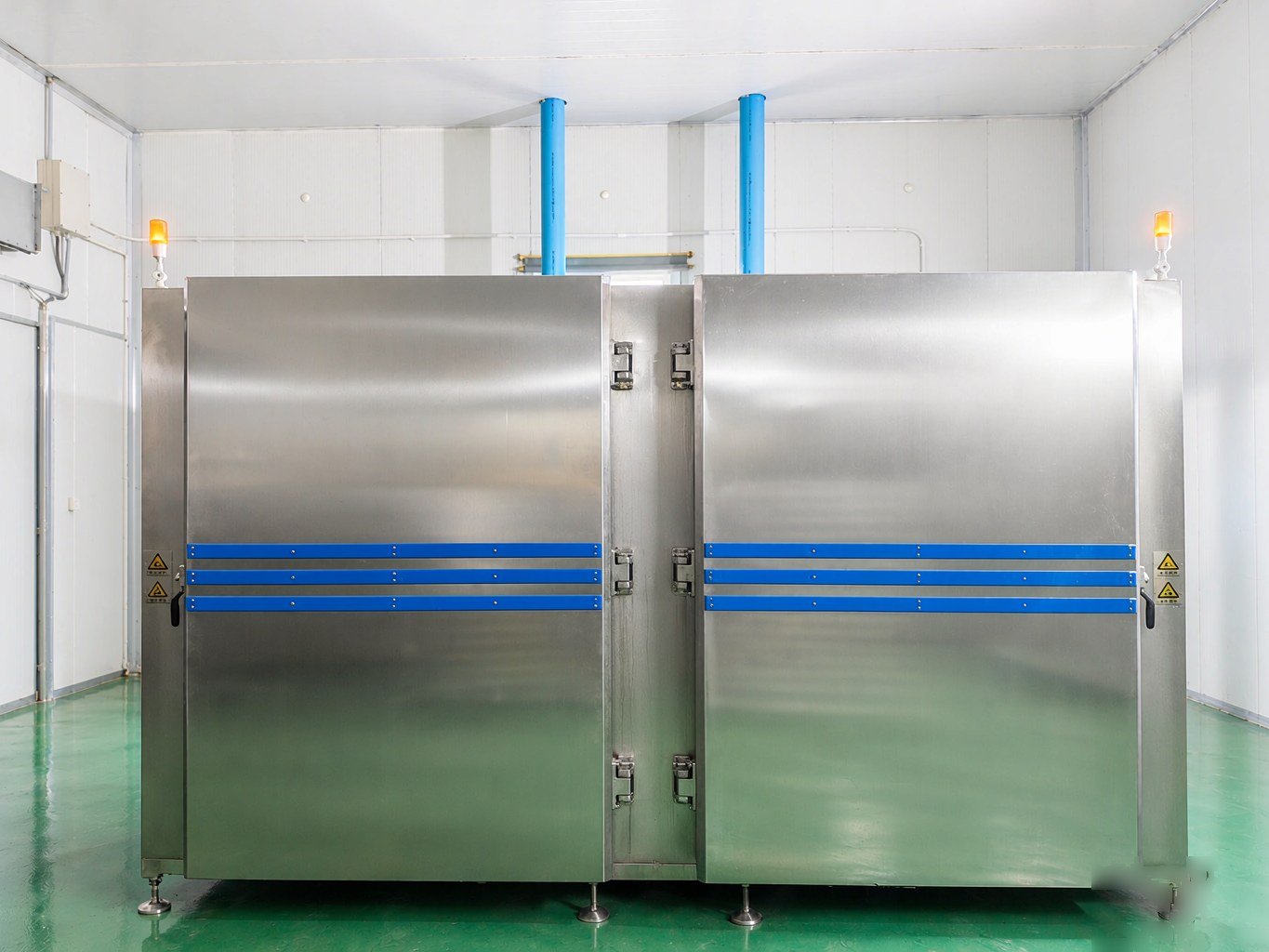
| Liquid nitrogen freezer cabinet DKN-LFC-1200 (four-zone) | -150℃ ~ room temperature | ±2℃ | 150 mm multi-layer insulated foam | Shallow V-type, with drain outlet |
| Liquid nitrogen freezing tunnel line DKN-LFT-1212 | -150℃ ~ room temperature | ±2℃ | 150 mm multi-layer insulated foam | Shallow V-type, with drain outlet |
II. Frost concentrates at these locations
Door seals and door frames. Cabinet machines have side-opening doors, and the door gap is the channel for air exchange between inside and outside. The sealing strip needs elasticity at low temperatures; if it does not press firmly, a continuous small stream of moisture enters, and frost forms first around the door frame. Hardened, cracked, or tray-deformed sealing strips all show the same phenomenon: frost at the door gap.
Inlet and outlet ports. The two ends of the tunnel line are open, relying on exhaust gas extraction ports with exhaust fans to draw away the escaping low-temperature nitrogen gas. When the extraction volume cannot keep up, the two ends do not frost but emit white mist, and frost at the inlet end forms faster than at the outlet end.
Mesh belt and inner cavity bottom. There are spraying devices above and below the mesh belt; airflow carries moisture to the belt surface and bottom, and frost accumulates on the mesh wires and near the bottom water collection groove. The LFT-1212 body is of integral lifting type; when cleaning and inspecting the mesh belt, the body can be raised, and the bottom shallow V structure has a drain outlet through which accumulated water and frost residue exit.
Drain pipes and floor drains. If the drain outlet is not water-sealed, moisture from the floor drain will return upward along the pipe, and frost will form blocks in the low-temperature section of the pipe. Once blocked, defrost water cannot drain out and can only seep into the insulation layer.
III. What thick frost brings
- Worse heat exchange, slower cooling. The frost layer itself is an insulating layer. With the same load and inlet temperature, cooling time lengthens and liquid nitrogen consumption rises—check frost first.
- Door seal pushed out. After frost accumulates on the door frame, the door cannot close properly, the sealing strip does not press firmly, cold leakage worsens, and frost forms even faster—a vicious cycle.
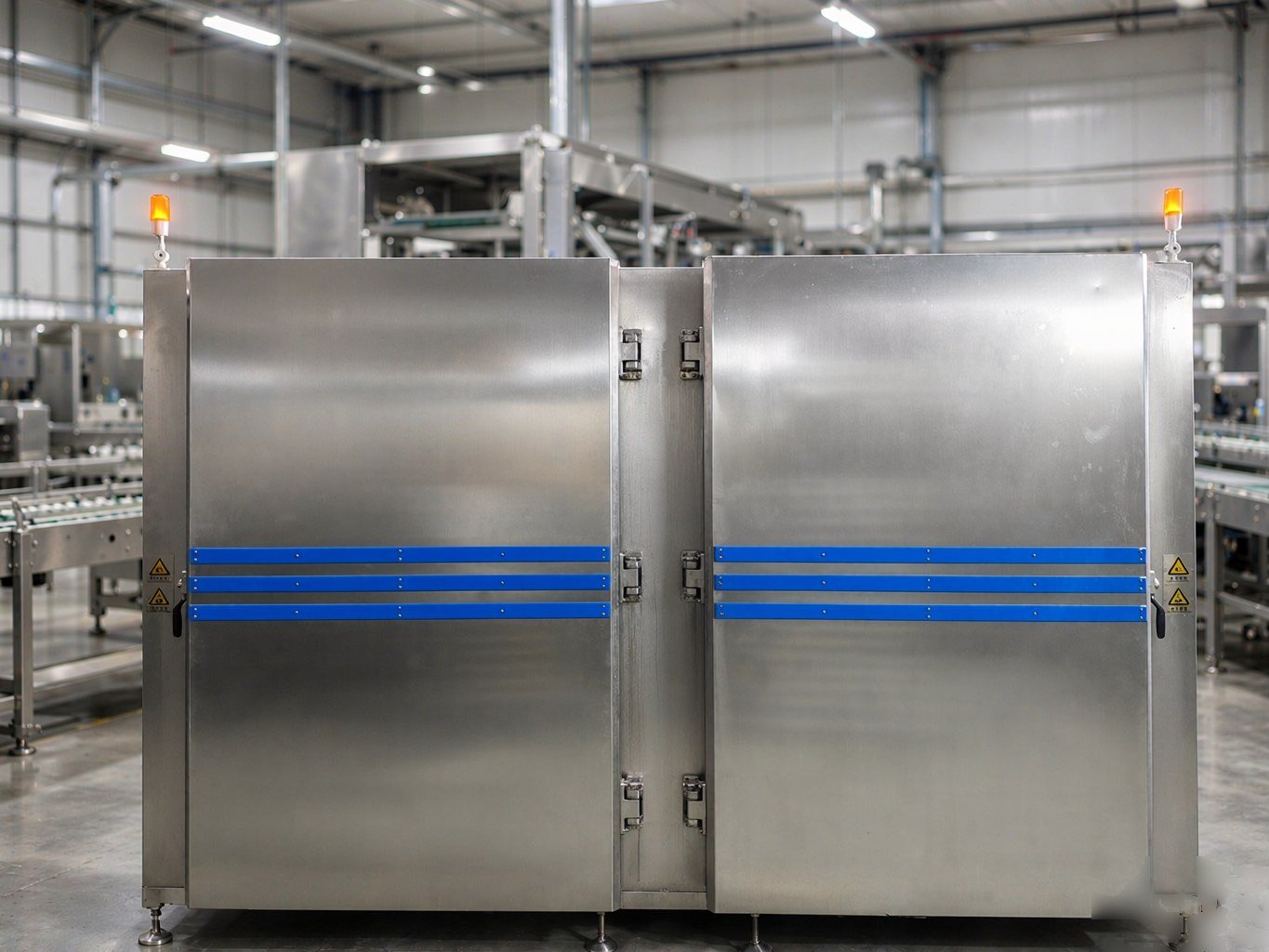
- Loading space eaten up. The rack dimensions of cabinet machines are fixed (LFC-1200 is equipped with 10 racks, loading 0~1200 kg/single zone); the space occupied by the frost layer directly affects single-batch loading.
- Mesh belt deviation and slipping. When frost forms thickly on the mesh belt surface, tension changes and the probability of deviation rises.
- Frost water entering the insulation layer. This is hard to fix. After water enters the insulation layer, performance declines, the outer surface temperature drops, and condensation follows. For the approach, see Cold Leakage and Condensation Control in Freezing Equipment.
IV. Defrosting actions and sequence
Defrosting is not a single action but a chain of “shutdown—temperature rise—thawing—sweeping—draining—temperature recovery.” Wrong sequence will push water to places it should not go.
- Finish the current shift’s batches before shutdown; do not leave semi-frozen products in the cavity. The frost layer will fall off during defrosting, and pressing onto products means foreign matter.
- Shut down and cut off liquid nitrogen, letting the inner cavity recover naturally. Move tools only after frost begins to loosen; hard scraping will scratch the stainless steel inner walls and welds.
- Sweep from top to bottom: top fans and guide plates, inner walls, racks, bottom water collection groove. Use soft scrapers and vacuuming for cleaning tools; metal shovels do not go on the inner cavity.
- Concentrate defrost water drainage. The bottoms of LFC and LFT are both shallow V-type with drain outlets; water flows by its own slope. If the slope is insufficient or the drain outlet is blocked by frost residue, water must be manually directed to the floor drain—do not let water stay at the bottom.
- Check the water seal of the drain pipe. After defrosting, drain water once and see whether the floor drain has return odor or moisture; if so, replenish the water seal.
- Feed again after empty-machine temperature recovery. No-load cooling rate for LFC-1200 is ≤50℃/min, and for LFT-1212 it is 10℃ per minute no-load; feed again after temperature recovery is in place, avoiding moisture from new product immediately forming another layer on old frost.
V. How to set the defrosting rhythm
There is no uniform duration; it depends on three variables: single-shift loading, product moisture level, and door-opening frequency. The approach is to set a fixed checkpoint by shift and look at frost layer status rather than the clock.
| Checkpoint | What to look at | Judgment and action |
|---|---|---|
| Before each shift starts | Door seals, observation window, inner wall frost | Local thin frost can start directly; if frost forms a ring on the door frame, handle the door seal first |
| At the end of each shift | Bottom water collection groove, drain outlet | Clear frost residue immediately; perform a water flow test on the drain outlet |
| Weekly | Drain pipe water seal, sealing strip elasticity | Replace sealing strip if hardened or cracked |
| Monthly | Mesh belt tension and deviation, fan blade frost | Check tension for mesh belt deviation; shut down and defrost for thick blade frost |
VI. Several on-site practices to reduce frost
- Control water on products. Trays should not accumulate juice or be filled above the tray edge; surface water should be drained before entering the equipment.
- Reduce unnecessary door openings. For cabinet machines, the number of door openings directly equals the number of moisture entries; frequent small-batch opening causes frost much faster than one large-batch loading.
- Stagger cleaning and freezing. After cleaning, workshop humidity is high; starting up with water on the floor will draw moisture into the cavity. Allow time for ventilation and floor drying.
- Exhaust extraction should work together with workshop ventilation. The exhaust fans at both ends and the workshop exhaust compete for air volume; when extraction is insufficient, the inlet end frosts first. For layout points, see Workshop Ventilation and Noise Design for Freezing.
- Keep the drain outlet clear. This is a low-effort matter and also the safeguard that defrost water does not go into the insulation layer. For hygienic design and seam treatment, refer to Hygienic Design and Material Selection for Food Freezing Equipment.
FAQ
How often should freezing equipment be defrosted?
Based on frost layer status, not on duration. For cabinet machines, look at the door frame and inner walls; for tunnel lines, look at the inlet end and bottom water collection groove. Thin frost can run with frost; ring-shaped frost or frost affecting loading requires shutdown. Sites usually set checkpoints by shift and perform a complete defrost and drainage check weekly.
Must defrosting be done with the machine stopped?
Yes. Liquid nitrogen equipment has no hot gas bypass or similar online defrosting means; inner cavity temperature recovery relies on shutdown and natural defrosting, then sweeping after frost loosens. Continuing to run with frost only makes cooling time longer and longer, and liquid nitrogen consumption rises accordingly.
What happens if defrost water cannot drain out?
Water staying at the bottom will enter the insulation layer along gaps. Once water enters the insulation layer, the outer surface temperature drops, and condensation and cold leakage appear simultaneously—and it is not something that recovers after one sweep. The drain outlet and pipe water seal should be confirmed for water flow by shift.
Frost always forms at the door gap first—is it a sealing strip problem?
Mostly yes. If the sealing strip hardens, cracks, or does not press into place at low temperature, the door does not close firmly. But it may also be that the door frame is deformed by trays or the door hinge is loose. Check the sealing strip first, then check whether the door frame and door body are aligned.
Does frost affect liquid nitrogen consumption?
Yes. The frost layer insulates, heat exchange efficiency declines, and the same cooling result requires more liquid nitrogen. For measurement methods, refer to How to Measure Liquid Nitrogen Consumption and Freezing Energy Consumption; if gas consumption steps up while process parameters are unchanged, check frost and cold leakage first.
Whether to choose a cabinet machine or tunnel line, and how to arrange the defrosting rhythm, depends on product form, moisture level, and production scheduling. Site conditions can be written on the Contact Us page, and we will give configuration suggestions according to operating conditions.