
Cold loss in liquid nitrogen quick-freezing equipment rarely occurs on the main cabinet panels; it is mostly concentrated at seams such as door seals, inlet/outlet ports, pipe penetrations and bottom drains. Condensation should be viewed from a different angle: water forms when the outer surface temperature is below the workshop air dew point. This has nothing to do with equipment workmanship and is more related to workshop humidity and floor construction.
I. Cold loss travels through seams, not through the middle of insulation panels
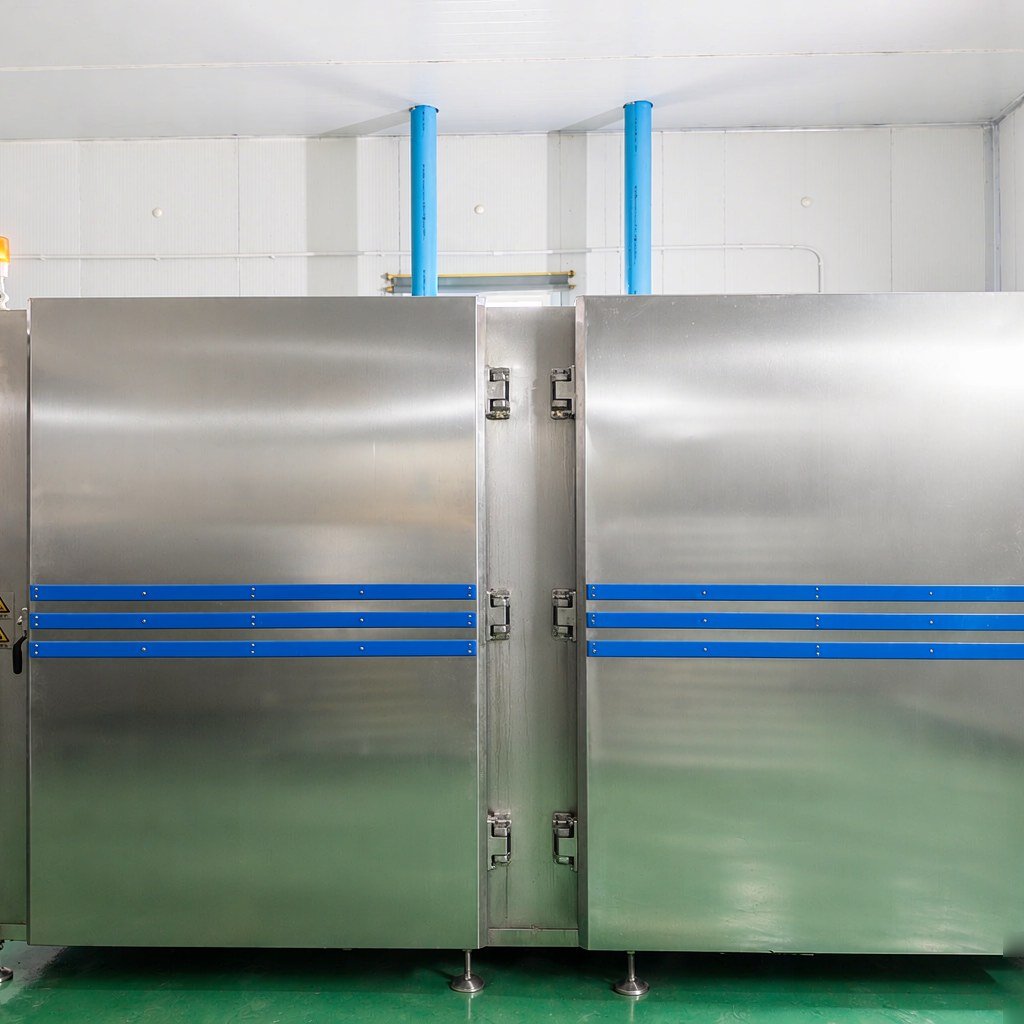
Cabinet insulation blocks large-area conduction. The places where cold truly leaks are where the insulation layer is interrupted: around door frames, at reinforcement rib penetrations, at pipe inlets and outlets, at drains and access holes.
| Item | Parameter |
|---|---|
| Liquid nitrogen quick-freezing cabinet DKN-LFC series cabinet insulation layer | 150 mm multi-layer insulated foam |
| Liquid nitrogen quick-freezing tunnel DKN-LFT-1212 insulation layer | 150 mm multi-layer insulated foam |
| Immersion-type rapid chiller DKN-RHV-2000L cabinet insulation layer | 120 mm |
| Operating temperature | -150℃ ~ room temperature |
| Temperature control accuracy | ±2℃ |
On the same equipment with 150 mm cabinet insulation, if the reinforcement ribs and pipe penetrations are not filled with low-temperature foam, that section becomes the weak point of the whole machine. When selecting equipment, asking “how are reinforcement ribs and wall penetrations handled” is more useful than only looking at insulation thickness.
II. Door seals and inlet/outlet ports: the larger the opening, the more it needs separate treatment
The opening of a cabinet-type machine is the door; the openings of a tunnel line are at both ends. If they cannot be sealed completely, they can only be controlled.
Cabinet-type machines rely on low-temperature-resistant sealing strips plus door frame structure. The sealing strip must remain elastic near -150℃; a hardened sealing strip cannot press firmly, and a gap appears as soon as the door closes. Inspection is simple: after the door is closed in place, run a hand along the door seam; continuous cold air means it is not pressing firmly or has already deformed.
Both ends of the tunnel line are open. DKN-LFT-1212 has exhaust gas extraction ports at both the inlet and outlet ends, connected to high-flow exhaust fans to extract the escaping low-temperature nitrogen from both ends. The exhaust duct and fan are confirmed per order; the routing, position and outlet height must be planned together with workshop ventilation, see Workshop Ventilation and Noise Design for Liquid Nitrogen Quick-Freezing. The mesh belt cycle from inlet to outlet is adjustable from 5 to 25 minutes; the shorter the cycle, the more the exhaust volume at both ends must keep pace.
III. Condensation is not an equipment fault; it is a dew point issue
Workshop air carries moisture; when it contacts outer surfaces below the dew point, water condenses. Door frames, observation windows, lower edges and nearby floors are the first places where water appears.
| Condensation location | Common cause | Treatment direction |
|---|---|---|
| Lower edge of door seam | Door seal not firm, cold air blows directly onto outer surface | Replace or adjust sealing strip, use thermal break in door frame |
| Observation window | Large temperature difference inside and outside single-layer glass | Change to double-layer hollow glass, or add electric heating for de-fogging |
| Equipment lower edge and bottom | Cold loss at drain, cold air spreads along the floor | Add water seal and insulation at drain, leave ventilation at bottom |
| Floor around equipment | Floor has no insulation layer, continuously cooled by cold air | Add insulation layer to floor or add thermal insulation pads under equipment |
Condensation itself does not damage food, but it brings two things: wet and slippery floors, and water entering the insulation layer along bottom seams. After water enters the insulation layer, performance declines, cold loss worsens, and the longer it is delayed, the harder it is to remedy.
IV. The workshop side: floor, drainage and doorways
- Floor: Floors in low-temperature areas need an insulation layer. A floor without insulation will be pulled down to near zero degrees by cold air within a few months, and frost and condensation will form on top.
- Drainage: The bottom of the LFC series cabinet-type machine is a shallow V design with a drainage outlet; cleaning residue and accumulated water are discharged through it. If the drain pipe opens directly into the floor drain, cold air will escape along the pipe and also draw moisture up from the floor drain; a water seal is standard practice.
- Doorways and humidity: Reduce frequent door openings near the inlet/outlet ends; add air curtains if necessary, with the air curtain directed outward to block moisture. Workshop humidity is high after cleaning; starting the machine at this time makes condensation likely. Leaving time between cleaning and freezing is more effective than wiping water afterward.
V. Three on-site actions to diagnose cold loss
- Stop the machine and observe the frost line. After running for a period, stop the machine and, when the frost layer is slightly stable, observe where the frost appears. The place where the frost line is concentrated is the cold leak point; door seams, flanges and access holes are common.
- Scan seams with infrared. During operation, scan along door frames, inlet/outlet ports and pipe penetrations. Points with temperatures noticeably lower than the surrounding cabinet surface are cold bridges. Read relative differences, not single-point readings.
- Compare gas consumption. With the same material, loading amount and inlet temperature, if liquid nitrogen consumption rises noticeably compared with earlier periods and process parameters have not changed, check for cold loss first. For measurement methods, see How to Measure Liquid Nitrogen Consumption and Freezing Energy Consumption.
The cost of treating seams is far lower than the liquid nitrogen consumption caused by cold loss. Handle it once during installation and save trouble for years afterward.
Frequently Asked Questions
Is thicker insulation always better for quick-freezing equipment?
Thickness alone is not the only factor. 150 mm multi-layer insulated foam is the current practice on LFC cabinet-type machines and LFT tunnel lines; the effect depends on whether the insulation layer is continuous. At reinforcement ribs, pipe penetrations and drains, where insulation is interrupted and not filled solid, thickening the main panel insulation cannot compensate.
How often should door seals be checked?
As part of daily inspection, once a week, running along the door seam. Sealing strips that have hardened, cracked or cannot press firmly should be replaced directly. In workshops with frequent cleaning, the interval should be shortened further.
Should the machine be stopped if condensation appears on outer surfaces?
Slight condensation does not affect operation and production can continue, but workshop humidity and ventilation should be checked. If there is extensive water accumulation on the floor or water begins to seep into bottom seams, stop the machine and address it: ventilate to reduce humidity first, then check the drain water seal and bottom insulation.
How to control cold air escaping from both open ends of the tunnel?
Both ends rely on exhaust gas extraction ports plus exhaust fans to extract escaping nitrogen; the exhaust duct and fan are configured on site according to the equipment interface. The exhaust volume should be checked together with overall workshop ventilation to avoid competing for airflow. Interface and layout can be confirmed against the description of Liquid Nitrogen Quick-Freezing Tunnel according to workshop conditions.
Treatment plans for cold loss and condensation depend on workshop conditions, machine model and production scheduling. You can describe your site conditions on the Contact Us page, and we will provide configuration suggestions based on actual operating conditions.