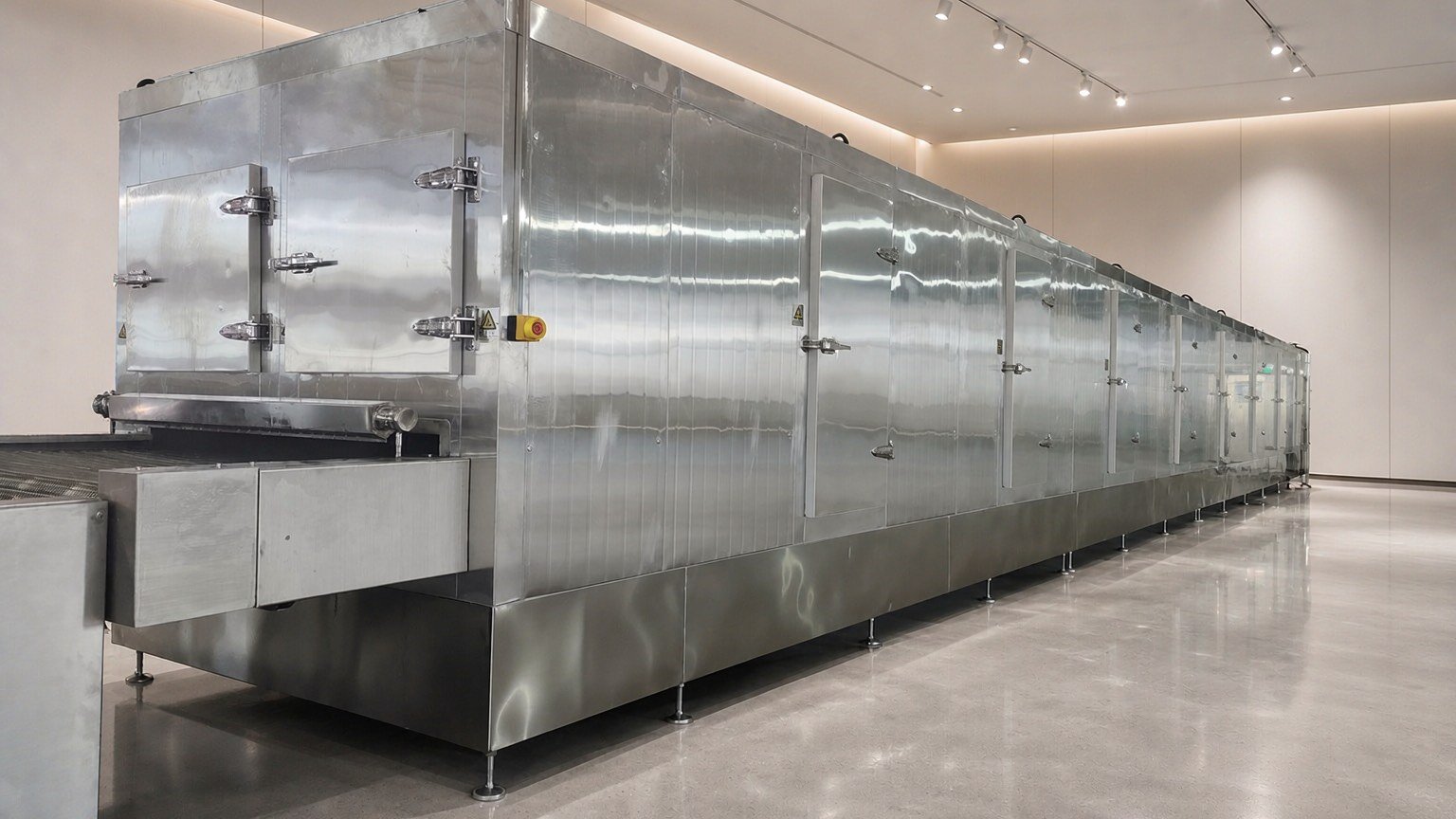
DKN-RFT-1616 is the 1600 mm wide belt model in the Kunning Cryo belt freezer product line, with a belt width of 1600 mm and a freezing section length of 16 m, using compressor refrigeration as the cold source. Material is spread onto the stainless steel belt from the infeed end, travels continuously through the low-temperature zone on the belt to complete freezing, and is then discharged from the outfeed end. The 16 m freezing section provides a longer residence time, suitable for continuous production lines with relatively thick individual pieces, higher infeed temperatures, and a need to bring the core temperature below -18℃; the equipment does not require a liquid nitrogen tank or cryogenic piping, and can operate once connected to power and provided with condenser heat dissipation conditions on site.
Technical Parameters
| Item | Parameter |
|---|---|
| Product Model | DKN-RFT-1616 |
| Product Line | Belt freezer (compressor refrigeration) |
| Belt Dimensions | 1600 mm (width) × 16000 mm (length) |
| Structure | Continuous belt conveying, material passes through the low-temperature zone on the belt |
| Cold Source | Compressor refrigeration (mechanical refrigeration) |
| Operating Temperature | Confirmed per order (configured according to material and capacity) |
| Freezing Cycle | Confirmed per order (belt variable-frequency speed control) |
| Discharge Core Temperature | Confirmed per order (quick-freezing conditions calculated at core temperature below -18℃) |
| Total Power | Confirmed per order |
| Condensing Method | Confirmed per site conditions and order (air-cooled / water-cooled / evaporative) |
| Refrigerant | Confirmed per order |
| Power Supply | 380V/50Hz |
Belt dimensions are effective conveying surface dimensions. The 16 m determines residence time, not hourly capacity: thicker spreading, heavier individual pieces, and higher infeed temperatures mean less material passes per unit time, and capacity is calculated according to the customer’s product.
Structure and Configuration
The whole machine is a continuous tunnel structure, composed of four parts: insulated enclosure, belt conveying system, evaporator and cold air circulation system, and control system.
- Insulated enclosure: inner and outer walls are formed from SUS304 food-grade stainless steel plates, with a rigid polyurethane foam insulation layer in between; access doors are provided along the length for cleaning and maintenance.
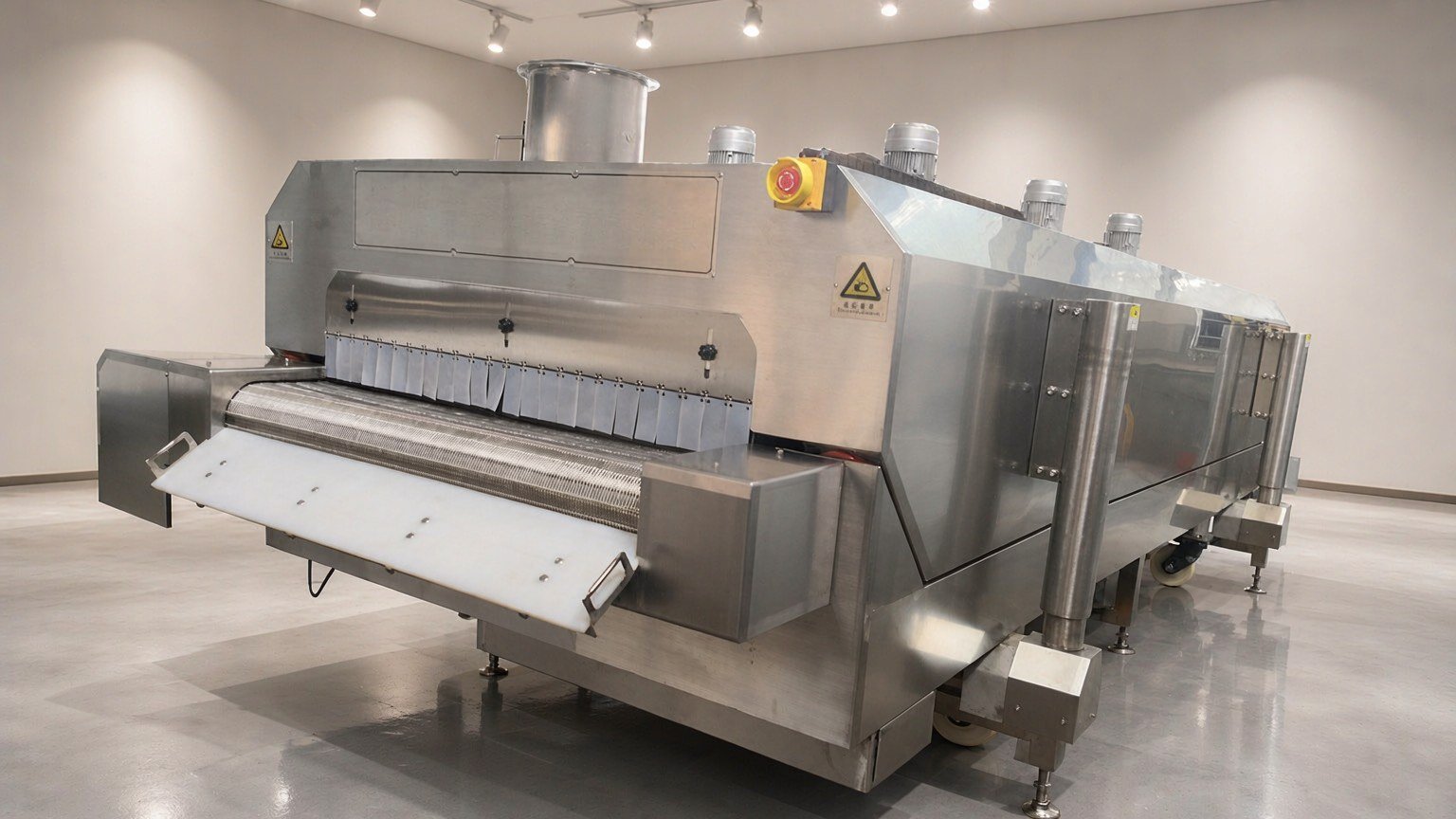
- Belt conveying system: stainless steel belt with variable-frequency speed-controlled motor and tensioning device, continuously adjustable during operation, and changing products only requires changing the speed; transition sections can be added at the infeed and outfeed ends to connect with pre-processing lines and packaging lines.
- Evaporator and cold air circulation: the evaporator is equipped with axial fans and air guide plates, and cold air circulates and exchanges heat on both the upper and lower sides of the belt; the long freezing section gives the material a more ample heat exchange path, so thick pieces do not end up with an over-chilled exterior and an under-frozen core.
- Control system: PLC plus touch screen control, PID automatic adjustment, temperature measurement using PT100 platinum resistance; equipped with over-temperature alarm, emergency stop switch, grounding and phase sequence protection.
Application Scenarios
| Scenario | Description |
|---|---|
| Thick pieces and large items, individually quick-frozen | Large cuts of meat, whole poultry, thick fish fillets and other items with thick individual pieces requiring long residence time |
| Aquatic product processing | Continuous IQF of fish, shrimp and shellfish; when infeed temperature is relatively high, the long freezing section compensates for heat exchange |
| Prepared dishes and prepared foods | Multi-category switching, calling different belt speeds and temperature programs per product |
| Main lines with concentrated capacity | Large upstream processing volume, one line runs continuously without stopping to reload trays |
The 16 m freezing section brings length, and the workshop must reserve a straight passage according to the overall machine dimensions. For thin individual pieces and tight spaces, shorter freezing section models are more suitable; for batch-type small-volume production, cabinet equipment can be considered (liquid nitrogen quick-freezing cabinet). For how belt speed and freezing cycle work together, see Freezing Cycle and Belt Speed of Belt Quick-Freezing.
Installation Conditions
- Site: reserve space for operation, maintenance and infeed/outfeed connection according to the equipment’s overall dimensions (overall dimensions confirmed per order); the 16 m freezing section is arranged in a straight line, with buffer sections at both ends, and column positions checked in advance.
- Power: 380V/50Hz, wiring and grounding according to total power and on-site distribution capacity.
- Heat dissipation: the compressor condenser requires ventilation or cooling water conditions, with reserved heat dissipation space and maintenance access; the condensing method is determined in the order according to on-site water and power conditions.
- Floor and drainage: floor load-bearing calculated according to full-load weight; the workshop is provided with slopes and floor drains according to cleaning and drainage requirements.
Warranty and After-Sales
The whole machine has a one-year warranty; after receiving a request, a solution is provided within 2 hours, arrival on site within 24 hours, and fault resolution within 72 hours; one free on-site service visit per year, with lifetime technical support.
FAQ
What does 1616 in DKN-RFT-1616 represent?
According to Kunning Cryo equipment numbering rules, the numeric segment for belt and tunnel models is “belt width (mm÷100) + belt length (m)”, so 1616 means a belt width of 1600 mm and a freezing section length of 16 m. These two numbers are design finalization values, indicating how large and how long the equipment is, not the hourly output.
How to choose between the 16 m and 12 m models?
The difference lies in how long the material can stay in the low-temperature zone. For products with thin individual pieces, low infeed temperature and a conventional target core temperature, the 12 m section can complete the run at the required pace; products with thick individual pieces, high stacking and relatively high infeed temperature require a longer heat exchange path, so choose 16 m. Give us the individual piece weight, spreading thickness, infeed temperature and target core temperature, and the length is determined after calculating residence time.
Does this equipment use liquid nitrogen or a compressor?
It uses compressor refrigeration. It does not carry a liquid nitrogen tank or cryogenic piping; it can operate once connected to power and provided with condenser heat dissipation conditions on site, with the cold source coming from the unit itself. For the trade-offs between the two cold sources, see Comparison of Liquid Nitrogen Quick-Freezing and Mechanical Refrigeration Quick-Freezing.
What are the capacity, operating temperature and total power?
These three items are configured according to the customer’s material, capacity and on-site power conditions; there are no fixed values in the technical documentation, and they are confirmed per order. After the working conditions are confirmed, we provide selection parameters and power distribution requirements.
To verify the model according to material and capacity, visit Contact Us and provide the individual piece weight, spreading thickness, target core temperature, shift output and available workshop length, and we will calculate according to the parameters.