
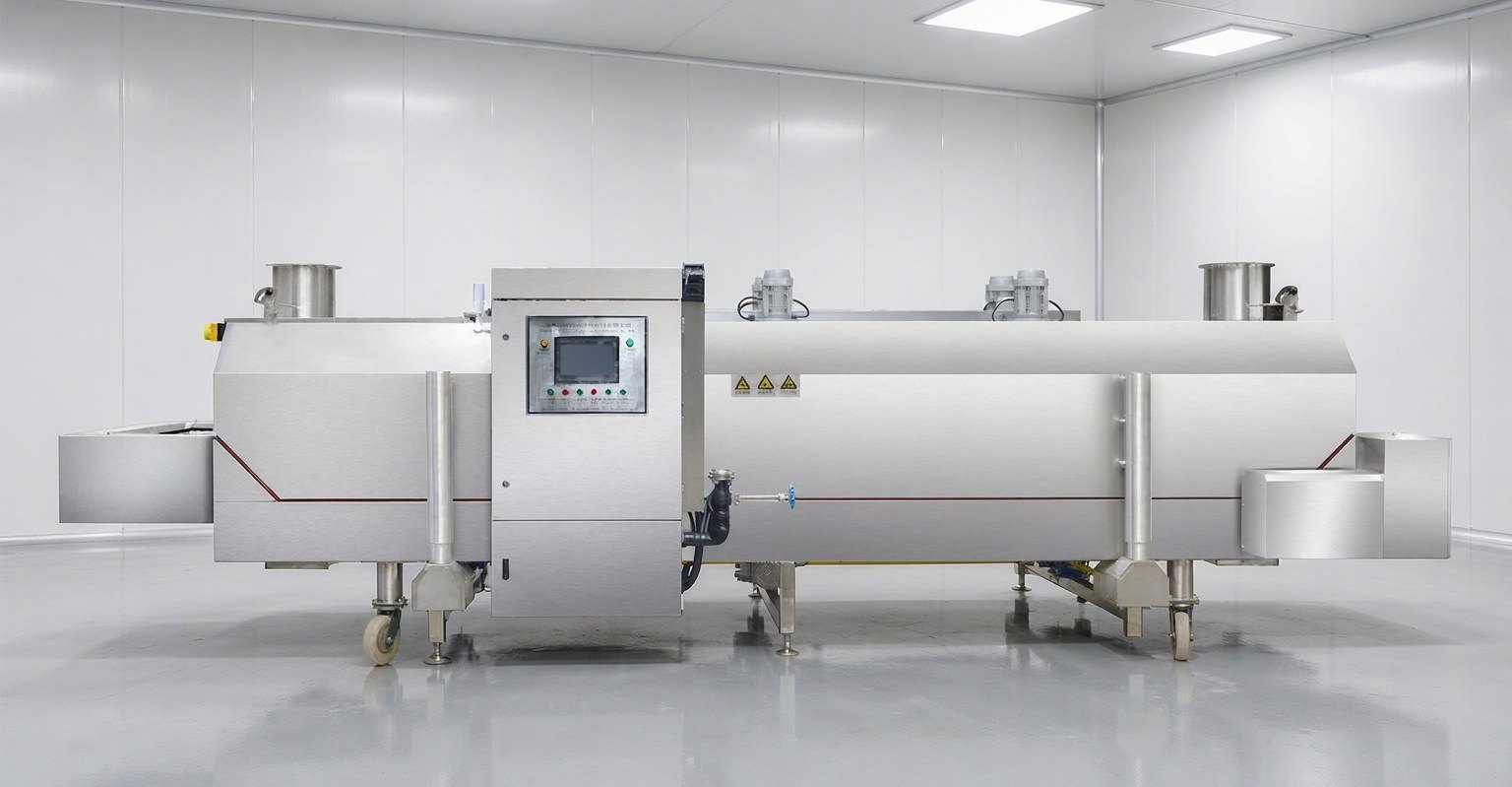
Industry: Overseas customers | Region: Domestic | Supporting model: DKN-LFT-1612 liquid nitrogen freezing tunnel Customer information has been anonymized; model configuration is a selection reference for similar capacity.
I. Application Background
The typical approach of overseas food importers is two-ends-outside: sourcing domestically, processing to destination country standards, and after customs clearance, shipping by sea to their own warehouse or distributors. Frozen products are one of the main categories—shrimp, fish, cut meat, prepared foods—moving container by container.
These customers raise requirements differently from domestic customers. Domestic customers ask about freezing performance first; importers ask three things first: whether the equipment can connect to the power supply on site, whether the frozen products can pass acceptance inspection when the container is opened at the port of arrival, and whether this line can fit into the existing workshop. The first two determine whether the goods can be sold; the third determines whether the equipment can be installed at all.
II. Process Challenges
First, mismatched power supply systems turn the equipment into a lump of iron on site. The voltage, frequency, and phase count of the destination country’s grid differ from domestic ones, and the power supply and control circuits need separate requirements. This must be settled before signing the contract. Changing it halfway through production means re-selecting electrical cabinets, motors, and heating components, with delivery time and costs recalculated together.
Second, the processing facility’s workshop often already has a layout. When adding a line to an existing plant, door opening widths, passage turning radii, and lifting space are all fixed. A 12000 mm tunnel line is not something that fits in as a standard piece—which direction the infeed and outfeed ends face, how much space to leave on the maintenance side, all need to be adjusted to on-site dimensions.
Third, sea freight packaging is not just wrapping a layer of film outside. For long equipment like tunnel lines, sea freight requires disassembly into sections, securing, and moisture protection. Container loading method and lifting points are part of the packaging design. Otherwise, when the container is opened at the destination port, the mesh belt is deformed and motors are damp—requiring repairs before installation even begins.
Fourth, acceptance standards follow the destination country. Thaw drip loss, individual piece sticking, frozen block core temperature—the importer’s quality control has its own table, typically one notch stricter than domestic sales.
III. Solution Configuration
This scenario is suited to the DKN-LFT-1612 liquid nitrogen freezing tunnel, with the following main parameters (from product technical documents):
| Item | Parameter |
|---|---|
| Tunnel mesh belt | 12000 mm (L) × 1600 mm (W), mesh belt effective width 1600 mm |
| External dimensions | 12000 × 2700 × 1950 mm |
| Operating temperature | -150℃ ~ room temperature |
| Temperature control accuracy | ±2℃ |
| Cooling rate | 10℃ per minute at no load |
| Capacity | Approx. 1000 kg/h (varies with product and packaging method) |
| Total power | 26 kW |
| Refrigerant | 0.5-0.8 MPa liquid nitrogen |
| Oxygen concentration monitoring | Oxygen concentration setpoint 19.5%-21.5% |
The configuration logic has three parts.
The mesh belt effective width of 1600 mm is 400 mm wider than the common 1200 mm model. This is useful for importers’ order structures: a single container often mixes several specifications, and a wider belt can place more trays side by side in one pass, reducing line changeovers when switching specifications. Capacity is approximately 1000 kg/h; this figure varies with product form and packaging method, and is confirmed per order for specific categories.
External dimensions 12000 × 2700 × 1950 mm and total power 26 kW—these two figures need to be provided to the processing facility in advance: installation space is reserved according to external dimensions, and workshop power distribution is declared according to total power. Only when both are settled can production scheduling begin.
Power supply, certification, and packaging are confirmed according to destination requirements. For export projects, voltage/frequency/phase count, destination country market access certification, sea freight disassembly method, and packaging materials are all specified item by item in the contract technical agreement, confirmed per order, without generic wording.
IV. Process Points
The time to pass through the maximum ice crystal formation zone remains the core. At no load, cooling of 10℃ per minute is achievable, with operating temperature reaching -150℃—sufficient cryogenic margin; when running with product on the belt, the belt speed is used to compress the residence time of materials in the -1℃ to -5℃ range. The specific speed is determined by trial runs according to product thickness and loading layers.
Temperature control accuracy ±2℃. Export orders are continuous batches; a line may run for hours or even all day, and whether accuracy remains stable directly reflects on the difference between early and late frozen products—the same batch must not vary from start to finish.
The cold source is 0.5-0.8 MPa liquid nitrogen, with storage tanks and supply piping provided by the user. For export scenarios, confirm in advance whether liquid nitrogen supply is convenient in the destination country—in some places liquid nitrogen is more expensive than electricity, and the operating cost structure differs from domestic. This point is recommended to be discussed openly with the customer at the selection stage.
Oxygen concentration setpoint range 19.5%-21.5%. Inside the liquid nitrogen tunnel, oxygen is displaced. After loading/unloading, maintenance, or cleaning the mesh belt, confirm the oxygen concentration has returned to range before entering. On-site safety procedures for export projects should be delivered together with the equipment; operator training cannot be skipped.
V. Applicable Users and Selection Recommendations
The DKN-LFT-1612 is suited to export-oriented processing scenarios with relatively concentrated specifications and high daily throughput: overseas importers’ designated processing plants domestically, continuous freezing of export shrimp and fish fillet aquatic products, as well as cut meat and prepared foods.
To decide whether to go with a tunnel line, ask three questions. Is the daily batch continuous enough—how many specifications per day; can the workshop accommodate a 12000 mm length while leaving maintenance-side space; is on-site liquid nitrogen supply stable. If all three are met, the wide belt and cryogenic zoning can be put to use.
For those with mixed specifications, small single batches, and tight workshop space, the DKN-LFC series liquid nitrogen freezing cabinets are more suitable—small footprint, fast changeover.
For export projects, four things must be locked down at the selection stage: destination country power supply system, market access certification list, sea freight packaging and disassembly method, and available workshop clearance dimensions. Only when these four are settled can the equipment solution be considered usable. Belt speed and nitrogen replenishment rate are left to the commissioning stage, adjusted according to actual products.
Customer information has been anonymized; model configuration is a selection reference for similar capacity.