
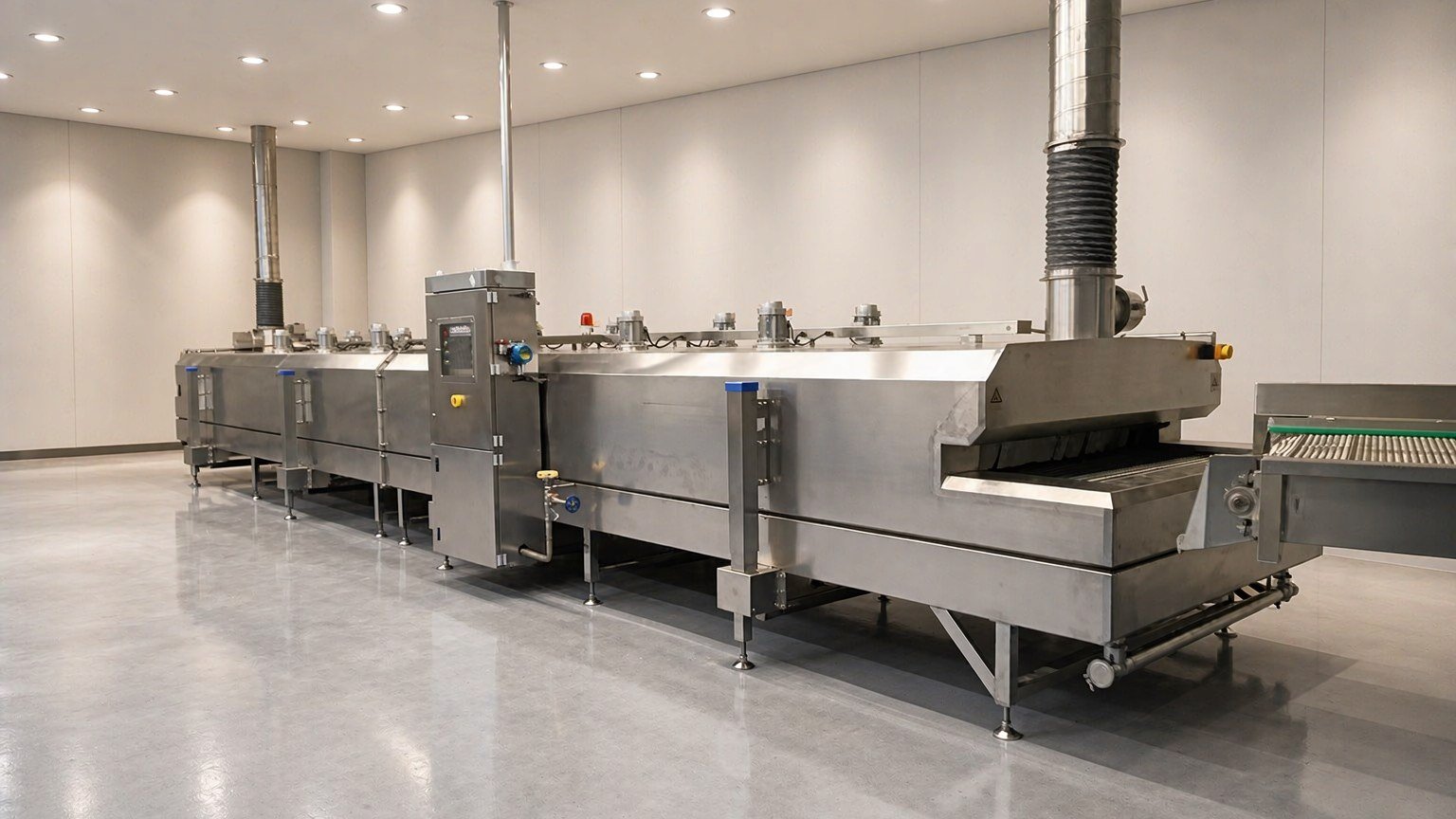
Industry: Meat processing | Region: East China | Supporting model: DKN-LFT-1206
A meat processing enterprise in East China produces prepared meat, meatballs, minced meat and formed meat products, running domestic and export orders on mixed lines. Export orders come in small batches with mixed items—one order may combine several varieties—and destinations have their own requirements for power system, packaging format and accompanying documents. Comparable capacity is matched by the DKN-LFT-1206 liquid nitrogen quick-freezing tunnel line, with mesh belt 6000 × 1200 mm and total power 9 kW; inlet/outlet heights and non-standard section lengths are cut after order confirmation.
I. Application Background
Products such as prepared meat and meatballs come in many varieties with modest batch sizes per item. Domestic sales can schedule long shifts by variety, while export orders often combine several specifications in one order, with packaging in cartons, trays or vacuum bags.
Export and domestic orders have no fundamental difference in freezing process; the difference is that equipment must follow destination conditions: what power system the local grid uses, what dimensions the packaging is set to, and how the equipment is disassembled for shipping and positioned on site. Until these are fixed, dimensions and electrical configuration cannot be finalized.
II. Process Challenges
Power systems are not universal. Destination voltage, frequency and phase configurations differ, so motors, control circuits and instrument power must be selected accordingly; the same model shipped to different countries does not share one distribution diagram. The common specification is 380V/50Hz; other systems are confirmed per order, and local grid parameters need to be obtained before signing.
Dimensions are driven by packaging format. Inlet/outlet heights, mesh belt width and receiving section length must match the customer’s packaging line, carts and pallets. A taller tray means the inlet material-stop structure must change; if workshop depth is insufficient, the machine may need sectional layout. These are non-standard items, confirmed item by item against the workshop floor plan and packaging specifications.
Certification and accompanying documents must be defined early. Certification category, nameplate language and manual language all affect material cutting and procurement lead times; changes after production starts take more time than design changes.
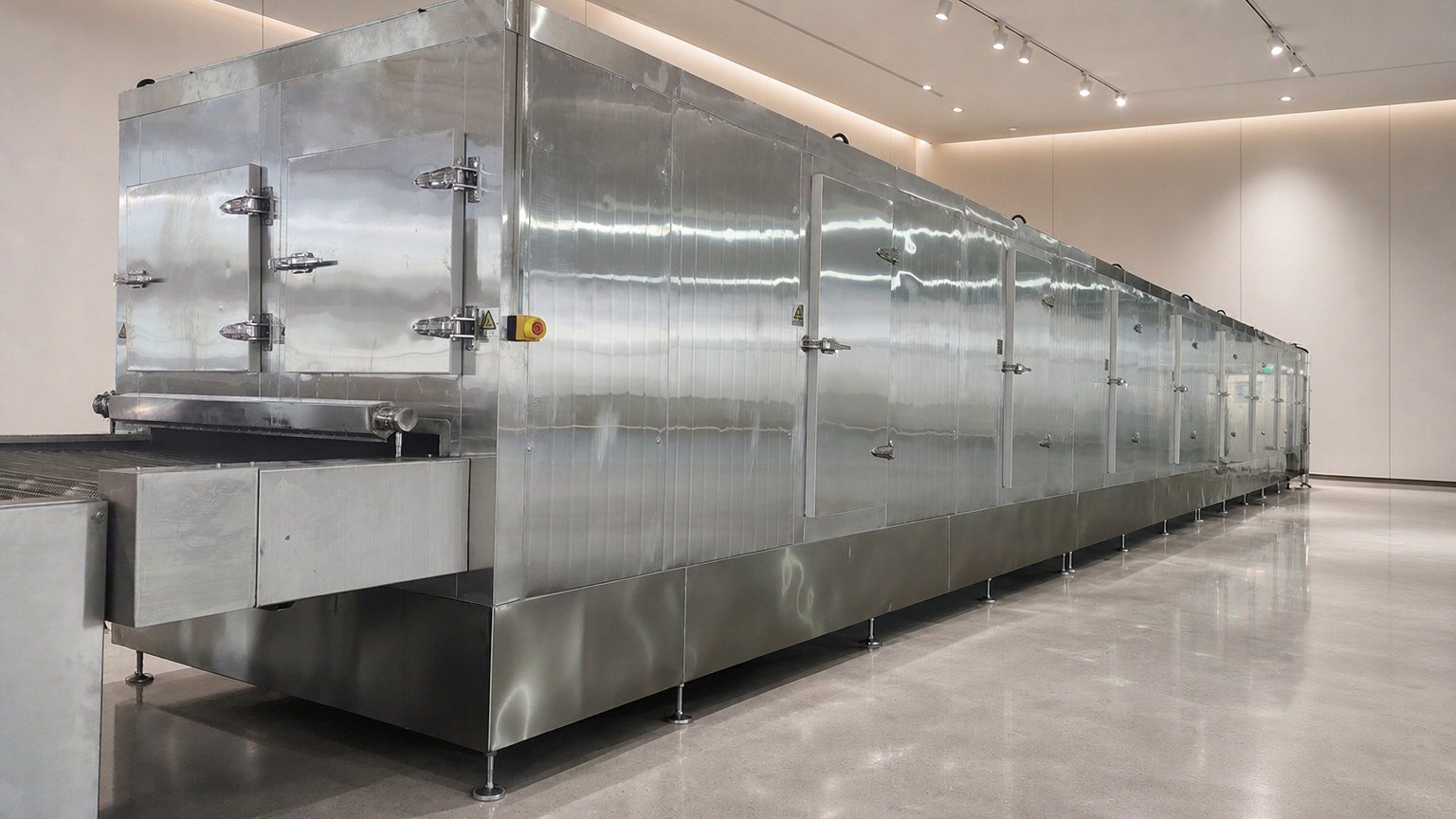
Sea freight and positioning are calculated together. The tunnel line is long overall and is usually shipped in sections for export. Lifting points, section interfaces, and the division of on-site airtightness and commissioning work must be written down before shipment. The liquid nitrogen tank is user-supplied, and who installs the piping from tank to equipment must also be agreed.
III. Solution Configuration
This scenario is matched by the DKN-LFT-1206 liquid nitrogen quick-freezing tunnel line, with parameters from the product technical file:
| Item | Parameter |
|---|---|
| Tunnel mesh belt | 6000 mm (L) × 1200 mm (W) |
| External dimensions | 6000 × 2200 × 1750 mm |
| Operating temperature | -150℃ ~ ambient |
| Temperature control accuracy | ±2℃ |
| Cooling rate | 10℃ per minute at no load |
| Total power | 9 kW |
| Refrigerant | 5-8 BAR liquid nitrogen (liquid nitrogen tank user-supplied) |
| Oxygen concentration monitoring | Oxygen concentration setpoint 19.5%-21.5% |
The configuration logic is “standard model + non-standard interfaces.” The tunnel body is standardized around the 6000 × 1200 mm mesh belt, cooling capacity is provided by liquid nitrogen, and the 9 kW total power supplies fans, drive and control; distribution capacity must be checked together with on-site auxiliary equipment and confirmed per order.
Non-standard items concentrate in three areas: inlet/outlet heights and material-stop structure, receiving and discharge section lengths, and electrical configuration for the destination power supply. The first two follow packaging specifications and workshop drawings; the third follows the local grid. All are cut after drawing confirmation. For transport and positioning, see Sea Freight Packing and Site Installation.
IV. Process Points
Check mesh belt speed against product type and packaging; do not apply a fixed value. Formed meatballs and prepared meat chunks differ in thickness and feed temperature, so time through the ice crystal zone differs. Bare product freezing and tray packaging differ noticeably in heat transfer; run material tests before scheduling to set line speed.
Look at core temperature, not surface. Measure product core at discharge and follow the final temperature required by the order. The 10℃ per minute at no load is equipment capability; with load it is affected by layer thickness, packaging barrier and feed temperature, and actual values are lower than no-load values, so it cannot be used directly to calculate freezing time.
Stable supply pressure matters more than volume. 5-8 BAR supply must be stable; pressure fluctuations increase the temperature difference between front and rear tunnel sections. The tank is user-supplied; tank capacity is set by per-shift usage and refill cycle, and piping insulation must be adequate.
Manage oxygen concentration per regulations. Setpoint 19.5%-21.5%, with monitoring points covering inlet/outlet and operator positions. Destination safety requirements for liquid nitrogen use may be more detailed than domestic ones; exhaust and alarm interlocking are confirmed per order.
Electrical configuration follows the destination. Voltage, frequency and phase correspond to different solutions; control cabinet components, motor windings and instrument power must be selected accordingly. For technical details, see Voltage and Frequency for Export Markets.
Leave an empty run section for product changeover. After the previous batch exits, run the belt empty for a stretch, box products by item at the discharge end, and label tail material separately.
V. Applicable Users and Selection Advice
This configuration suits meat enterprises with medium single-shift output, many product items, and mixed export and domestic lines: one line covers multiple specifications, non-standard interfaces are set to the main packaging dimensions, and other specifications are matched by adjusting mesh belt speed and loading pattern.
For continuous large batches of a single product, consider a wider belt or longer tunnel to reduce empty runs during changeover; for sampling and small trial orders, cabinet models are more flexible—see Cabinet vs. Tunnel Selection.
Four items determine the specification: tons to freeze per shift, how many items are in production simultaneously, main packaging dimensions, and destination power and certification requirements. The first two set mesh belt width and length; the latter two set non-standard interfaces and electrical configuration. Full parameters for DKN-LFT-1206 are on the product page; to check configuration against your order structure, contact us.
FAQ
If the export destination has a different power system, which parts of the equipment change?
Motor voltage and frequency, control circuit supply, instrument and sensor power, and component selection inside the control cabinet. The same model shipped to different countries does not share one universal electrical list; local grid parameters are needed before signing, and the distribution diagram is issued after order confirmation.
Why does packaging format change equipment dimensions?
Inlet height, material-stop structure and receiving section length all align with the packaging line layout. When tray height, carton dimensions or cart height change, inlet/outlet pass heights must be adjusted accordingly; this is non-standard customization, confirmed against the workshop floor plan and packaging specifications.
What output does a 6000 × 1200 mm mesh belt correspond to?
Mesh belt size is the base condition for throughput; actual output is jointly determined by layer thickness, product type, feed temperature and target temperature requirements, and is not a fixed value. Comparable enterprises typically run material tests based on single-shift batch size and main items, then work backward to the required belt width and tunnel length.
Is a liquid nitrogen tank supplied together?
The equipment is designed for 5-8 BAR liquid nitrogen supply; the tank is user-supplied. Tank capacity is set by per-shift usage, refill cycle and site conditions; the piping interface from tank to equipment and the division of installation work must be agreed before shipment.